Sunday, 12 February 2012

Revolutionary Road (2008)


Dir. Sam Mendes
Starring: Leonardo Di Caprio, Kate Winslett, Kathy Bates, Michael Shannon


The cities are worth living in, right? The cities are vibrant, electric, crowded with thousands of people with thousands of stories. The cities are great.

Or if you can’t live in the cities, live in the countryside. Proper countryside – go all Walden. Go all Into the Wild. Have the courage to live out among nature providing for yourself.

And then, in between, we have the suburbs. Neither one thing nor the other. Identikit houses, with identikit families, holding identikit values. It was Anna Karenina that said that “Happy families are all alike…”. Maybe that is what the suburbs are all about – if every family looks alike, then maybe they must all be happy. But the rot behind the middle class values has been creeping in to public discourse since the ‘30s. Perhaps it found truest expression in Richard Yates’s 1961 novel Revolutionary Road which delved into the life lived behind the picture windows of the Wheelers’ Connecticut residence.

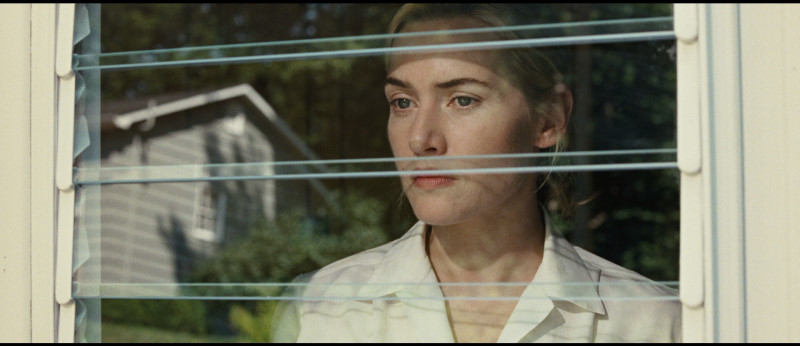
Frank (Leonardo Di Caprio) and April (Kate Winslett) Wheeler are the golden couple of their town, seemingly universally liked. Married with two children, they reside in a white-painted house at 115 Revolutionary Road. Each morning Frank commutes into New York where he sells office machines; April is a stay at home wife. And it is killing them. Frank hates his job; April feels imprisoned and unable to realise her acting dreams. When they first moved out to Connecticut they looked down upon the other humdrum suburbanites. But now they have become the same as everybody else. To try and create the spark she thinks they are lacking, April persuades Frank that they should revive one of his own dreams and move to Paris. She would earn good money as a secretary and support him while he decides what he wants to do with his life. Their willingness to leave the suburbs shocks their friends and neighbours – all except John (Michael Shannon), the son of their real estate agent friend Helen (Kathy Bates). He approves their brave move… but then he is currently resident at a psychiatric clinic.

John is the voice of reason – ironically for a mad man. He is the only person who looks at 1950s middle class conformity with modern eyes. He sees the trap that everyone has got themselves into: “You want to play house you got to have a job. You want to play nice house, very sweet house, you got to have a job you don’t like.” That is only half the trap; the remainder is when people convince themselves that this is what they want, and what they have always wanted. Giving up their own dreams to realise what they assume are the dreams of their parents and peers. Frank speaks of the “hopeless emptiness” of the suburbs, a phrase which really strikes John: “’Hopeless emptiness’. Now you’ve said it. Plenty of people are on to the emptiness, but it takes real guts to see the hopelessness.”

April says that “It takes backbone to lead the life you want”. Frank does not have those guts or that backbone. Instead he has “the backbone not to run away from my responsibilities”. He is offered a promotion at work. At the same time April discovers that she is pregnant again, the child probably conceived in a fit of kitchen-work-top passion after telling their neighbours Milly and Shep (Kathryn Hahn and David Harbour) of their plans to emigrate. Frank stops her from aborting the foetus (illegal in Connecticut in 1955, as was contraception). He casts away their plans to move to Paris. He will take the promotion, they will stay here, they will give up on their dreams. April is crushed. “For years I thought we’ve shared this secret that we would be wonderful in the world. I don’t know exactly how, but just the possibility kept me hoping… We were never special or destined for anything at all…”

Trapped in the suburbs:
Kate Winslett as April

April talks of living in a “little trap”, that they are living by rules that someone else made. “Look at us. We’re just like everyone else. We’ve bought in to the same, ridiculous delusion.” But this is safe territory for Frank. He wants to feel like a man, and here he can do that, providing for his family and sleeping with the secretarial pool. Shep is horrified by the thought of Frank being supported by April in Paris: this is a world where gender roles were firmly defined. There is no individuality. Everybody fits into one of a limited number of templates. Frank’s commute is a case in point, just one anonymous figure among all the other suit-and-hat-wearing men pouring off the train at Grand Central Terminal. Everyone dresses the same, drives the same cars, has the same values and principles. For a little while Frank and April try to swim against the tide. And it is because they dare to hope for something different that they are destroyed.

It is their children that have brought them to this place. They moved out to Connecticut because April was pregnant; they then had a second to – as she puts it – prove that the first was not a mistake. When she becomes pregnant a third time this puts paid to ideas of emigrating, the golden bullet she had set all her hopes on to save their relationship. Frank forbids her to have an abortion and decides that they will stay where they are. This is terrible for her, but even worse for their unwanted baby. As John comments, “I’m glad I’m not gonna be that kid.” Having to go through with the pregnancy makes April hate Frank; Frank in turn cannot understand why she is carrying his child if she hates him so. “What the hell are you doing in my house if you hate me so much? Why the hell are you married to me? What the hell are you doing carrying my child? I mean, why didn’t you just get rid of it when you had the chance? Because listen to me, listen to me, I got news for you – I wish to God that you had!” This is the cruellest line in the entire film. In effect he forbids her from trying to save their marriage, then damns her for not trying to save their marriage. The next morning she gets up, dresses nicely, makes him his breakfast, takes an interest in his day at work, and then attempts to abort the foetus despite her having passed the safe time limit to do so.

At the end of the film Frank moves back to the city. Helen tells her husband that she never really liked the Wheelers. They were whimsical and neurotic. They didn’t fit in. They were not like everybody else; they were not a happy family.

What have I learnt about Connecticut?
It is commuter territory, suburbs where the housewives stay home to look after the children and the men catch the train en masse to work ten hours a day at jobs they dislike and fool around with the secretary. People are constantly trying to get ahead, to work out what they want next – a hobby, a bigger house, the neighbour’s wife. Acquisition is the God here. It is like a giant version of ‘Game of Life’. Nothing about life that is good can flourish here. Connecticut destroys your hopes and your dreams.

Can we go there?
Wouldn’t you rather go to Paris?

The entire movie was filmed on location in precisely the sort of Connecticut surroundings that the Wheelers would have lived in. Nothing was shot on set. The Wheelers’ house – 115 Revolutionary Road – is actually 15 Chasmars Pond Road in Darien (pronounced “Dairy En”), Connecticut. You can still reach New York – and specifically Grand Central Terminal – by train from the town. For a day out you can follow in their footsteps and hit Sasco Beach in Fairfield. And for a night out you can try and find Vito’s Log Cabin, which is by Pinewood Lake in Trumbull. 


Overall Rating: 4/5

Thursday, 9 February 2012

Week 7: Connecticut


"The wives, the wives are up in Connecticut,
 Trying to forget it,
 That they really do regret it,
 That they moved up to Connecticut..."
 - 'The Wives Are In Connecticut',
  Carly Simon


Welcome to Connecticut, 'the Nutmeg State' (who makes up these names? I mean, really? Nutmeg? 'Skinny Mocha Latte State' more like!). We've left the mountains far behind and all we can see now is white picket fence suburbia.

Think of all the things Connecticut is famous for. Think harder. No? Well, Yale University is in New Haven, Connecticut. The US submarine fleet is headquartered at Groton, Connecticut. But I suppose it is most known for its convenient access routes to New York City. NYC is just down the line, you can almost see it. Patience, patience, we're not going there yet. Connecticut is prime commuter territory. Its 'Gold Coast' has some of the most expensive real estate on the eastern seaboard of the USA.

So will this week's films depict Connecticut as a suburban heaven or a suburban hell? I wonder...

The three films for this week are:
  • Revolutionary Road (2008)
  • The Stepford Wives (1975)
  • Mystic Pizza (1988)


Tuesday, 7 February 2012

South Park: Bigger, Longer & Uncut (1999)


Dir. Trey Parker
Starring: Trey Parker, Matt Stone, Mary Kay Bergman, Isaac Hayes


While I have been trying to deliberately watch films that I have never seen before on my little American movie marathon, when I reached Colorado I felt I had to watch South Park: Bigger, Longer & Uncut despite having seen it before. I remember watching it at university with friends and even today, over eleven years later, I can still recite from heart most of the lyrics to the songs “Uncle Fucka” and “It’s Easy, MMMKay”. The strange thing is that I was never a particularly big fan of the original South Park animated television series. It is probably eight years since I even watched an episode. But I loved the movie. In the same vein I liked the film Beavis and Butthead Do America though the attraction of the TV series paled rapidly for me (even before I had to sit through a three-hour Beavis and Butthead marathon one night). The Simpsons Movie didn’t impress me overly however, despite loving the show.

The film (and TV series) of South Park revolve around a group of four schoolfriends in the fictional town of South park, Colorado: Stan, Cartman (both voiced by Trey Parker), Kyle and Kenny (both voiced by Matt Stone). Here they are excited because the stars of their favourite television show, the potty-mouthed and infantile Canadian comedians Terrance and Phillip, have released their own movie Asses of Fire. Despite its “R” rating the children sneak in to watch it. They are awed by the freedom their heroes have to use bad language and come out singing the catchy “Shut your fucking face, Uncle Fucker”. Soon all their classmates have seen the film, and an epidemic of swearing his swept the town. Cartman passes on responsibility for his language by claiming “that movie has warped my fragile little mind”. Their parents form a pressure group to ‘protect’ their children from the film, exposure to profanity, and Canada itself. Terrance and Phillip are arrested. A diplomatic spat between the U.S. and Canada escalates towards war. Meanwhile in Hell Satan rejoices that should Terrance and Phillip be executed their blood on American soil would bring true a prophecy, and he would be freed to take over the world… with his domineering gay lover Saddam Hussein at his side (Hussein had, according to the film, been killed six weeks earlier by a pack of wild boars). The boys must lead ‘La Resistance’ in rescuing the two Canadians and preventing not just war but also the rising of Hell itself.

I have to say that, by and large, the film did stand up to a repeat viewing after all this time. The entertainment factor is skewed pretty heavily towards the first half of the movie – within the first 15 minutes viewers are treated to no less than three songs: “Mountain Town”, “Uncle Fucka” and “It’s Easy, MMMKay”. Yes, I said songs. As an animated movie it contains a number of songs in a variety of Disney-esque or musical theatre styles. “La Resistance” is a rather good medley in the style of Les Miserables. The number “Blame Canada” was even nominated for an Oscar! After the start the entertainment started to drag a little bit. I didn’t particularly enjoy the Satan and Saddam scenes either, as amusing as the idea of the Archprince of Darkness being a clingy lover might seem to be on paper. It was perhaps a little overlong for the one idea the writers (Parker and Stone once again) had.

The idea concerned censorship. Terrance and Phillip are liberated by the move to the big screen, because there they can say words like “fuck”, “bitch” and “donkey-raping shit eater”. Likewise the writers of South Park can make their big-screen version more explicit. This provokes outrage. But in what way is use of ‘the f-word’ worse than an America where the film industry glorifies violence and the news media is presented by a midget in a bikini (okay, that last one might not be indicative of the US media, I don’t know). As Kyle’s mother says: “Remember what the MPAA says; horrific, deplorable violence is okay, as long as people don’t say any naughty words. That’s what this war is all about!” (The MPAA is the Motion Picture Association of America that certifies films for release). South Park  attacks the double standards whereby it is more acceptable for movies to feature live-action killings and violence than for them to have a little bit of profanity.

Blame Canada!
(and who knew the Canadians were so potty-mouthed?)

Having said that, despite having such an ambitious aim the film is guilty of attacking the easy targets. Who is the main villain? Saddam Hussein. In reality Saddam was never the arch-villain the US tried to build him into. He was a local thug who, post 1991, was only a threat to his own people. If even people like Parker and Stone were prepared to give him such prominence is it any wonder that the entire nation got swung off course just a few years later into invading Iraq when they should have been tracking down Osama Bin Laden and finishing off the Taliban? Of course, alongside brickbats directed at Saddam they also have some to spare for the agents of moral panic and ill-informed rednecks (“We’re gonna kill us some goddam Australians!” “I think we’re fighting Canadians” “Canadians, Australians, what’s the difference?”). So, something for the left and right to cheer at there. Really it took them another couple of years, until they brought out Team America: World Police to perfect the art of offending everybody…

What have I learnt about Colorado?
That it is entirely two-dimensional and the kids have very large heads. Or, in cartoons it does anyway. It is hard to draw any firm conclusions from such a skewed portrait. However, the fictional town of South Park, with its snowy mountains and main street, is supposedly based upon the town of Fairplay, in Colorado’s South Park Basin. I cannot say whether this town really is a “quiet, little, pissant, redneck, podunk, jerkwater, greenhorn, one-horse, mudhole, peckerwood, right-wing, whistle-stop, hobnail, truck-driving, old-fashioned, hayseed, inbred, unkempt, out-of-date, white trash, kick-ass mountain town”.

Can we go there?
It’s a cartoon, idiot.

But, as was said above, it is supposedly based on or around the town of Fairplay (or four miles away from Fairplay according to one reference in the TV series). The school in Fairplay is called ‘South Park High School’ and Fairplay’s annual ‘Burro Days’ are reinvented as ‘Cow Days’ in the series. Renants from its late nineteenth century mining boom are collected as an open air museum called 'South Park City'. Expecting to see any trace of Stan, Kyle, Cartman or Kenny there would be a vain hope however.


Overall Rating: 3/5

Monday, 6 February 2012

American Flyers (1985)


Dir. John Badham
Starring: Kevin Costner, David Grant, Rae Dawn Chong, Alexandra Paul


“It’s like Top Gun on push bikes.”

With that, Natalie pushed something into my hands. It was a VHS video cassette. With this glowing endorsement how could I not consider American Flyers for one of my Colorado movies?

In some ways American Flyers has aged less well than Top Gun however. It is *so* ‘80s. The fact that it came on VHS (after having never been released in the UK on DVD) really got me in the mood. There is a pumping synth-rock sound-track with wonderfully over-earnest lyrics (I challenge any viewer to not come out singing along to Glenn Shorrocks’s “Let’s go – American Flyers!”). There are personal battles to fight as well as political – Marcus has a history with ex-teammate Muzzin, and the Soviet Belov (with their red uniforms, well orchestrated team, and recourse to cheating) is accused of only being Olympic champion by default due to the U.S. boycott of the Moscow Olympics. (As a matter of fact Muzzin also has a rant about the policymakers in Washington who withdrew the United States from that competition depriving him of something he had been training for all his life. “I’m not riding for America!” he states). A young Kevin Costner is in it – with a beautiful moustache. There are an inordinate amount of shots and scenes and conversations involving McDonalds. And during the opening sequence Davey is seen cresting a hill with the entire background being taken up by a superimposed American flag, flying in the wind. The film really pushes the ‘America’ of its title (the race commentary continually points out that the Hell of the West cycle competition is tougher and at higher altitudes than anything in Europe). Oddly enough the director, John Badham (of Saturday Night Fever, WarGames and Short Circuit fame), was actually born in Britain; even more oddly, he is the elder brother of Mary Badham, who played Scout in To Kill a Mockingbird.
So in the same way that Top Gun is about more than just flying fighter planes, American Flyers is about more than cycling. It is about family. Marcus (Kevin Costner) and Davey (David Grant) are two very different brothers, still trying to come to terms with family tragedy. Their father had died from a cerebral aneurysm. The driven Marcus would not forgive his mother for how she dealt with her husband’s illness and walked out, moving to Madison, Wisconsin, to become a sports physician. The free-wheelin’ cowboy-hat-wearing Davey stayed with her in St Louis. He is less focused and has dropped out of pre-med and pre-law at university; he is currently majoring in Eastern philosophy and cowboy movies (“The ying and the yang and the bang-bang.”) But he is starting to worry that he may have inherited his father’s condition. Marcus takes him to his sports institute to check him out. Their rivalry spurs David to outlast his brother on a stamina test. But he then overhears a conversation between Marcus and Dr Conrad (John Amos) that seems to suggest that Davey has the same symptoms as his father. It seems important for them to reconnect, and the best way is their shared love of cycling. They both enter as a team into a notoriously tough cycling competition called ‘The Hell of the West’ with three separate stages dotted around the Colorado Rockies. There is a real sense of Marcus passing on his drive and sense of purpose to his carefree younger bro.

"Nice tash Kev"
"Nice hat Dave"

I have never seen a good sport movie. This could well be because most movies come out of America, and America thrives on niche sports that fail to exist anywhere beyond their borders like baseball and American football. Really, I have only ever been able to enjoy a sports film for its cheesiness (I’m looking at you, Escape to Victory!). Taken on the same grounds American Flyers is actually pretty watchable. It also helps that the rules of cycle racing are pretty clear – get to the finishing line as quick as you can. Where there are variable rules – such as the four sprint flags in the second stage – the film gets around them by having Marcus talk his brother through tactics. Action during the race itself is helpfully explained by a commentator. The commentary, the ‘80s aesthetic, the synth-heavy score, the occasional snarled comment from Muzzin (of the “Watch your line!”  or “Enough of this Sunday stroll!” calibre) make the cycle races feel surprisingly engrossing – like playing Daley Thompson’s Decathlon on a ZX Spectrum. And while I could tell from the outset that the business end of the competition would be a duel between the Muzzin, Belov and the Sommers boys, I honestly did not know who was going to be crowned champion. OK, sure, the ending is a touch sentimental, and the film closes without really covering the ‘what happens next’ of someone suffering from a cerebral aneurysm, but I would tend to class this film as a hidden gem and well worth a watch.

What have I learnt about Colorado?
I was worried that the answer was going to be ‘nothing’. The film opens on the bank of the Mississippi in St Louis, Missouri, paddleboats and the Gateway Arch in the background. The action then shifts to Madison, Wisconsin. Finally we reach Colorado. And it was worth the wait. The mountain scenery, the wiggling roads with precipitous drops, the lunar landscape of the ‘Mountains of the Moon’ in the Colorado National Monument present a breath-taking backdrop for the race scenes. The landscape is tough and uncompromising – think the Mont Ventoux stages of the Tour de France, but higher and hotter and repeated day after day. Looking at the infrastructure, the crowds and the peloton of riders a conclusion can easily be drawn that this cycle race is something that actually exists, and which the filmmakers have piggy-backed on to. In actual fact this is correct: the ‘Coors Classic’ took place in Colorado from 1975 to 1988.

Can we go there?
The Coors Classic no longer runs, but the sites associated with it in Colorado can still be visited. The Morgul-Bismarck circuit race (stage 1 of the fictitious ‘Hell of the West’) was a real stage near Boulder – ‘The Wall’ is in Superior. There was a stage – known as ‘’The Tour of the Moon’ – along Rim Rock Drive through the Colorado National Monument (cyclists today must stay in single file and have front and rear lights fitted ). Stage three commences in Golden (home of the Coors brewery which can be prominently seen) and runs along the  Mount Evans Scenic Byway to Echo Lake, near Idaho Springs.

Outside Colorado you can cycle along Laclede’s Landing in St Louis. A lot of the road-cycling scenes en route to Colorado actually took place in Kansas. The McDonalds where Davey meets Becky (Alexandra Paul), for instance, is in McPherson, Kansas.


Overall Rating: 3/5

Sunday, 5 February 2012

The Shining (1980)


Dir. Stanley Kubrick
Starring: Jack Nicholson, Shelley Duvall, Danny Lloyd, Scatman Crothers


The snow piles up outside. A solitary figure tap-tap-taps at their keyboard, snarling if disturbed. They’re tired, they say, but they can’t sleep, they have work to do. With this atmosphere at home is it any wonder I decided to watch The Shining instead…?

The Overlook Hotel stands above the snowline in the Colorado Rockies. Jack Torrance (Jack Nicholson) is appointed the winter caretaker – when the hotel shuts down for the season it is his responsibility to keep the boilers working and manage running repairs and so forth. Suffering from writer’s block he is keen to take the post: he welcomes the promised seclusion. He brings his family with him: wife Wendy (Shelley Duvall) and son Danny (Danny Lloyd). Danny has psychic visions, with his imaginary friend ‘Tony’ warning him about the place. Mr Hallorann, the cook (Scatman Crothers), communicates with Danny, saying that they both share a special gift known as ‘shining’. He also warns him to stay away from Room 237.

Hallorann never explains precisely why he is scared of Room 237. Upon taking the post Jack was informed that a previous caretaker, Grady, had suffered from ‘cabin fever’ and had slaughtered his wife and daughters with an axe before 'stacking' them in their room and committing suicide. Was their room 237? I don’t know. Danny later finds the door to the room open. He emerges with strangulation marks around his neck, which Wendy blames on her husband. Jack goes to investigate and finds a beautiful young woman in the bath; upon kissing her she transforms into a rotting corpse. Danny also sees visions of two twin girls who ask him to play with them, and a tidal wave of blood flooding down the corridor; his terror somehow transmits itself to Hallorann, who flies back from Florida when no contact can be made with the hotel. Meanwhile an increasingly manic Jack is having conversations with a phantom barman called Lloyd (“Best goddamned bartender from Timbuktu to Portland, Maine. Or Portland, Oregon, for that matter.”). This vision expands to an entire 1920s ballroom scene where he encounters a waiter who is also called Grady. Jack claims to recognise him. “You were the caretaker here Mr Grady.” “No sir; YOU are the caretaker. You have always been the caretaker. I ought to know: I’ve always been here…” Grady suggests that ‘the owners’ have put a lot of faith in Jack. He ought to ‘correct’ his wife and son.

Welcome to the Overlook Hotel:
You can check out any time you like but you can never leave...
 
The apparitions could all just be Jack’s imagination – a lot has been made of the fact that whenever he is talking to one of these ‘ghosts’ he is facing a mirror or highly reflective surface. But in that case who releases him from the pantry Wendy locks him into? Wendy herself sees some of the ghosts as she runs terrified through the corridors at the film’s climax. And Danny has been seeing visions before he even arrived there. The tidal wave of blood roaring down one of the Overlook’s corridors is first seen by Danny prior to leaving home; he transmits the image to Hallorann; Wendy later sees it. This ties them all together. Lloyd and Grady are peculiar to Jack’s private world however – when Wendy bursts into the Gold Room Jack is found sitting at an empty bar. Frankly, I doubt Kubrick wanted his audience to be able to form any clear conclusions. His screenplay is a masterpiece of foreboding, suspense, mystery and violence.

The Shining is based on a novel by Stephen King. However the film is noticeably different to the source material. It is Stanley Kubrick’s vision that we see here. Plot elements have been changed. Character motivations and depictions altered. The family’s history is barely mentioned. A lot in the film is unexplained. What is the mystery of the Overlook Hotel? Are there ghosts or just psychotic visions? What is it that drives Jack to madness? Are his flashbacks real? Is the story the viewer sees objective ‘truth’, or the subjective perceprions of the characters within it? Has Jack really always been the caretaker? In few films is the directorial vision so clear. The long shots of symmetrical corridors and architectural features, the rattling of Danny’s tricycle over the floorboards and carpets, the definite colour palettes where one room would be yellow, the next green, the third blue, the ominous music ratchetting up the pressure cooker of tension – these are Kubrick’s details, not King’s. King famously disliked the movie.

What have I learnt about Colorado?
The winters can be fantastically cruel. The Overlook Hotel has to close for half the year. Roads become impassable and telephone lines frequently come down in the storms. It is so cold a man could easily freeze to death. The only way to travel in weather like that is by tracked SnowCat (the Torrance’s VW is never referred to again once they arrive at the hotel). These conditions are known and accepted by the state authorities.

Can we go there?
Would you really want to? Sure, the July 4th party looked great, but that was in 1921. This is a hotel built on that oldest of clichés, the Indian burial ground, remember?

The Overlook Hotel was based on a real location – the Stanley Hotel in Estes Park, Colorado. The Stanley did, indeed, open in 1909, and it hosted presidents and royalty… as well as Stephen King, who stayed in room 217 the night before it closed up for winter. The hotel shows this movie on a continuous loop on one of its in-house TV channels (What are the management thinking of? I mean, why would you?). And the building also has a reputation for being haunted, particularly the ballroom. The hotel itself runs ghost tours. They also have a resident psychic, called Madame Vera, who claims to be able to see your future. One can only hope it does not involve elevators full of blood...

The Shining was not filmed at the Stanley Hotel however – another of Stephen King’s grounds for complaint. Establishing exterior shots used in the film were actually of the Timberline Lodge on Mount Hood, Oregon. This historic hotel offers a full range of winter sports. It also offers tours, though not ghostly ones.

But The Shining was not filmed here either. The interior filming (and quite a bit of the exterior filming – viewing the overhead shots at the start of the film will show quite clearly that there is no hedge maze) took place in England, with a giant set being constructed specifically for the movie at Elstree Studios in Borehamwood. The management of the Timberline Lodge requested that Kubrick change the number of the haunted room from 217 (as specified in the novel) to 237. They were worried that no one would ever want to stay in room 217 ever again, but they did not have a 237. The interior design was based on elements from many different American hotels: the Colorado Lounge on the Ahwahnee Hotel in the Yosemite Valley, and the red bathroom on Frank Lloyd Wright’s Arizona Biltmore in Phoenix.

The road that Jack is seen driving his VW up is not in Colorado either. It is the Going-to-the-Sun Road in Montana’s Glacier National Park. While not as famous overseas as many of the U.S.’s national parks I think it is one of the ones I would most like to visit.


Overall Rating: 4/5

I am the blogger. I have always been the blogger...

Saturday, 4 February 2012

Week 6: Colorado

"Tell me how Colorado is
 'cause I'm stuck down in Texas wondering if
 Writing love songs about you
 Is still healthy..."
 - 'Tell Me How Colorado Is',
 The A-B Theory


Ladies and gentlemen, this week we're heading up from the coast to the 'Mile-High City' of Denver to get Rocky Mountain high.


The state of Colorado is famous for its geography, being located right where the Great Plains run slap bang into the Rocky Mountains. Colorado has wild Alpine scenery alongside well-groomed ski resorts. It is full of NORAD and USAF Academy defence chiefs alongside liberal college kids from Boulder and Denver. It voted for Bush in 2000 and 2004 but voted for Obama in 2008. It strikes me as a conflicted state where there are polar opposites in all things balancing each other out. It seems like an interesting place to visit.

I can't visit unfortunately, so I will have to make do with seeing it on screen. My three Colorado-set movies for this week are:
  • The Shining (1980)
  • American Flyers (1985)
  • South Park: Bigger, Longer & Uncut (1999)

If that doesn't give me enough variety to be worthy of Colorado then I don't know what will!

Orange County (2002)


Dir. Jake Kasdan
Starring: Colin Hanks, Jack Black, Catherine O’Hara, Schuyler Fisk


I heard it said once that California is a state of mind. I would disagree. California is two states of mind.

In popular culture there always seems to be a very clear division between north and south California. So-Cal is the ‘great big freeway’ of L.A., Hollywood vacuosity and wannabe starlets, surf dudes and mall rats, money but no taste. North California is the hills, trams and clap-board houses of charming San Francisco, the universities at Berkeley and Stanford and the brains behind Silicon Valley, fog-bound shorelines and the awe-inspiring scenery of Yosemite or the giant Redwoods. I know that given a choice I would rather go north, young man.

The young man in the film Orange County in Shaun Brumder, played by Colin (son of Tom) Hanks. He has lived an outwardly privileged life in Orange County, California, the expensive beach-side residential suburbs south of Los Angeles. But these are brainless areas. His best friends are bread-dead Jackass-like surfers whose main joy is jumping off things, his mother (Catherine O’Hara) is a lush, his re-married father (John Lithgow) is absent, devoted purely to making more money while his nymphet second-wife plays with the pool guy, his brother Lance is a dope-head, his school relates to Romeo and Juliet  in terms of Leo di Caprio and Clare Danes and would rather invite Britney Spears to give a talk that Toni Morrison, and even the maid is in therapy. Only his environmentalist girlfriend Ashley (Schuyler Fisk) understands his need to write. In one of the best lines his father asks “What do you have to write about? You’re not oppressed, you’re not gay!” Following the death of his best friend (in a surf accident, natch) he discovers a dog-eared paperback on the beach: Straight Jacket by Marcus Skinner. In the way of these things, that book changes his life. From that day he decides that he wants to be a writer, and he wants to learn under Skinner, who is a professor at the prestigious Stanford University in Palo Alto (north California). Thankfully, for the purposes of the story, he also happens to be a straight-A student.

When he is rejected from Stanford – due to the college counsellor sending in the incorrect transcript – he is devastated. Together with girlfriend Ashley and Jack Black-esque brother Lance (Jack Black) they resolve to somehow make his dreams come true. Hilarity ensues. It seems that should one be rejected by the university of ones choice in America there are multiple ways of getting them to change their mind – inviting a school-mate’s grandparents (who happen to be university board members) around for tea, pleading directly with the Dean of Admissions, or – hell – just promising to buy the university a new building. In the end he discovers that the students at Stanford (such as the guy who wants to use his comparative literature degree to write novels, plays, films, whatever, maybe a TV series around vampires that is *really* about German reunification) are just as shallow in his eyes as the folks back home. A chance encounter with his idol Professor Skinner, however, Shaun realises that it is his connection to his family and friends – and to Orange County – that inspires his writing.

"I didn't go to college and look at me. I'm awesome!"
Lance (Jack Black) gives Shaun (Colin Hanks) some life advice.

The cast list is out of this world, with cameos all over the place. I’m not entirely sure why. Jack Black does classic early Jack Black – a stoner rock dude with his usual brilliant physicality. He is really the only character who gets serious screen time other than Shaun and Ashley. Needless to say he ends up on the run from the police in his underwear. John Lithgow is underused as the wonderfully shouty and insulting father. Kevin Kline pops up as Marcus Skinner. Lily Tomlin has two scenes only as the ditsy college counsellor. Harold Ramis has a bit more to do as Stanford’s Dean of Admissions who mistakes Lance’s ecstasy pills for painkillers. Ben Stiller plays it straight as a fireman and Chevy Chase has around three lines as the college principal. One is left wondering why. The comic elements are not fully formed. Ashley rescues a tearaway stray puppy. It appears for two scenes, then vanishes. Shaun’s wheelchair-bound stepfather Bob is used for some slapstick and then is forgotten about (his mother even agrees to get back together with his father while, presumably, her second husband is still in the house). Some of the best comedy scenes are gobbled up by the ill-equipped English teacher, who tries to interest his class in Shakespeare by pointing out that some great movies were based on his plays – not just Romeo + Juliet but also “Hamlet, West Side Story, The Talented Mr Ripley, Waterworld, Gladiator, Chocolat…” Notably he is played by Mike White who also wrote the screenplay.

The film is produced by MTV, which may explain the soundtrack of 2002-era pop hits. Butterfly by Crazy Town in particular makes three appearances, two of them with choreographed dance sequences. To be honest it could have benefitted from a re-write or maybe just a spot of extra care taken during filming. It comes off as just a bit of a rushed job. On the plus side, it means that the movie is only 79 minutes long – very useful when the film I was planning to watch (Boyz n the Hood) was forgotten by the person at work who was going to lend it to me and I only had one evening to find a replacement. It was either this or Beverley Hills Cop II on E4!

What have I learnt about California?
The perceived difference between south and north California seems to be believed by Californians too. The north has Stanford, world famous writers and class; the south has stoners, surfers and slutty cheerleaders. It is nice to see Shaun realise this perception is somewhat false. It is inevitable that there is some difference, just because California is so large - larger than I probably realized. Shaun also wants to go to Stanford to get away from his family. This left me wondering why, in that case, he didn't choose to go somewhere further away. After checking on a map I worked out that Palo Alto is probably around 350 miles north of Orange County - it's equivalent to someone from Surrey going to uni in St Andrews.

Orange County is rolling in money. The high school looks like the Bilbao Guggenheim, the parking lot is full of customised SUVs, and they can seriously think of asking Britney Spears to give a speech there. People live in mansions with pools and views down towards the Pacific. More worryingly is the belief that applicants can get around the acceptance process for elite universities like Stanford should they be rejected. One wonders what would have happened if Shaun had not known someone whose grandfather was on the university board, or if his father had not been able to donate a new Admissions building. An ‘elite university’ that will accept a potential student just because his daddy is rich? If that is the way the American educational system is run then I feel quite concerned! Even more so because not a single character – even Ashley - seems to register that this is somehow unethical.

Can we go there?
As long as you only want to visit Southern California, yes. The entire movie was shot in the Los Angeles area. The film crew certainly never went up as far north as Palo Alto (between San Jose and San Francisco) where the real Stanford University is located. The version seen on screen is a mish-mash of the California Institute of Technology (CalTech) in Pasadena and (appropriately enough) L.A.’s University of Southern California. The Orange County scenes are theoretically set in San Clemente (“the surfing media capital of the world”), though it does not seem to have been particularly filmed there either. The beach is north-west of L.A. in Malibu.‘Vista del Mar’ High School is actually a real school, but the Diamond Ranch High School, east of L.A. in Pomona. The Brumder residence is in West Hills, an area of the San Fernando Valley that was purchased by real estate speculators in the early twentieth century to expand the area of Los Angeles. Very Chinatown.


Overall Rating: 2/5