Monday, 16 April 2012

Field of Dreams (1989)


Dir. Phil Alden Robinson
Starring: Kevin Costner, Amy Madigan, James Earl Jones, Ray Liotta


Another state, another sports movie. Or so I thought. Hoosiers was definitely about basketball. Field of Dreams is about baseball. Or dreams. Or regrets. Or fatherhood. Or all of the above. Get the hankie ready…

Field of Dreams gives us one of cinema’s most famous lines: “If you build it, he will come.” This is the instruction heard by farmer Ray Kinsella (Kevin Costner) as he walks his rows of corn. “If you build it, he will come.” Visions show to him a baseball diamond superimposed over his fields and an image of “Shoeless” Joe Jackson, the legendary batsman who was banned for life due to his part in the 1919 ‘Black Sox’ game-fixing scandal. He becomes convinced that the mysterious voice wants him to plow under his corn and build a baseball pitch in the middle of his farm. Incredibly, his wife Annie (Amy Madigan) permits him to do this. And so he tears up his cash crop and spends all their savings on building a regulation baseball ground, complete with flood lights and bleachers.

And then, one night, a figure is seen on the pitch. It is “Shoeless” Joe Jackson (Ray Liotta). He and Ray have some batting practice before Jackson melts away into the corn. The next day he returns, bringing the other seven players suspended as a result of their involvement in the Black Sox scandal. In heaven, or hell, or limbo, or whatever form of afterlife they inhabit all they want to do is get out and play baseball once again.

Then the Voice returns. “Ease his pain” it says. This sends Ray on a quest to Boston, to find reclusive ‘60s author and activist Terrence Mann (James Earl Jones). Dragging Mann to Fenway Park to watch a game they both have a vision of Archie ‘Moonlight’ Graham, who only ever played part of one game and never got to bat. Following his trail they journey to Chisholm, Minnesota, only to find that Graham has now passed away himself. After his brief flirtation with the big time he had returned to his hometown and became a doctor. Ray has a vision of meeting Dr Graham (Burt Lancaster) in 1972 and offers him the chance to make his dreams come true by coming back to Iowa with him. The doctor declines the invitation. Confused, Ray and Terrence head back to the Kinsella farm. En route they pick up a young hitchhiker (Frank Whaley); his name, he tells them, is Archie Graham. Arriving back in Iowa they find that Shoeless Joe has brought two full teams to have a proper game. Graham is invited to play. And so Ray, his family, and Terrence sit in the stands to take it all in.

So the film is about baseball. But more than that, it is about dreams and regrets. Shoeless Joe and his teammates seem to regret throwing the World Series as it deprived them of playing the sport they loved. Their dream is to play once more. By following his dreams (or, more accurately, the voice in his dreams) Ray gives them a chance to do that. Terrence wrote that he dreamed of playing for the Brooklyn Dodgers. What he actually seems to regret is turning his back on the openness and innocence Ray still represents to him. Doc Graham’s dream is that he never got to bat in the Major Leagues, and Ray is able to fulfil that dream too. But as for the good doctor’s regrets… he has none. When Ray tries to persuade Graham to come with him he states that “Fifty years ago, for five minutes you came within… You came this close. It would kill some men to get so close to their dream and not touch it. God, they’d consider it a tragedy!” Graham merely replies “Son, if I’d only gotten to be a doctor for five minutes…now that would have been a tragedy.” And when Ray’s daughter Karin (Gabby Hoffman) has an accident the younger version of Graham does not hesitate to run to her assistance. Crossing over the field’s boundary line he transforms into the older version; this is an irreversible process. He cannot go back to being the young baseball player and he does not mind. He has saved a life.

And what of Ray’s dreams? Well, he wants to be a good husband and a good father, but by following the voices and the visions he puts their future at risk. He uproots their corn and spends their savings. But he has one very real regret. He has unresolved father issues. A child of the ‘60s, he rejected everything his father stood for. He left home at age 17 with a barbed insult on his lips. He never saw him again until the man’s funeral. And one of those ghostly players turns out to be the young John Kinsella. The final scene of the movie shows father and son having one last game of catch. Ray built it, and his father came; he has eased his own pain.

Baseball is merely a metaphor for dreams and regrets. We talk of ‘the American dream’ and baseball is part of that. Baseball has the capability to make people forget the worries of today and hark back to a simpler, more innocent, time when they could believe in the future. “The one constant through all the years, Ray” Terrence tells him, “has been baseball. America has rolled by like an army of steamrollers. It has been erased like a blackboard, rebuilt, and erased again. But baseball has marked the time. This field, this game: it’s a part of our past, Ray. It reminds us of all that once was good and it could be again.” A little bit nostalgic, I thought, given that a central plot point surrounds professional baseball players who cheated for money. But baseball is that uniquely American metaphor. Spending quality time with one’s father is synonymous with playing ball with one’s father.  

Not your usual corny sports movie...

What have I learnt about Iowa?
“Is this heaven?”
“No… it’s Iowa.”

Iowa, certainly as seen in this film, is a land of endless fields stretching as far as the eye can see. The green corn grows shoulder-high, and the farming supply shops are populated solely by crusty old timers.

In general Iowa doesn’t seem to have had much counter-culture. As Annie says, they didn’t experience the ‘60s, they “had two ‘50s and moved right into the ‘70s”. Which may explain why the film shows the citizenry as being pretty reactionary, with the public meetings to talk about banning books from schools.

Oh – and if you go to Iowa City you will be bored…

Can we go there?
The actual baseball diamond from the film still stands. It was operated for many years by two neighbouring families (the pitch was built over the dividing line between two different farms). It is located in eastern Iowa, at 28995 Lansing Road, near Dyersville, Dubuque County. The  genuine Field of Dreams can be visited between April and November. There is no entry charge, just a souvenir stall.

The school used for the PTA meeting was the Western Dubuque Elementary / Jr High School in Farley. Scenes were shot in Boston, most notably the match at Fenway Park watched by Ray and Terrence (the crowd that night also contained two youngsters by the name of Matt Damon and Ben Affleck). They don’t go to Chisholm, Minnesota, however. The 1972 street scene was instead filmed in Galena, Illinois. Galena is in Illinois’s north-western Jo Daviess County, which adjoins Iowa’s eastern Dubuque County.

Overall Rating: 4/5

Thursday, 12 April 2012

Week 16: Iowa

"There's nothing half-way
 About the Iowa way to treat you
 When we treat you,
 Which we may not do at all;
 There's an Iowa kind of special
 Chip-on-the-shoulder attitude
 We've never been without..."
 - 'Iowa Stubborn',
from the musical 'The Music Man'


Typical isn't it? We've only just journeyed from Illinois into its eastern neighbour of Indiana when we have to retrace our steps and head instead to Illinois's western neighbour of Iowa.

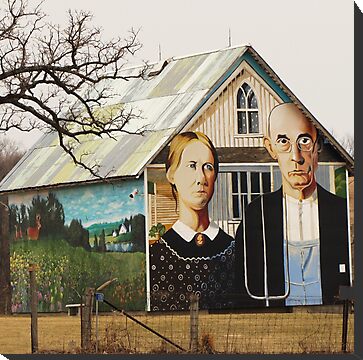
Iowa. Well, now we are really in the Midwest. My mind's eye focuses on endless seas of rippling golden corn stretching to the horizon. Its state capitol is, of course, Des Moines, whose name is French for "some Moines". This was French territory before Napoleon sold it to the United States. I'm not sure whether the Iowans really are famously stubborn, as the song above suggests. Maybe they are just stoic to deal with prairie life. Certainly I know that the artist Grant Wood, painter of the famous American Gothic portrait hailed from Iowa. 


I'm not sure Iowa has huge amounts of attractions to detain us for long, so shall we get straight to the movies? My three film choices are:
  • Field of Dreams (1989)
  • What's Eating Gilbert Grape? (1993)
  • The Bridges of Madison County (1995)


Wednesday, 11 April 2012

Hoosiers (1986)


Dir. David Anspaugh
Starring: Gene Hackman, Barbara Hershey, Dennis Hopper, Sheb Wooley


What with Indiana being ‘the Hoosier state’ and everything, I had to order a film called Hoosiers from Lovefilm. So Imagine my confusion when something called Best Shot arrived in my letter box. In turns out that I was looking at the same film; Hoosiers was released under the name Best Shot in the UK. The distributers obviously thought no one in Britain would know what the hell a Hoosier was – and unless they are talking about the quirky ‘Starting to Worry About Ray’ pop act they may well have been right. But would it really be the title that would put people off? After all, we are talking here about a period film set in the 1950s about a uniquely American sport: basketball.

Now, I accept that basketball is probably a lot more accessible to a non-American than some of their other sports such as baseball or American football, but its modern image is a cool, urban, black hip-hop-influenced sport. Would a film about a school-team made up of white country-boys in 1951 Indiana have the same resonance? It certainly explains why I had never heard of the film – under either name.

Thankfully, Hoosiers / Best Shot sticks to the strongest of all sporting narratives – that of the Underdog ™. Norman Dale (Gene Hackman), a Man With A Past ™, starts the new term as basketball coach in the small southern Indiana town of Hickory. He finds he has problems – the school only has seven players in its basketball team, one of whom promptly quits. His Unconventional Techniques ™ also meet with opposition from the sports-mad local parents and citizenry. His techniques start to slowly pay dividends, but at a crunch meeting it is decided to dispense with his services. He is only saved by the arrival of Jimmy Chitwood (Maris Valainis), the school’s Star Player ™ who had previously refused to join the team. He says he will take part – as long as Dale remains as coach. There then follows the usual Action Montage ™ of the Hickory Huskers taking on and beating team after team. They make it to sectionals, then regionals, and then, incredibly, to the Indiana State Championships. There, of course, they have to play the Reigning Champs ™, the much bigger and better-equipped South Bend Bears. The game, of course, comes down to a Late Fightback ™ when all hope seems lost and a (literally) Last Second Winning Goal ™. Throw in a Scene-Stealing Comedy Supporting Character ™ in Dennis Hopper’s Shooter and a Token Love Interest ™ (whose feelings for Dale naturally turn From Dislike To Respect ™) and there’s your movie right there.

It's the final countdown!
(and Kylie wants her shorts back...)

So Hoosiers ain’t gonna win many prizes for originality. But it doesn’t need to. There is a saying about there being only seven original plotlines in the world, and Shakespeare having done them all already. I’m not quite sure which of his plays would be most appropriate for an Underdog Sports Movie (maybe Henry V?), but there is a reason that it has become a cliché. It’s a cliché because there is a great deal of truth in the tale. To translate into a genre I certainly would be more familiar with: think of a football club with a glorious history but little recent success. The club’s owner hires in a new manager. The manager, obviously, wants to remake the team his own way but is hampered with very few funds or resources, and a star player who cannot take to the field – say through suspension or injury. At first his team lose, and lose badly, as his new tactical thinking takes time to bed in. By the time performances are improving, less than half-way into the season, the fans and shareholders have had enough and demand his head. By this point the original owner is out of the picture (in the film Principal Cletus has a heart attack, but for the example he may have sold up). It is only the return of the team’s star player and a public vote of confidence from the dressing room that saves his job. Basically, up until that last sentence we were looking at Roy Hodgson at Liverpool or Brian Clough’s notoriously ill-fated spell at Leeds United. Put into those terms it is easy to see that even today, in a completely different sport, in a completely different country, the same themes and experiences hold true. And the story is kind-of based on a true story too – pokey little Milan High School overcame the odds to become Indiana state champs in 1954.

The strength of the film lies in its central character. Gene Hackman manages to portray Norman Dale as an almost evangelical figure. He is absolutely convinced that he, as coach, knows best – or maybe just that his team need to trust him and follow his instructions. In his first match he tells his players that they must complete four passes before the shoot. When one of his players disobeys him and actually brings Hickory back into the game by shooting from distance Dale benches him. He is actually prepared to finish off the game with just four players rather than allow a player who ignores his instructions back into the match. Little wonder that he makes enemies. In fact he does not even try to avoid making them. He meets them full on like a bull. He dispenses with the services of the stand-in coach and bans the townsfolk from practice sessions. He tells the team to concentrate on keeping possession rather than shooting. He brings in Shooter as assistant coach despite the man being a drunken bum. The attraction is clearly that – other than the school principal (Sheb Wooley) – Shooter is the only man who accepts Norm’s right to run the team his way. Rather than chipping in with how he thinks the team should play he just gives advice about Hickory’s opponents. And Norman thinks he can change him. At every step of the way Norman is convinced that he is doing what is right, and does not care about upsetting anybody in his way.

Barbara Hershey has some meat to her role as well as Myra, the teacher who wants the best for Jimmy Chitwood: in her eyes this means him concentrating on his schoolwork and winning a scholarship to college. She wants him to get the hell out of Hickory and never come back. She sees remaining in this small town as proof of a waste of potential; she counts herself among that number. “I don’t want this to be the high point of his life. I’ve seen tthem, the real sad ones. They sit around the rest of their lives talking about the glory days when they were 17 years old.” She could almost have been describing Kip from Napoleon Dynamite. This is part of the reason she clashes with Dale. He thinks Jimmy could win a college scholarship through his basketball. But he tells the boy that it is his potential. He can choose to use it however he pleases. “You have a special talent, a gift. Not the school’s, not the townspeople’s, not the team’s, not Myra Fleener’s, not mine. It’s yours, to do with what you please.” The move towards a romantic relationship between her and the elder Dale is signposted from the start; this is where the film does veer into cliché. The romantic subplot is so underwritten it could easily have been left out.

Dennis Hopper was nominated for an Oscar for his performance as Shooter. I can’t see why. He does comedy drunk pretty well, but that’s it. I would have hoped to see a bit more truth in Hopper’s performance as a man in slavery to his addictions. And the rest of the cast are place-fillers. Of the team we have the Star Player, the Deeply-Religious One, the Short Unlikely Hero, Shooter’s Son, the One Who Quit Then Came Back, and two or three more. They have a bare handful of lines in which to establish themselves. Every character is rather one note.

And then there is the basketball itself. I can tell you that I now know more about basketball than I did previously. I now know that the game is played with five players from either side. I know now that two points are scored for each goal. But I do not understand how a team can have an odd number of points, I do not understand the rules surrounding time outs (which seem to happen every five seconds), I do not understand fouls and why a player would get two free shots on goal, and I did not understand a single word of the tactical advice coming out of Norman or Shooter’s mouth. For example: “They been pickin’ low all night. Rade, let yourself get taken out. Buddy, drop down and take his place. Close that lane!” That could have been in French for all I understand what Shooter is referring to there! But that did not hamper my enjoyment too much. I just took each moment as it came. In this segment they have to pass four times prior to shooting. In this one they have two shots on goal. In this one they have five seconds in which to score once. Broken down into those bite-sized chunks the action is comparatively easy to follow.

One final word should be made about the music. Jerry Goldsmith won the Academy Award for Best Original Score. Again, I can’t see why. The film is set in 1951; why on earth would ‘80s electro Yamaha keyboard be appropriate? He should have stuck to music more keeping to the era.

What have I learnt about Indiana?

Indiana is basketball mad. This seems to be noteworthy: even among other Americans the Hoosiers are notorious for living, eating and breathing basketball. Everyone from elderly ladies to town sheriffs are addicted to the extent that they will follow their local high school team all across the state to watch them. And it must be hurtful when the championship is won season after season by the bigger schools in the state. I can understand why Dale exhorts his team to win it for all the smaller teams that never had the chance to get to the final.

What I also got was a look at Indiana countryside: wheat fields, sugar cane, water towers and silos. Certainly in the area depicted in the film it is a rural state of close-knit small towns. And success seems to be measured in how far away from those towns you get in life. Anybody from outside that society who comes in is treated as an object of curiosity. It is assumed that they will look down on Hickory as a “hick town”.

Can we go there?

Hickory does not exist in reality. The story is, as I mentioned before, based on the true tale of Milan High School . Milan is located in south-east Indiana in Ripley County.

The film was not shot in Milan however, even though the film was entirely shot on location in Indiana. The town of New Richmond, north west of Indianapolis, was used as the principal filming location, something the town is very proud of. Signs around town proclaim is starring role. However it is not the only town cashing in on its connection to the movie. Hickory High’s gym was not in New Richmond. Those scenes were shot in Knightstown, east of Indianapolis. The 'Historic Hoosier Gym' is open for visits. Knightstown hosts the Hoosier Fall Fest every September. The other school scenes were shot in Nineveh south of Indianapolis; the school house burnt down a few years ago however.

Other key scenes were filmed in Indianapolis. Shooter’s hospital was the Wishard Memorial Hospital. And most notably, the final match was played at Butler Fieldhouse, a National Historic Landmark. It is the home of the Butler University Bulldogs, so it seems most fitting to take in a match on one’s visit.

Overall Rating: 3/5

Tuesday, 10 April 2012

Hard Rain (1998)


Dir. Mikael Salomon
Starring: Morgan Freeman, Christian Slater, Randy Quaid, Minnie Driver


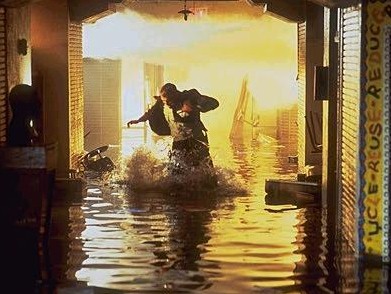
The mid ‘90s saw every type of natural disaster feature at the cinema: volcanoes (Dante’s Peak, Volcano), tornadoes (Twister), giant radioactively-mutated lizards (Godzilla)… Hard Rain is another offering, this time presenting the viewer with a much more believable natural threat: a Midwestern town inundated with floodwater.

In 1993 the Mississippi and Missouri Rivers flooded, swamping some 30,000 square miles and causing around $15 billion damages. This obviously influenced writer Graham Yost (the man behind Speed) who then put pen to paper on what would become Hard Rain. The film sees constant rainfall, swollen rivers, and a dam under pressure to contain the raging torrents. At the heart of the story is the Indiana town of Huntingburg, the floodwaters swirling through its streets. But Hard Rain is not a disaster movie. It is a heist movie.

As the citizens of Huntingburg evacuate the businesses and banks are clearing out too. The last armoured security van out of town is crewed by Tom (Christian Slater) and his crotchety Uncle Charlie (Ed Asner – the old geezer from Up); in the back is a cool $3m. But also in town is a gang of armed robbers led by Morgan Freeman’s Jim. They know where the truck is, they know what it contains, and they want the money.

Their plans go awry however. Charlie is shot dead and Tom escapes with the money, stashing it in a safe place. He then has to keep ahead of the gang who are on his tail. Complicating matters are the independent Karen (Minnie Driver) who is determined to protect the church she has been restoring, and Sheriff Mike Collig (Randy Quaid) and his two deputies. Events spiral into a tense actioneer as the various groups play a violent game of cat-and-mouse throughout the submerged town.

The film contains plenty to keep the viewer interested, not least a regular procession of explosive set piece action scenes. The initial stick up at the armoured van leads to a jet ski chase through the corridors of a flooded school. Tom has to escape from a prison cell as the waters rise ever higher around him. There is a shoot-out at the swamped cemetery, bullets pinging off the tombstones and mausoleums, before a siege at the church. Meanwhile Karen finds herself handcuffed to the banister at her house while the floodwaters swell. Unpredictability comes from the creaking old dam and its need to open extra sluices to control the floodwater: Huntingburg lies right in its path. The threat that the dam might breach is ever present as the town is submerged. Throw in a series of stunning sets representing Huntingburg and its buildings, some comedy old timers played with relish by Betty White and Richard Dysart, some passable repartee between Slater and Driver and a really good twist about half-way through that I certainly didn’t see coming (and which I shall endeavour not to spoil for you here) and the film rattles along at a breathless pace.

"You boy! No jet skiing in the corridors!"

Genial old Morgan Freeman, the only actor who could manage to portray Nelson Mandela, a black American president and God without anyone feeling insulted, here plays a thinking-man’s crook (complete with bad-ass earring and shed-loads of guns). His gang comprise former high school science teacher and explosives expert Mr Mehlor (Dann Florek), the Samuel L. wannabe Ray (Ricky Harris) given to quoting apposite Biblical passages, and big-mouthed first-timer Kenny (Michael Goorjian). Ranged against him is the outgoing Sheriff doing one final job and his two deputies, the rather unfriendly Wayne (Mark Rolston) and the naïve Phil (Peter Murnik). Christian Slater does his best as an action hero though I’ve never been entirely sold on him in this sort of role. Minnie Driver made the film following on from breakthrough successes in Grosse Pointe Blank and Good Will Hunting.

Yet, with all this in its favour it was a flop. It had a budget of $70m and only recouped $20m at the US box office. It was, apparently, released straight-to-video in most countries after is limping performance in America, which might explain why I could not remember it. It’s a shame, because I rather enjoyed it. The flooded town provided an interesting twist to an action thriller, as the competing participants had to contend with the water as well as each other.

What have I learnt about Indiana?
Not that much. The film has a real Midwest setting – small town, interesting locals, danger of flood inundation – but other than the references to Huntingburg frankly it could have been in any state from Idaho to West Virginia. But the concept of a flooded town is a good one. We have all seen those images from the Midwest before – JCBs piling up earthen levees, walls of sandbags surrounding the buildings, mobilisation of the National Guard, evacuations and concerned citizens worrying about looters. This is territory where nature’s wrath is not entirely tamed. The dam tries to hold back the floodwater, but has to vent increasing amounts to prevent its own collapse. Little towns like Huntingburg lie right in the path of any deluge.

Also wages are clearly not great, whether we are talking about Charlie the security guard or Mike the sheriff. And like all sheriffs in America, Huntingburg’s is elected – and can be unelected just as easily.

Can we go there?
Huntingburg is located in Dubois County, south-west Indiana. According to Wikipedia it has the nickname ‘Hollywood of the Midwest’ – as well as Hard Rain the Madonna movie A League of their Own was also shot there. Contrary to its depiction in the movie there are in fact no major rivers or dams nearby. There are a couple of reservoirs, but that’s it.

Lots of the interiors and action sequences were filmed in a specially converted aircraft hangar in Palmdale, California. Reassuring to know that they didn’t actually flood the town church!

Overall Rating: 3/5

Monday, 9 April 2012

The Magnificent Ambersons (1942)


Dir. Orson Welles
Starring: Joseph Cotten, Dolores Costello, Anne Baxter, Tim Holt


There is a strange conceit at the end of The Magnificent Ambersons. Instead of written credits, there is a voice over named the cast and crew. The final words of the film, therefore, are: “I wrote the script and directed it. My name is Orson Welles…”

Mr Welles should maybe have not been so quick to put his name to the film. This, his second directorial effort (after Citizen Kane) is a ponderous, turgid affair. It tells the story of the lordly Amberson family – aristocracy almost in their provincial ‘midland’ town (hell, in his younger days 'Georgie' almost looks the spit of Sun King Louis XIV with his ringlets and velvet). Founded in their splendour (or ‘magnificence’) by one generation – the Major (Richard Bennett) – the family fortune decays away in the lifetime of his grandson George (Tim Holt). By the end of the film George is working for hazard pay in industry, his paternal aunt Fanny (Agnes Moorhead) is slightly deranged and playing bridge in a boarding house, and his maternal uncle Jack (Ray Collins) is away working. His father has died, his mother has died, and his grandfather has died. The grand Amberson mansion has been vacated and they have a bare handful of scraped together dollars to sustain them.

Time has passed them by. And this is something the film handles well. It raises a wry eyebrow at the passing fads of fashion and fancy. Welles’ own narration early in the film sets the scene as a time when “there were seen men of all ages to whom a hat meant only that rigid, tall silk thing known to impudence as a stovepipe. But the long contagion of the derby had arrived. One season the crown of this hat would be a bucket; the next it would be a spoon. Every house still kept its bootjack, but high-top boots gave way to shoes and congress gaiters, and these were played through fashions that shaped them now with toes like box ends, and now with toes like the prows of racing shells.” Certainly with the shoes he could be almost talking about today. Fashion flitted by, and the Ambersons’ moment in the sun proved too just to be one of those fashions. They rose; they would also fall. Such is the passing of the ages. It is almost elegiac. And the midland town around which once they swaggered changed too: “the town was growing… changing… it was heaving up in the middle, incredibly; it was spreading incredibly. And as it heaved and spread it befouled itself and darkened its skies.”

There are two things that prove to be more than just passing fashions. The first is the horseless carriage: the automobile. Eugene Morris (Joseph Cotten, serial collaborator of Welles) is an inventor. We first see him with a primitive steam-powered model. When he returns to town after twenty years he has a hand-cranked version with an internal combustion engine. He perfects it further; he builds a factory to churn out his automobiles. It is the automobile that changes the town. They shorten distances; they help the town spread to the county limits. And, as the Major and Jack recognise, as the town spreads the property values of the current residential areas such as Amberson Addition are undercut. Through his invention, his industry, and his ability to spot a rising trend, Eugene becomes a rich man; conversely the Ambersons, through lethargy, laziness and bad investments impoverish themselves. The old world of respect for names is eclipsed by the new world of self-made men.

The second is love. As a young man Eugene had wooed Isabel Amberson (Dolores Costello). She rebuffed him and married instead Wilbur Minafer (Donald Dillaway); George Amberson Minafer was their issue. Eugene left, married, had a daughter, and became a widower. Upon his return it is obvious that the intervening years have not lessened his and Isabel’s ardour for each other. After Wilbur’s death they spend more and more time with each other. They plan to marry. But George forbids it. George, the spoiled brat of the start of the film, has become a conceited young prig of a man. He is horrified that the town gossips are suggesting that his mother still loved Eugene, even when she was married to his father. He sends Eugene away, and takes his mother off to Europe. The irony, of course, is that a union with the by-now wealthy industrialist would have solved any financial problems the Ambersons had. But to George the family name is more important than the sordid world of trade (when he is asked what he wants to do with his life he replies that he does not intend to go into a business or profession at all). George, too, finds love, of a sort, with Eugene’s daughter, Lucy (Anne Baxter). When he tells her he is going to Europe he clearly, desperately, wants her to feel something. Instead she smiles and laughs and prattles on. It is only when he walks off that her face crumples into an abject mask of misery and she runs into a nearby druggist, where she faints. She later, in one of the best-written scenes, talks to her father about a local Indian legend of a young chieftain who was so arrogant and dictatorial that his tribe rebelled, loaded him into a canoe, and let him drift all the way out to sea. It was only when he was gone that they realised that no other individual could ever have taken that chief’s place. It is clear that she is discussing, in a coded way, her feelings for George.

George, the horrid child, the swollen-headed Bullingdon Club-ber, is forced to taste the fruits of his youth. He actually grows up. He realises that $8 a week will not be enough to support himself and his aunt, so he refuses an entry into the legal profession in favour of working in a hazardous industry (he mentions working with dynamite) where the pay is better. He makes sacrifices to support his aunt. When at last all the vestiges of nobility have been stripped away from him, he finally learns to act nobly. He receives the “comeuppance” his childhood contemporaries had prayed for. “But those who had so longed for it were not there to see it, and they never knew it. Those who were still living had forgotten all about it and all about him.”

And then he is knocked down by a car. He breaks his legs. Eugene Morgan goes to see him in hospital. Eugene takes care of everything. And so, a happy ending. Even Fanny, who we were led to believe had harboured feelings for Eugene for years, is happy. What just happened there? I’ll tell you what just happened: Orson Welles went to Brazil. While away his work was edited and re-edited in Hollywood. He tried to exercise some control by phone and telegram from Brazil, but the studio made excisions. They reinserted scenes he had cut. And they completely reshot the ending. In the final edit that survives, Eugene goes to see the dying Isabel upon her return but is turned away by Ambersons saying that the doctor recommends she have quiet. In Welles’ original George and Fanny continued to conspire to keep him from her. And in Welles’ original audiences could see the decaying Amberson mansion, and could see a passive Fanny in her boarding house. The studio reshot scenes to give it a more happy ending (in this the studio were actually closer to the 1918 novel by Booth Tarkington from which the story was adapted). Fanny, who appeared raving and mad in one scene is now smiling contentedly in the finale. Furthermore Major Amberson just vanishes; the screen simply fades to black part way through a rambling speech. He never reappears. In fact George never reappears after he leaves the legal office. We simply see a crowd around a car crash, read about him in the newspaper, and then hear Eugene speaking about going to see him. Frankly, the way the ending has been cobbled together it would be like Casablanca's Rick and Ilsa vanishing off screen prior to the final airfield scene and instead having Renard sat at a desk talking about how Rick insisted on her getting on the plane and that they would be leaving together shortly. But test screenings showed mostly poorly whatever they did. It was released to no great fanfare (though Welles and Moorhead were both nominated for Oscars) and made a $600,000 loss on a $1 million budget, much as Welles’ previous effort, Citizen Kane, had made a loss. Yes, Citizen Kane, which regularly tops lists of the greatest movies ever made, was a flop. So was The Magnificent Ambersons. What was released was not what Orson Welles had wanted to release but, removed to Rio, was unable to prevent. But his name was all over it. He personally felt that Ambersons ruined him; as late as the 1970s he was hoping to get the surviving cast together to shoot extra footage and ‘fix’ the film. Certainly comparing 1942’s limited black and white story of the Ambersons with 1939’s epic Technicolor Gone With the Wind leaves this looking distinctly, drearily, third-rate.

And so George is left with Sweet Fanny Amberson
The Amberson / Minafers before they have to leave their mansion

 In the end, both the strengths and also many of the weaknesses of The Magnificent Ambersons come from its genesis as a novel. The elegiac narration about the passing of time and the changing of the seasons and the endless parades of fads and fashions is lovely; so too is Lucy’s parable about the Indian chief. These feel as though they were chunks of text lifted straight from the novel. But the film keeps too closely to its literary origins. Its reliance upon Welles’s narration and upon a chorus of behatted townsfolk passing comment upon every action makes the film appear too much like a literary adaptation rather than a stand-alone movie in its own right. I just get the feeling that, if I had read the book, I would find it an improvement over the film.

What have I learnt about Indiana?
The state is never mentioned. It is only at the end that we see a copy of the Indianapolis Daily Inquirer (which, incidentally, was one of the newspapers in Charles Foster Kane’s stable). This sites the pleasant midland town that became a sprawling, befouled, industrial city: Indianapolis. And one of Indianapolis’s big industries in the early years of the 20th century was indeed automobile manufacture, a link that still survives in its fame as a motor-racing venue. So presumably the city saw men of business and industry rise in wealth and status around the turn of the century at the expense of the elder gentry of the county. Mind you, these gentry themselves had risen from somewhere: as Lucy tells us, once the grove of trees in her garden was the heart of an Indian tribe. And whatever happened to them?

Furthermore, from how it is depicted in the film, one would imagine that the winters can be very bitter.

Can we go there?
Indianapolis is the largest city in Indiana, and lies right at the heart of the state. Its motoring heritage is still preserved at the museum of the Indianapolis Motor Speedway. In particular the refined circles that the Ambersons move in was based by original author Booth Tarkington upon the sort of society he knew growing up in the late-19th century residential area of Woodruff Place, one mile east of the centre. Woodruff Place is now on the United States’ National Register of Historic Places.

That being said, the movie was shot entirely in California. The wonderful exterior town scenes and the mighty three-storey set that served as the Amberson Mansion were created on the RKO Ranch at Encino. The winter scene did use real snow, and it was filmed at the Ice & Cold Storage Company at 400 S Central Avenue in Los Angeles.

Overall rating: 1/5 

Sunday, 8 April 2012

Week 15: Indiana

"Again I seem to be
 Back home again in Indiana
 And it seems that I can see
 The gleaming candlelight still burning bright
 Through the sycamores for me..."
 - '(Back Home Again in) Indiana',
 Louis Armstrong


I'm sorry to be leaving Illinois. I loved the movies I watched there and am aware that there are so many more I could add to my list. But we're not travelling very far, just circling east around the bottom of Lake Michigan to the neighbouring state of Indiana.

Indiana is the Hoosier State. The folks of Indiana are known as Hoosiers. No one seems to know why (maybe it is because, as Professor Henry Jones Senior once pointed out, "Indiana was the dog's name!"). Nor does anyone seem to be able to say who they are Hoosier than or, indeed, who is the Hoosiest. But at least they're happy.

Other than their odd demonym the only thing I can immediately think of about Indiana is that it is the home of the Indianapolis 500, a 500-mile speedway motor race. Now I tend to find Formula 1 racing where competitors speed around twisty-turny tracks 70-odd times pretty dull so I find it hard to believe that I would be enthused by drivers simply having to keep their left hand down for 200 laps of a perfectly oval circuit. But American sports are strange things, as we may soon discover...

I've had a touch of trouble getting hold of films set in Indiana. It is not that there aren't any, It is just that none of my original three choices are held by Lovefilm. So I have had to wave farewell to Frank Sinatra and Dean Martin in the Oscar-nominated Some Came Running (1958), Viggo Mortensen in David Cronenberg's A History of Violence (2005), and Kevin Kline and Tom Selleck in the comedy In & Out (1997). And instead we have:

  • The Magnificant Ambersons (1942)
  • Hard Rain (1998)
  • Hoosiers (1986)


Hoosier daddy!

Friday, 6 April 2012

Ordinary People (1980)


Dir. Robert Redford
Starring: Donald Sutherland, Mary Tyler Moore, Judd Hirsch, Timothy Hutton


I had never heard of the film Ordinary People before I started searching out films set in Illinois for this challenge. This in itself proves the worth of the objectives, because the film is very powerful, very moving and superbly acted by an all-round ensemble cast who have to dig deep into some very uncomfortable territory. And I am not the only person to think so. In 1980 Ordinary People won the Academy Awards for Best Film, Best Director (Robert Redford), Best Supporting Actor (Timothy Hutton, still the youngest person to have won that award) and Best Adapted Screenplay (Alvin Sargent). There were nominations too for Best Actress (Mary Tyler Moore) and another Best Supporting Actor (Judd Hirsch). It won five Golden Globes and was nominated for three more. This was a very successful and critically praised movie. I’m actually quite shocked that I had never heard of it previously.

The film centres on the Jarretts, a well-to-do family in the well-to-do suburbs of Chicago. There are three of them: tax attorney father Clive (Donald Sutherland), homemaker mother Beth (Mary Tyler Moore) and high school student Conrad (Timothy Hutton). But there used to be four. The absence of eldest son Buck (Scott Doebler) haunts the family as the first of two serious incidents to have impacted upon their lives. During a sailing trip the two sons got into trouble when their boat capsized. Conrad survived. Buck didn’t. The second incident relates to the reaction to that event. Four months prior to the current time Conrad had attempted suicide. The film then relates how the different family members try to process those events. Conrad was hospitalised following his suicide attempt. Back at home now he has trouble relating to his family or his friends. Eventually he starts to open up to two individuals: Jeannine (Elizabeth McGovern), a girl in his choir with whom he goes on a date, and Dr Berger (Judd Hirsch), a psychiatrist whom he reluctantly agrees to see but who has a major and far-reaching impact upon him. Calvin tiptoes around Conrad with forced jollity, hesitant to push his son too far. Meanwhile Beth remains glacially distant, trying to make everything go back to normal, as though nothing had ever happened.

Of course, none of this is apparent at first. The story is not rushed. The specifics of the story and the characters’ reactions to them emerge gradually. But back behind the scenes a kettle is boiling, the pressure building up. Events come to a head at Christmas. After several cringingly awkward attempts to “connect” with his mother Conrad finally snaps when her unease at posing for a photo with him becomes clear. She later bites back in anger when she discovers from another mother that he has dropped out of swim team without informing them. She accuses Calvin of being soft on the boy and always taking his side. She persuades her husband to take a trip with her to Houston, leaving Conrad with her parents. The pressure finally explodes during their absence, leaving me twisting on the couch for fear that Conrad would again attempt to take his own life (there is a nail-biting scene when runs to the bathroom, runs the sink, and plunges his writs into the water… before splashing it over his face). In panic he turns to the only person he feels he can trust: Begrer. In a late-night emergency counselling session a catharsis is reached, Conrad screaming at Berger as though he were Buck: “I said put the sail down but you said keep it starboard and then we go over! And you say ‘Hang on, hang on!’ but then you let go! Why’d you let go?” Realising this Berger replies, as Buck: “Because I was tired!” “Oh yeah? Well screw you, you jerk!” Maybe therapy sessions are over-used and old-hat now, but I have to admit that scene hit me like a punch in the gut. “What was the one wrong thing you did?” “I hung on.” Conrad did not kill Buck, but he is stricken with the feeling that he could have done more. He is angry with his brother for dying, and he is angry with himself for living. He has survivor’s guilt.

One other scene had me likewise tearing up, and that is Cal and Con’s reconciliation at the end of the film. I don’t know what it is, maybe it’s just the age I am at, but father-son relationships always have me blubbing, whether it’s Ordinary People or Doctor Who. Just as Conrad is coming to understand himself, Calvin is coming to understand his family. And in particular his brittle, high-strung wife. Beth does not like emotions to be aired in public. She does not like the family’s dirty linen to be aired in public. She does not want her family to be seen as exceptional and talked about. After Calvin meets with Dr Berger his thoughts turn to one episode: on the day of Buck’s funeral Beth told him to change his shirt and his shoes. It bothers him that she was concerned with the family looking appropriate on the day their son was being buried. “You are beautiful. And you are unpredictable. But you’re so cautious. You’re determined Beth, but you know something? You’re not strong. And I don’t know if you’re really giving. Tell me something: do you love me?” The only answer Beth can give is “I feel the way I’ve always felt about you.” She cannot name it. She cannot say that she loves her husband. Calvin’s assessment is damning: “We would have been all right if there wasn’t any mess. But you can’t handle mess. You need everything neat and easy. I don’t know. Maybe you can’t love anybody. It was so much Buck. When Buck died it was like you buried all your love with him.” Had Buck not died, had Conrad not tried to kill himself, the family unit would have gone on intact as it always had. But the stresses and strains of the last year had revealed that there was an emotional hollow at the heart of that family. Needless to say, Beth walks away without saying a word. Only in the privacy of her room can she finally break down. (Calvin’s comments about Beth and mess are foreshadowed earlier in the film when Conrad tells Dr Berger that his suicide attempt stained the towels, rugs and tiles in the bathroom).

The two parents are very different. In family dramas it is usually the mother who is the nurturing supportive parent, with the father the emotionally distant one. Not here. And all credit to the two actors for inhabiting their roles so completely. Donald Sutherland’s Calvin is encouraging and tactile (Beth comments that he is always hugging people). He may be a tax attorney who commutes into Chicago on a daily basis, but he cares about his family. And he cries. Welcome to the birth of the New Man. (He is pretty alone in this however; his colleagues can only spout incomprehensible tales about floating stock options). But Mary Tyler Moore deserves even more credit for blasting away her sitcom past with a role so horrifically yet believably emotionally stunted (interestingly Judd Hirsch also broke out from his starring role in the sitcom Taxi – bold imaginative casting from debut director Robert Redford all around!). Beth is a Stepford Wife with little if any obvious humanity about her. Except she is not Calvin’s fantasy woman. She has made herself like this, building her own protective walls. A clue to why she is the way she is comes from a revealing interchange with her own mother; when she mentions Dr Berger her mother immediately wants to know whether he is Jewish. Why? What possible use could such information have? But it shows the fussy mannered WASP pretensions that she herself grew up in. Possibly the most unpleasant revelation is that she never came to visit Conrad while he was hospitalised. Con accuses her of favouritism: “You woulda visited Buck if he was in hospital!” She shoots him straight back down: “Buck would never have been in the hospital!” She cannot understand Conrad’s turbulent emotions because hers are so deeply buried that it seems as though she hates him.

Conrad's End: Beth and Conrad attempt to only connect...

In a way this gives the film a scapegoat. The situation is not Conrad’s fault. It is not Calvin’s fault. It is Beth’s fault. But Beth, somewhere, deep inside, is hurting too. Maybe more than anyone else: all she wants is a nice stable family, and Calvin has snatched that away from her. We see the father and son reunion; we do not see what becomes of Beth. Really, nothing is anyone’s fault. Shit happens. People deal with it the best way they are able. There is the implication that talking about things, bringing all the skeletons in the closet out into the light, is the best way to deal with stress. This is a very American viewpoint, the viewpoint of a fundamentally optimistic and open society. But Beth comes at things from a more reserved, almost British, angle: it is up for the individual concerned to deal with their own problems their own way, and if that means repressing anything uncomfortable, so be it. The film is a call for people to be open and in touch with their feelings. But as Dr Berger warns, “Feelings are scary. And sometimes they’re painful. And if you can’t feel pain… you won’t feel anything else either.”

So why had I never heard of this film? I think the title doesn’t help. Ordinary People is a very, well, ordinary title, nothing really to stick in the memory. I can understand that the film title had to stay true to the original source material, Judith Guest’s 1976 novel of the same name. This had proved a hit in the US, making it easy to hang a film off it. I suppose it has a deeper meaning. The Jarretts are not particularly exceptional. They are the same as any family one might pass in the street. How many of those are too trying to come to terms with – or cover up – a deep family trauma? How many families that you assume are functioning normally are actually cracking apart under stress? I’m reminded once again of Dostoevsky’s quote from Anna Karenina: “Happy families are all alike; every unhappy family is unhappy in its own way.” Beth aspires to be one of the crowd, just another happy American family. But inside they are dying.

What have I learnt about Illinois?
I’ve learnt where the families with money live. We had the Los Angeles suburbs in Orange State. We had the New York suburbs in Revolutionary Road and The Stepford Wives. Now we have the Chicago suburbs stretching north up the Lake Michigan shoreline: Lake Forest and Highland Park. And they look nice places in which to live: big houses, parks of autumnal golden trees, bridges and streams. This is a very pastoral-themed part of the world. Compared to the flatness of the Texas golf courses (Cal cannot get over how flat the land down there is) the Illinois scenery seems to be more in keeping with the English idea of beauty – a nature tamed but not eradicated. Appropriate somehow for the movie’s themes. No wonder Beth likes Houston so much.

Calvin commutes in to Chicago by train daily. The city as shown here seems crowded and dirty in comparison.

Can we go there?
Lake Forest sits half way between Chicago and Waukegan in an area known as the North Shore. It must be a haven for wealthy suburban kids - a quick look on Wikipedia shows that Risky Business, Sixteen Candles, The Breakfast Club, Weird Science, Ferris Bueller’s Day Off and Mean Girls were all set in the North Shore area as well.

The film was shot extensively in the local area: Lake Forest, Highland Park, Lake Bluff, Fort Sheridan and Northbrook. The house used for exterior shots of the Jarrett residence is located on Greenbay Road, east Lake Forest (interior scenes were shot nearby in Fort Sheridan). Jeannine’s house is on Scott Street. Lake Forest High School, whose alumni include actor Vince Vaughan and writer Dave Eggers, was used for the film’s school (though the pool scenes were filmed at nearby Lake Forest College instead). Their school colours are indeed blue and gold. After Conrad’s first full conversation with Jeannine he skips through Triangle Park – notable for the copper deer statue shown in the film – singing the Hallelujah Chorus. Their first date occurs at McDonalds on Sheridan Roaf, Highwood. Earlier Con had met up with Karen at the Walker Bros Original Pancake House on Green Bay Road in Wilmette. Conrad uses the pay-phone at Lake Forest Train Station to make his emergency call to Dr Berger; Berger’s office is supposedly somewhere in Highland Park. Cal also has a scene above the Chicago River, in amongst all the tower blocks of Chicago’s Loop.

The golf course scene was meant to be in Houston, but instead it was filmed in Apple Valley, California.

Overall Rating: 4/5