Showing posts with label Wyoming. Show all posts

Friday, 21 December 2012

Brokeback Mountain (2005)


Dir. Ang Lee
Starring: Heath Ledger, Jake Gyllenhaal, Michelle Williams, Anne Hathaway
 

Brokeback Mountain has become famed as ‘the gay cowboy love story’. I worry about this on several grounds. Firstly, the homosexual aspect of it might put off straight filmwatchers from viewing it, which would be a shame (I know whereof I speak: it was offered as an inflight movie on a trans-Atlantic flight I was on in 2006 and I opted to watch less, erm, challenging fare instead). Secondly, that description contains a number of inaccuracies. 

Firstly, I’m not sure quite how ‘cowboy’ the central pairing of Ennis Del Mar and Jack Twist (Heath Ledger and October Sky’s Jake Gyllenhaal) are. Sure, they wear cowboy hats and hang around in dusty Western towns, but this is not the 1880s Wyoming of Shane and Unforgiven. This is the West of the 1960s and ‘70s. Ennis and Jack are two hirelings employed to watch over the sheep flock of Joe Aguirre (Randy Quaid from Hard Rain and Balls Out: Gary the Tennis Coach) while they pasture up on Brokeback Mountain for the summer. After that summer they do go into various cow-related professions, Ennis continuing as a ranch hand and Jack trying his luck as a rodeo rider before settling down selling farm machinery. 

Secondly, for fear of upsetting people, I must say that I’m not sure how ‘gay’ Ennis and Jack are. The story is that of their relationship and how they give in to passion sharing a tent up on Brokeback. Four years later they pick up their relationship and arrange to continue their affair in secret. But they are certainly not exclusively homosexual. Ennis produces two daughters with his wife Alma (Michelle Williams) and is seen participating eagerly in bed with her; after his divorce he has another relationship with a waitress. Jack responds to the forthright advances of rodeo rider Lurleen (Anne Hathaway) and has a son with her. He later tells Ennis that he has been seeing another woman behind her back. Yet it is implied that he is seeing that woman’s husband as well, and we see him cruising for gay sex in Mexico. Both characters engage eagerly with partners of both sexes. This, then, would make them bisexual. But in many ways it is pointless trying to label their relationship. The nuances of homosexuality or bisexuality are lost on Ennis and Jack – they just do not have the vocabulary. This is not a relationship with a background in any equality movement; it is two men answering a need within each other. 1960s Wyoming may as well be Victorian England. Men may carry on with each other is secret but the public face they must display is of a macho family man. When it all begins Ennis tells Jack “You know I ain’t queer.” “Me neither” Jack replies. Ennis has reason to fear, having seen a murdered gay man when he was a child. When Lurleen tells him of Jack’s death all he can think of is his lover being brutally assaulted by thugs. The truth of Jack’s death is never actually explained.

Thirdly, Brokeback Mountain hardly seems like your stereotypical love story. Sleepless in Seattle it is not. There are no grand romantic gestures – there is only need. There are no flowery expressions of love. Everything goes unspoken. The nearest they get is Jack’s heartfelt “I wish I knew how to quit you!” Their backgrounds condition them to know that two men could not possibly ever be in love with each other and so they don’t have that conversation. The nearest they get is the matter of their shirts. Following Jack’s death Ennis goes to see his parents. Secreted behind a wardrobe he finds the bloodstained shirts they wore up on Brokeback Mountain twenty years previously, one tucked inside the other. Ennis takes them and hangs them in his trailer, now with their positions reversed. This is the signal and sign of the depth of their attachment to each other. They can only find solace with each other.


He couldn't resist the stay-fresh
scent of new improved Lenor
 
I was going to write about how much of a genius Ang Lee is. For a man from Taiwan to direct a film like Brokeback Mountain full of dusty small towns, hardbitten ranchwork and gay romance is, I immediately thought, taking him way beyond his comfort zone. But why should a director have to personally know the scenarios he is bringing to the screen? Steven Spielberg never searched for sharks, Alfred Hitchcock was never pursued by spies, David Lean never rode with the Bedoiun. All a director needs is a good script which evokes the necessary atmosphere and an imagination to see the world through the eyes of his characters. But Lee has always pushed boundaries. Whil one might imagine that Crouching Tiger, Hidden Dragon was not too much of a stretch for him, he had directed Jane Austen’s Sense and Sensibility five years earlier. 19th century English manners must have been as alien to him as the smalltown West and yet that was a success. He has refused to be limited in what he chooses to direct, be it big budget Hollywood actioneers like Hulk or the current The Life of Pi. Kudos to him.

Brokeback Mountain is a beautifully shot and tender study of a forbidden romance. It does not provide any easy answers to the viewer. And yes, okay, the scene of Ennis and Jack’s first sexual encounter did make me feel uncomfortable in a way that I hadn’t felt since watching Priest many years ago. Really, the only negative is the scope of time the film covers. To be honest at the end of the film Heath Ledger and Jake Gyllenhaal do not look twenty years older than at the beginning. They look like kids playing dress-up (Michelle Williams' dowdy Alma is the exception to this). Sideburns get a little longer, shoulders sag a little more, but it was hard for me to understand quite how long their relationship had been going on without making reference to their children. I suppose the refusal to drown the main characters in makeup left greater scope for acting – and Ledger in particular as the closeted inarticulate Ennis is superb. Brokeback Mountain is more than the cliché everyone knows it as and should be watched by people whether or not they like cowboys, gays or love stories. 

What have I learnt about Wyoming?
Well, for starters, Wyoming in the early ‘50s was pretty homophobic. Even as late as the 1970s gay individuals were scared of making their sexuality clear for fear that they would be murdered. I’m not sure how much of that came as a surprise to me. 

What was more surprising was the animals tended. Yes, Ennis later rounds up steers, but he starts out tending sheep with Jack. A Western form of transhumance was practiced, with sheep being driven up to the mountains to pasture over summer before being brought back down again for winter. But even during summer the weather is unpredictable, with cold nights, hailstones the size of marbles and sudden overnight snowfalls. Menacing wildlife includes coyotes and black bear. 

Can we go there?
Many of the locations mentioned in the film – and in the original short story by Annie Proulx – are entirely fictitious. There is no Brokeback Mountain, there is no Signal, and there is no Lightning Flats (where Jack hails from). The one town that really does exist is Riverton, in the centre of the state, where Ennis and Alma settle down.
 
However, like Unforgiven, Brokeback Mountain was filmed in Alberta, Canada, rather than Wyoming itself. Cowley was used for Signal. Fort Macleod stood in for the real Riverton – for instance during the 4th July sequence when Ennis fights two bikers and his family apartment above the laundrette. The bar in which Jack and Lurleen first hook up is actually Ranchman’s in Calgary. Brokeback Mountain itself was a composite of Mount Lougheed and Moose Mountain, both in Kananaskis Country to the west of Calgary. The campground scenes were shot at Canyon Creek (theit first campsite), Goat Creek (the second), Elbow Falls and Upper Kananaskis Lake (where Jack wished he could “quit” Ennis). 

The two intertwined shirts can be seen at the Autry National Center of the American West in Los Angeles. 

Overall Rating: 3/5

Wednesday, 19 December 2012

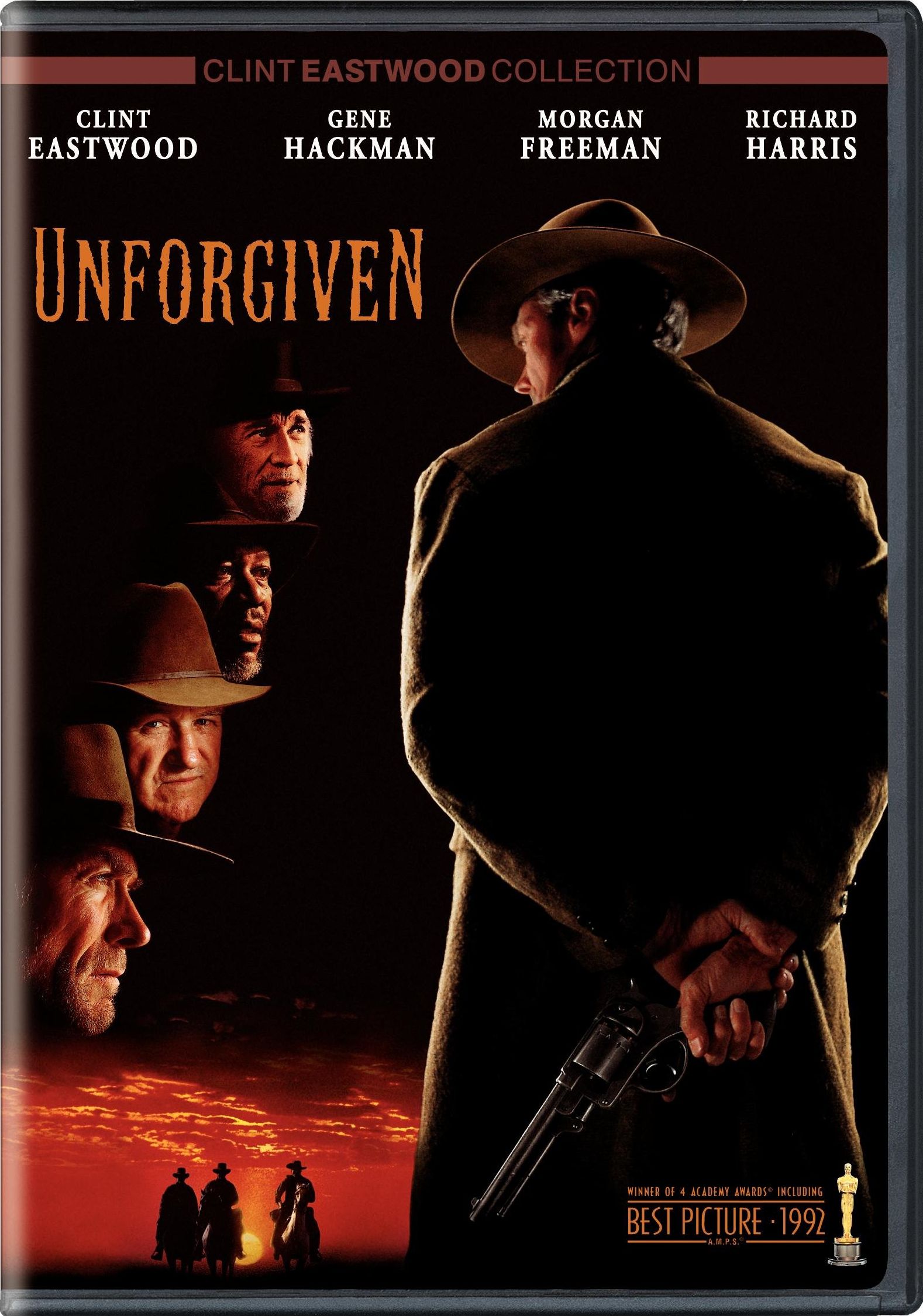
Unforgiven (1992)


Dir. Clint Eastwood
Starring: Clint Eastwood, Gene Hackman, Morgan Freeman, Richard Harris
 

I don’t know about you, but just reading the cast-list for Unforgiven got my mouth-watering. Clint Eastwood (directing again, as he directed The Bridges of Madison County and Midnight in the Garden of Good and Evil) and Gene Hackman (only seen this year in Best Shot) facing off against each other? Supported by the Godlike Morgan Freeman and notorious Irish hellraiser Richard Harris? In a Western? Sign me up! 

The danger sometimes is that you can go into these things with expectations that are set too high. Some of the films I have enjoyed most this year completely blindsided me – like In Cold Blood or October Sky. Some I was looking forward to – like High Noon or The Shining – left me a little disappointed. I am happy to say that Unforgiven is a beautiful film with an intelligent script and a good meaty story. Oh yeah – and the cast ain’t too shabby either… 

Like Shane, Unforgiven is a story about not being able to escape ones past. William Munny (Clint) is a widower struggling to raise two children on a farm that is failing. But once he was the most feared cold-blooded killer in the West. The love of a woman turned him away from violence and away from booze. But one day a youngster calling himself the Smithfield Kid (Jaimz Woolvett) arrives on his doorstep. He knows of Munny’s reputation and wants him in on a job. In Big Whiskey, Wyoming, a prostitute was attacked by a cowboy. She lived but is terribly scarred. Her fellow whores are offering $1000 for whoever kills the two cowboys involved. Munny is in, but only for the money. He recruits his old partner Ned (Morgan Freeman). He tells Ned that he has changed, that he is no longer the killer he once was – unpredictable, violent, drunken.”I ain’t like that no more.I ain’t the same Ned. Claudia, she straightened me up, cleared me of drinkin’ whiskey and all. Just ‘cause we’re goin’ on this killin’, that don’t mean I’m gonna go bck to bein’ the way I was. I just need the money, get a new start for those youngsters.” As if that changes anything. 

And so the three head off across country. Munny is trying hard to cling on to the better man he became through his dead wife’s love. Ned realises that he no longer has it in him to kill a man. And the Kid is not the man he claims to be either; he is no five-time killer – and he is chronically short-sighted to boot. All of them come to appreciate that “It’s a hell of a thing, killin’ a man. Take away all he’s got and all he’s ever gonna have.”

But Munny and Ned are not the only relics of the Old West. Little Bill Daggett (Hackman) is now Sheriff of Big Whiskey. It’s a quiet place and that’s the way he’d like it to stay. He has an ordinance that no guns are allowed in town. He wants to spend his time building his house on the outskirts of town with a porch upon which he can sit and watch the sun go down. The reward put up by the whores complicates the matter. He preferred to deal with the attack his own way. As Delilah (Anna Levine) had a contract with Skinny (Anthony James) it is a matter of damage to property – the cowboys have to compensate Skinny, Delilah’s ‘owner’. Now he has to prevent Big Wiskey becoming one big gunfight. He hopes that when he sends the first would-be bounty-hunter, Richard Harris’s ‘English Bob’ packing that would be an end of it. The arrival of Munny and Co threatens his authority. 


The flasher was caught red-handed

 
The problem is that the glamour and mystique of the West remains. Just as Little Joey in Shane idolises gunslingers there is still a fascination with the law of the West. Enter writer W. W. Beauchamp (Saul Rubinek). He arrives towed in the wake of one glamorous legend, English Bob, the ‘Duke (or “Duck” as Little Bill calls him) of Death’. When Little Bill takes glee in rubbishing his stories Beauchamp turns his attention to the sheriff. At the end of the film we can see him, clearly petrified, but still pumping Munny for information. He gazes after him in awe. Munny dreamt of the Angel of Death. Munny is that Angel. There is no romance in farming pigs or building a house; sadly, there is romance in shooting people dead. Even if the truth is never the same as the myth. Daggett tells Beauchamp the true story behind one of English Bob’s exploits. The actual killings of the two cowboys are not glamorous – one is shot in the belly and bleeds to death in a gulch, the other is shot on the crapper.

Like Shane, the moral is that you cannot change your past. In Shane the symbolic moment when the hero accepts his role is when Shane puts his buckskins back on again. In Unforgiven that moment is when Munny takes a swig of whiskey. Automatically that improves his aim. In vino veritas. What are we to make of the Munny we see at the end? He is badass, standing up for his friend. He unleashes an Old West hell on Big Whiskey – the sort of hell that Little Bill wanted to keep the town safe from. Little Bill’s aims are laudable; unfortunately, his methods are those of the Old West. He displays Ned’s body as a warning to others – this just serves to get Munny riled. Little Bill wants a clean village free of the wrath and violence he has lived through, but his reactions breed them. Like Little Bill Munny commits an act for the right reasons - protecting his friend - but the only way he knows how to do that is all guns blazing. Who is the hero: the stone-cold killer or the gentle pig-farmer? 

The film is beautifully acted and shot. It deserves its four Oscars (Best Film, Director, Editing and Supporting Actor for Hackman). Harris and Rubinek provide comic relief, Eastwood and Freeman encapsulate the old timers back for one last job. I probably found Hackman’s Daggett the most fascinating character, a lawman prepared to act outide the law to keep the peace. All of the latter characters are struggling to correlate the two aspects of their natures – the side that wants peace and the side that is prepared to kill to get it. Altogether it is a thought-provoking companionpiece to Shane. It is the story of the men that made the West struggling to shape it in line with their own ideals. And its moral is that you cannot hide from your past no matter how hard you try. 

What have I learnt about Wyoming?
Much like Shane Unforgiven is set on the cusp of great changes in the West. The frontier was being tamed – unlike Shane Big Whiskey has a Sheriff (with many deputies) and is reachable by train. Yet elements of the Old West remain. Sheriffs can give people extra-legal beatings. Taverns are stocked with whores who are treated as property. A man can earn a living “shooting Chinese for the Railroad”; the mystery is not that Chinese labourers can be shot without repurcussions but that the Railroad would hire someone to do it for them. Trying to forge one’s own path seems fraught with troubles – Munny’s pig farm seems very marginal. Taking orders as a hired cowhand seems to be much more profitable. 

Can we go there?
Unlike Shane this film was not shot on location in Wyoming. Instead, like so may other Westerns we have seen this year it was shot up in Alberta near Calgary. The town of Big Whiskey and Little Bill’s cabin was constructed specifically for the movie around Longview; the buildings were demolished after use. Spoil sports. Likewise the Munny pigfarm around Brooks and Ned’s farm in the vicinity of Drumheller (somewhat appropriately ‘The Dinosaur Capital of the World’). The only sequence shot in the U.S. was English Bob’s train journey – this was filmed at the Railtown 1897 State Historic Park in Jamestown, California. 

Overall Rating: 4/5

Tuesday, 18 December 2012

Shane (1953)


Dir. George Stevens
Starring: Alan Ladd, Jean Arthur, Van Heflin, Brandon deWilde
 

A man rides out the the great expanses of the West. He wears buckskins and totes a sixshooter. He is Shane (Alan Ladd), a Man With A Past. The kindness and hospitality shown to him by the Starretts, a small-holding family he happens across, offers him a chance of redemption.

The Starretts and their fellow homesteaders are being oppressed by Ryker (Emile Mayer), the local cattle baron. He wants to graze his herds across the open range; the little farms of the “Sodbusters” prevent him from doing this. He wants the farming families out – by fair means or foul. The homesteaders are determined to resist. It is into this combustible mix that Shane rides. By signing on to work for Joe Starrett (Van Heflin) Shane makes their concerns his own. 

The background noise has featured before in the Westerns I have watched this year – the conflict between the Old and the New West. We saw this in Pat Garrett and Billy the Kid. The trailblazers move in, take the risks and make the West habitable. Then the new forces of order come in to set the law the way it will benefit them. In Shane we see Wyoming on the cusp of that change. Ryker complains that he took all the risks to clear the land for habitation: “We made this country. We found it and we made it, with blood and empty bellies. Cattle we brought in were hazed off by Indians and rustlers; they don’t bother you much any more because we handled ‘em. We made a safe range out of this. Some of us died, but we made it.” He now cannot get his herds to water because of the little farms that have claimed areas of his “open range”. It is rare to hear the villain of a movie get to outline his (actually very reasonable-sounding) concerns in this way. But as Joe points out Ryker’s rights would come at the expense of theirs; and anyway, wasn’t it the Indians and the French trappers who really tamed the land before Ryker rode in? Ryker’s way is that of a bully. The homesteaders are the aspiring middle classes. They work hard to grow something – to grow a family. In town they frequent Grafton’s store to buy seed and barbed wire; Ryker’s cowboys frequent Grafton’s saloon next door. The homesteaders believe in the value of honest labour and community. They celebrate the 4th of July and – whether Yankee, Confederate or immigrant – believe in American values. Their problem is that they have outpaced the law. There are no Marshals or Sheriffs this far out west. There is only the Law of the West – if the other feller drew first you are entitled to shoot to kill. The homesteaders are not violent types. It therefore means that Ryker’s hired-in gunslinger Wilson (a grinning Jack Palance) needs to taunt the farmers into reacting. 
 
Chris could never get the hang of tequila shots
 
The threat of violence simmers beneath the surface. It is implied that this is the sort of world Shane is trying to leave behind. If he enjoys working alongside Joe, he revels in the chance to swap his buckskins for the garb of a labourer and lay his gun to one side. When he walks into Grafton’s to buy Joe’s son Little Joey (Brandon deWilde) a soda-pop he is mocked by the cowboys. Yet he doesn’t react when Charlie (Ben Johnson) throws a drink over him. It is only on a second visit when Charlie swings at him that Shane finally fights back. Joe comes to his aid against the entire band of Ryker’s rowdies. In the middle of the brawl Joe and Shane exchange a grin. They may not want violence, but they still enjoy it when their blood is up. But Shane recognises the threat Wilson represents. The loyalty he feels towards the Starretts prevents him from letting Joe walk into a trap. He has to embrace the past he tried to leave behind – represented symbolically by him changing back into his buckskins. He tells Ryker straight that “You’ve lived too long. Your kind of days are over.” The same goes for him – “The difference is, I know it.” They are both products of a West that no longer exists. Shane also realises that he cannot change his background. There is a fight, shots are fired, and Shane rides away into the night. 

And to my joy, Shane has an ambiguous ending. He wins his fight, but he himself is shot. We know he is bleeding when he mounts his horse. The very last shot shows horse and rider picking their way over Cemetery Hill. Shane is unmoving in the saddle, head down. The question persists: is he alive or dead? The very fact that there is ambiguity means that to me the answer is clear. Shane dies. The fact that the shot takes place in the graveyard is enough of a hint. If this was meant to be a rousing, joyous finale we would have seen Shane galloping into the sunset. Instead he is on the voyage of the dead. He has no place in the New West. All he can do is sacrifice himself to protect the Starretts and the other homesteaders. 

Shane is a classic Western that I like. Its morals may be conservative and its hero might be too good-looking for words, but it has an elegiac quality. Yes, trailblazers like Ryker did tame the West. But then they had to be tamed themselves. Joe’s wife Marian (Jean Arthur – last seen as the sparky Saunders in Mr. Smith Goes to Washington) tells Shane that she wishes there wasn’t a gun in the valley. She gets her wish. Shane is a story about not being able to escape your past. We never know what Shane’s past is. But he is jumpy and he knows how to handle himself in a fight. We gather that he finds the peace with the Starretts he is looking for. In particular he attracts the open-mouthed adulation of Little Joey. But he and Joe are able to inspire their fellows to make a stand and not run. They are responsible for the survival of America in a lawless world. 

What have I learnt about Wyoming?
Ryker gives us a potted history of Wyoming. The first settlers chased off the Cheyenne and the other natives to claim the land as their own. Yet they didn’t act too much differently to the Indians. They used the whole expanse of the plains to graze their ever-expanding cattle herds. Then families moved west in search of a plot of land they could call their own. They fenced in their own homesteads, sowing crops and raising their own cattle, chickens and pigs. They did not want all the land, just a piece of it. But it nibbled at the edges of what the cowboys felt was legitimately theirs and deprived them of some of the best grazing. So conflict grew and turned into violence (in fact Wyoming’s Jackson County War featured just such tensions). 

Despite the soil being the source of so much bloodshed, the terrain looks quite scrubby. Deer can graze there however, and farmers’ wives can always provide hot apple pie. The land wanted is the wide flat valley bottoms threaded through by the shallow streams that run down from the ice-capped mountains – it looks like a glaciated landscape. The weather can vary from tinder dry to thunderstorms which leave the roads ankle-deep in mud. And snow is present on the mountain peaks at all times of the year. 

Can we go there?
The actual location in Wyoming is never specified. It takes a ride to get to Cheyenne, where any old low-life can be hired. But the movie was filmed in the valley of Jackson Hole. While most of the sets were built specifically for the movie, the house of Ernie Wright actually was once an actual frontier homestead. Its remains can be found just past Kelly. Other period homesteads can be found scattered around the area. The soaring jagged peaks of the Grand Tetons can be seen in the background of many of the shots.  

Overall Rating: 4/5

Monday, 17 December 2012

Week 51: Wyoming

"The sky, its line and this run
 And I cry out in Wyoming;
 My boots, my pride and my gun
 And I cry out in Wyoming..."
 - 'Wyoming',
 Brand New Sin

Wow - Wyoming. Alpahabetically the last of the states in the Union. I still have the somewhat nebulous topic of 'Road Movies' to finish off the last week of 2012 but frankly I'm amazed I've made it this far. To Wyoming.

Wyoming is, I'd imagine, much like Montana - wide open skies, endless expanses of prairie, weather-beaten pick-ups driven by weather-beaten cowboys looking like the Marlboro Man. I imagine everyone has a gun (or five) and are hardy, independent sorts who don't look for much intrusion from the state in their lives. I know Dick Cheney hails from here, so I imagine it is one of the Reddest of the Red States.

Though Wyoming is libertarian in all senses of the world. It is known as the 'Equality State' and gave women the vote - and let them stand for office - before any other state in the U.S. Maybe this was a result of the small population (Wyoming is the least populous of all 50 states and has the second lowest population density after Alaska). But it makes Montana seem crowded.

The one real claim to fam of Wyoming - and the reason most people visit I would imagine - is that it houses the bulk of Yellowstone National Park. Yellowstone is, of course, a UNESCO World Heritage Site. So I may, with luck, get to visit Wyoming myself one day. I may even try to get out to the eastern side of the state, home to Devil's Tower, so memorably modelled in mashed potato by Richard Dreyfuss in Close Encounters of the Third Kind.

Leaving Close Encounters to one side, my three films seem to be stuck in a hardy outdoorsman sort of vein I'm afraid. They are:
  • Shane (1953)
  • Unforgiven (1992)
  • Brokeback Mountain (2005)