Showing posts with label Virginia. Show all posts

Tuesday, 20 November 2012

Remember the Titans (2000)


Dir. Boaz Yakin
Starring: Denzel Washington, Will Patton, Wood Harris, Ryan Hurst 

Writing about The Blind Side I commented that I must watch a film about American football before the end of the year – and that wasn’t it. Remember the Titans is it. It is the based-on-a-true-story tale of a high school team from Alexandria, Virginia, who went on to win the state championship.

It is therefore similar in plot outline to Best Shot / Hoosiers. We have the new coach with unconventional techniques. We have a ragtag fractious squad inspired to be more than they thought was possible. And we have triumph snatched from defeat with the very last ball of the game. But I am glad to say that Remember the Titans manages to be more than just another cheesy sports movie. It adds another ingredient to the mix. That ingredient – as in Pocahontas and as in The Howards of Virginia – is prejudice.

The Titans are not just one high school team – they are two. In 1971 the school board merged two schools. Or rather ‘integrated’ them. Because there had previously been two schools – one whites only and the other blacks only. Each school had its own American football team. And each team had its own coach. Black Coach Boone (Denzel Washington) is made head of this new team; white coach Yoast (Will Patton) is appointed as his deputy. Together they must find a way to work together and forge a unified team.
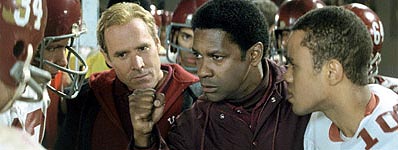
"Remember team: scissors cuts paper but rock blunts scissors..."
 
In this film sport is a means to change society. The opening narration explains that in Virginia everyone is American football-mad. “In Virginia high school football is a way of life. It’s bigger than Christmas Day.” The question really is which they love more – football or racism? They may disapprove of the integration of their schools, but once the Titans start their winning streak the population starts to come around. There is a great contrast shown just on one street. When Boone and his family move in there are twitched curtains and a lot of comments from his neighbours about if you let one in the place will soon be drowning in blacks; when his team qualify for the final they come out on their porches to applaud him. The success of the team has led to social acceptance of blacks. This is shown most clearly when Julius Campbell (Wood Harris) goes to see team captain Gerry Bertier (Ryan Hurst) at his house. They had started as fierce opponents but were the first to see that they needed to play as a team if they were to win. Hatred turned to respect and then turned to friendship: Bertier later refers to Julius as his “brother”. But as Julius walks into an all-white neighbourhood he is clearly on edge. A police car rolls up to him and stops. The window is slowly wound down. The cop looks at Julius. Everyone knows what to expect. But instead the policeman congratulates him on a great game and passes on. The early part of the film has led the audience to expect racism. When it doesn’t happen we all share in the victory.  

Perhaps the biggest challenge is for Coach Yoast. He has gone from being number one to just being an assistant. It becomes clear that as soon as the Titans lose just one match Boone will be sacked and Yoast will take over. The local league even conspire to make that happen with a series of crooked refereeing decisions. It is up to Yoast to decide what position he takes. And he, too, commits to the team even though it means missing out on his former position and on induction in the Hall of Fame. 

It’s a good thing that the film focues on the human elements of the story. Because the sports part is all but incomprehensible. Shots of the scoreboard are too quick to allow unfamiliar viewers (like me) work out what is meant to be displayed. We have to rely on reaction shots and music cues to figure out how the game is going. It appears that jumping on someone is a good thing in Anmerican football. In the last game the Titans are trailing 7-3 with only a minute remaining. This is, apparently, hopeless. But then they do a ‘fake 38 with a back George’ or something and they win the game. Fake 38s with back Georges obviously get you more than one point.  

I have to admit, before watching the film I did not have high hopes. It was about a sport no one outside the US cares about and it came from Disney Pictures. I expected a saccharine underdog-beats-the-world schmaltzfest. And I was proved wrong. Remember the Titans is actually a very engaging watch. Yes, it does go a bit Dinseyfied at times (“Before we reach for hate, always, always, we remember the Titans!”) and it does deliberately pull on the emotional levers, but so what? We are given enough to make us care about the players – Captain Bertier, his foe turned best friend Julius, big fat colourblind Louie Lastik (Ethan Suplee), smart-mouthed Petey (Donald Faison, Turk from Scrubs), the testifying Rev (Craig Kirkwood), the Californian dreamboat Sunshine (Kip Pardue) – even one of the smaller parts played by an instantly recognisable Ryan Gosling from The Ides of March. Boone is not the most-sympathetic character in the film – he is an arrogant tyrant who insists on perfection and refuses to show weakness (“This is no democracy. It is a dictatorship. I am the law.”) Yet we believe in him and we believe in Yoast. The only character I hated was Yoast’s precocious daughter Sheryl, played by Hayden Panettiere of Racing Stripes. I found her insufferable – though not as insufferable as SJ from The Blind Side. I know that the idea of watching a film about American football must be anathema to many people. But I would urge them to put aside their, well, their prejudices and give Remember the Titans a try. It is a lot better than I ever thought it would be. 

What have I learnt about Virginia?
When I tend to think of the Civil Rights struggle in America I tend to think of places like Alabama and Mississippi. This film reminds us that race was an issue in Virginia too. According to the film it was in 1971 that the first schools were forcibly integrated. That school then played an integrated team while every other team in the league was all-white. Even the American football authorities were racist and were not afraid of bending the rules a little to ensure the Titans lost (according to this film anyway). Presumably all-black schools had their own league. (Actually T.C. Williams had been integrated since 1963; their success in the 1971 season came more from two other schools being combined, giving it a larger pool of talent to draw players from). 

Virginia folks are football-mad. We are told that it is like a religion to them – “bigger than Christmas Day” remember? And they are proud that the high school league in Virginia is of a higher calibre to that in North Carolina. 

Can we go there?
Alexandria is just – just – in Virginia across the Potomac from Washington, D.C. You can easily recognise it from the tall Masonic memorial to George Washington (though this is not seen in the film). The school portrayed in the story – T.C. WilliamsHigh School – still exists.

But it won’t look familiar. No filming took place in Virginia. Instead the film was made on location in Georgia. Decatur and Covington stood in for Alexandria. Druid Hills High School in DeKalb County stood in for T.C. Williams; Shamrock Middle School provided the training pitch. Berry College in Mt. Berry was used for the training camp scenes; the players roomed in what are actually girls’ dorms. Their night-time run did not really visit Gettysburg, but it did visit Chickamauga National Park. Decatur Cemetery was used for the funeral scene. 

Overall Rating: 4/5

Sunday, 18 November 2012

The Howards of Virginia (1940)


Dir. Frank Lloyd
Starring: Cary Grant, Martha Scott, Sir Cedric Hardwicke, Alan Marshal


The Howards of Virginia is a tale of class conflict and blinkered attitudes in the years running up to American independence. It is a family saga showing how some prosper and some fall. It also, despite its starry cast, feels like an amateur theatrical production.

Matt Howard (Cary Grant) is a rough outdoorsman from the backwoods of Virginia. Left fatherless at an early age, he hs to struggle through on his own. Well not quite on his own: his best friend is looking after him. Not too shabby when that best friend is the boyish Thomas Jefferson (Richard Carlson). Jefferson fixes him up with an education, some new clothes, even an estate up in the hills and persuades him to stick around Virginia rather than heading for the frontier country of Ohio. This is how he meets the Peytons, the grandest of the Williamsburg aristocracy. Head of the family, Fleetwood (Sir Cedric Hardwicke) is a pompous old snob; younger brother Roger (Alan Marshall) is a gad-about-town); sister Mary (Martha Scott) is a honey. It is discovered that Matt once worked his own land – with his own hands! Scandal ensues! Yet Matt and Jane marry and retreat to his home in the Shenandoah Valley where they raise a family. Jefferson intervenes, again, and encourages Matt to stand for the House of Burgesses. Confronted with the political situation between England and the American colonies Matt is radicalised into fighting for independence; Fleetwood opposes any break with the king.

The whole thing is as one-dimensional as many of the set backdrops. Cary Grant gives an awful performance; his Matt Howard talks loudly and fast the entire time as though he were high on cocaine. Sir Cedric Hardwicke, the esteemed character actor, sneers and scowls and stomps about. Martha Scott floats around and simpers. Matt’s two sons are paragons of perfection, Roger vanishes from the story half-way through, and Jefferson is the real hero. Those who support independence are energised and heroic; those who oppose it venal snobs.

Fauntleroy did not understand the concept of the 'toga party'

In many ways the first half of the film held the nucleus of a good story in it. Matt struggles to overcome the prejudices of the Peytons and Jane struggles to come to life in the hills of the Shenandoah Valley. Here life is hard, debts are paid in kind, and the locals have none of the fancy graces she is used to. Surviving in these circumstances, not least with a lame son, and dealing with her disapproving family could – if handled better – have made an involving plot. But all we get is a few awkward moments, an argument, and then everything is put right by a montage. By the montage’s end Matt’s log house has been transformed into a grand estate and Jane is once again able to act the lady of the manor. Phew – problem solved. The second half of the film is bogged down by the significance of the struggle for independence. There follows another montage: stirring speeches, a metaphorical sea of royal proclamations, messengers galloping through the forests and then we are into the war. You need to know your American history here. There are gasps when it is learnt that “the hot-heads up in Boston” have tipped a load of tea into the harbour. It is never explained why they have done this.

The war itself must rate as perhaps the dullest dramatization of conflict ever. There is one chase where Matt is shot off his horse. The remainder is him shivering in a wooden hut while the camp dreams of frozen potatoes. He and his companions do not play any part in the victory. One minute the British are in Williamsburg, the next they are bottled up at Yorktown waiting for the end. Matt and his troops march south, but the film ends before the final battle.

There is a lesson about toleration in there somewhere. Even Matt Howard is not immune to intolerance. He is happy for his new wife to join him in the hills but he is hostile to visiting Williamsburg. He also slights his firstborn son, Peyton, because his limp reminds him of Fleetwood. It is disgraceful the way he greets his other two children and ignore Peyton; of course Peyton later comes to be the apple of his eye. The boy idolises his father, though heaven knows why. Matt realises that as the product of two different cultures Peyton has taken the best of each – a parallel with the new generation of Americans presumably. But the portrayal is heavy handed and clumsy. The entire thing is less morality play and more like a sub-par church hall drama society. It is not one I would urge people to watch.

What have I learnt about Virginia?
The film does give a good picture of Virginia society in the later 18th century however. The ‘Tidewater’ area around Williamsburg is home to the estates of wealthy plantation landowners. Their fields are worked by slaves and they spend their days dallying in drinking houses and their evenings socialising at balls. They are snobbish, imperious and – in the case of Fleetwood – loyal to His Majesty. Up in the hills there is a different sort of society. Here the men are free but barely scratch a living from their crops, from hunting and from smuggling. It is a poorer, more lawless area and the Tidewater aristocracy look down upon them as ill-educated and ill-mannered yokels.

Virginia had a House of Burgesses to which members were democratically elected. This provides the forum for debates about Virginia’s relationship with the crown – or it did until the governor shut it down anyway. During the War of Independence Virginia raised a militia; the then-governor Thomas Jefferson sent it away on campaign, leaving the area defenceless. All the same, the vicissitudes of war took a terrible toll on the great landowners.

Can we go there?
There are two main settings in this film, both of them in Virginia. It is a clash between the wealthy Tidewater aristocracy of Williamsburg and the rural backwoods boys of the Shenandoah Valley.

In fact, despite the fact that most of the film was clearly shot on set there are a few recognisable images of Colonial Williamsburg (as it is known) in there: the Raleigh Tavern, the Governor’s Palace, and the Capitol. All were recosntructed in the early 1930s. The Fleetwood estate of Elm Hill never existed however; the estate of Carter’s Grove was used. The plantation was once a part of Colonial Willamsburg but was sold off in 2007; its owner later went bankrupt and the estate is now held by a trustee.

Matt’s background lies in Albemarle County. Thomas Jefferson’s estate of Monticello still exists in Albermarle, just outside Charlottesville. It is a UNESCO World Heritage Site and I can well recommend a tour. It is stated that Matt’s estate was further up the Shenandoah Valley. That valley is now a National Park.

Overall Rating: 1/5

Saturday, 17 November 2012

Pocahontas (1995)


Dir. Mike Gabriel, Eric Goldberg
Starring: Irene Bedard, Mel Gibson, David Ogden Stiers, Christian Bale 

In the words of Peggy Lee (seen in Coal Miner’s Daughter):

“Captain Smith and Pocahontas
 Had a very mad affair;
 When her daddy tried to kill him
 She said ‘Daddy, oh don’t you dare –
 He gives me fever…”

The film Pocahontas is the tale of that fever. As seen by the Disney Corporation. 

Captain John Smith (voiced by Mel Gibson) is an Indian-killer, aboard a ship bound for the New World. Commanding the expedition of the Virginia Company is the villainous Governor Ratcliffe (David Ogden Stiers, the genial mayor from Doc Hollywood). He believes that the new territories hide a fortune in gold with which he can truly break into court society. Smith, however, is more impressed by the wonders of the New World. 

One of those wonders is Pocahontas (voiced by Irene Bedard but sung by Judy Kuhn). She is the free-spirited daughter of Chief Powhatan (Russell Means, who died last month / Jim Cummings). She consistently wants to see what is happening ‘Just Around the River Bend’… and just around the bend she finds the English staking claim to the continent. Fortunately the first of their kind she meets is the adventurous Smith. Despite coming from two very different cultures they fall in love. Meanwhile both the Natives and the English declare war to wipe out those whom they consider to be “Savages, savages, barely even human”.  

So actually, the plot is not unlike that of Romeo and Juliet – a forbidden love in a time of conflict. When Kokoum (James Apaumut Fall) if killed beneath Pocahontas’s arm I was irresistibly reminded of the death of Mercutio in R&J. Thankfully there are no other deaths however. The two sides manage to make their peace following intervention from Pocahontas. 

WWE wrestling dates back to the earliest
years of the American colonies
 
Pocahontas is not as amusing as other Disney movies of that era such as Aladdin or Beauty and the Beast. There is some humour provided by Pocahontas’s animal companions Flit the hummingbird and Meeko the raccoon (and Meeko’s provocation of Ratcliffe’s pet pug, Percy). But generally the humour feels geared towards the very young. It is visual humour as the animals don’t speak – a decision made in pre-production. It was felt that humour did not land itself greatly to the themes of the storyline. Because Pocahontas has a Serious Message. It is a warning against prejudice and hate. “They’re different from us, which means they can’t be trusted” sing the natives about the English.  “They’re not like you and me, which means they must be evil” the English sing back. Even the accepting Smith causes offence by referring to Pocahontas’s people as savages: “’Savage’ is just a word, you know. A term for people who are uncivilised.” “What you mean”, Pocahontas fires back, “is ‘not like you’.”  

The two sides have different views of the world. To the English ‘civilisation’ is the mighty city of London. No sooner do they arrive then they start tearing down trees and digging up the ground in search of gold. To the natives civilisation is living in harmony with the natural world. In the Oscar-winning ‘Colours of the Wind’ Pocahontas says

“You think you own whatever land you land on,
 The Earth is just a dead thing you can claim;
 But I know every rock and tree and creature
 Has a life, has a spirit, has a name.”
 
She invites Smith to “Roll in all the riches all around you / And for once never wonder what they’re worth.”
 
Tolerance means accepting the other’s point of view as valid – accepting that the person holding that view is valid too. Demonising anyone different is the path to hate and war. 

This is of course a worthy philosophy and so I feel mean for saying anything critical about the film. Personally, I found its worthiness a bit tedious. I would have liked more laughs. And, compared to, say, Toy Story which was released in the same year the animation looks flat and matte. The story has been acclaimed for telling a story in which the Injuns were not the bad guys… but the tale is not the great let’s-all-live-alongside-each-other fable it is hailed as. In the end Pocahontas and Smith do not live happily every after – neither can bear to be away from their homeland. Chief Powhatan tells Smith that he is welcome back any time. And come back the English did. And where are the Native Americans in Virginia now? Their holdings in the state have been reduced to around 8km2. The film won praise by casting Native American actors such as Irene Bedard, Russell Means and Gordon Tootoosis in Native American roles. This takes a very broad-brush interpretation that says that all Indians are the same: Bedard is Alaskan of Inupiat and Inuit descent, Means was Oglala Sioux from the Pine Ridge Reservation in South Dakota seen in Thunderheart, and Tootoosis (who played One Stab in Legends of the Fall) was a Cree from Saskatchewan in Canada. Mind you, the ‘English’ are just as loosely drawn: their number includes the Australian Mel Gibson, the American David Ogden Stiers, the Welsh Christian Bale and the Scottish Billy Connolly. Considering that the flag they sail under seems to date (depending on the scene) either from after the 1707 Act of Union with Scotland or the 1801 Act of Union with Ireland I can understand the confusion. 

All-in-all, a worthy film, but one that doesn’t have the pizzazz I was looking for from a Disney film. 

What have I learnt about Virginia?
The learnings from the film are really about how to live one’s life. But it gives an interpretation of the English arrival in Virginia. The Virginia Company was on the search for gold and came into conflict with the Powhatan tribe who lived in the area in harmony with their surroundings. The Powhatan grew corn, gathered squashes and fished in the rivers. Native wildlife included wolf, bear, moose, raccoon, eagle, hummingbird, tortoise, otter and heron. 

Can we go there?
Trying to visit the actual location of the film is difficult because it is, after all, a cartoon. However, the general area of the story was around the Jamestown settlement. The remains of the settlement (Historic Jamestowne) can be found up the James River, south of Williamsburg. The Queen visited in 2007 to celebrate the 400th anniversary of its foundation. There is also a living history park called Jamestown Settlement nearby. 

Pocahontas later married another Englishman, John Rolfe, and travelled to England with him. She died in 1617, some ten years after the events depicted in the film, aged 22(!), and is buried in the vicinity of St. George’s Church in Gravesend, Kent. There is a statue there to commemorate her passing. 

Finding any of the dramatic scenery of Pocahontas’s world, like the soaring cliffs and plunging waterfalls will be difficult however – the area around Jamestown is flat and low-lying. 

Overall Rating: 2/5

Friday, 16 November 2012

Week 47: Virginia

"In the Blue Ridge Mountains of Virginia
 On the trail of the lonesome pine;
 In the pale moonshine
 Our hearts entwine
 Where she carved her name and I carved mine..."
 - 'On the Trail of the Lonesome Pine',
 Laurel & Hardy

The trail of the lonesome pine has led us down from Vermont to Virginia. With the possible exception of Massachusetts no state was more important to the early history of the United States.
 
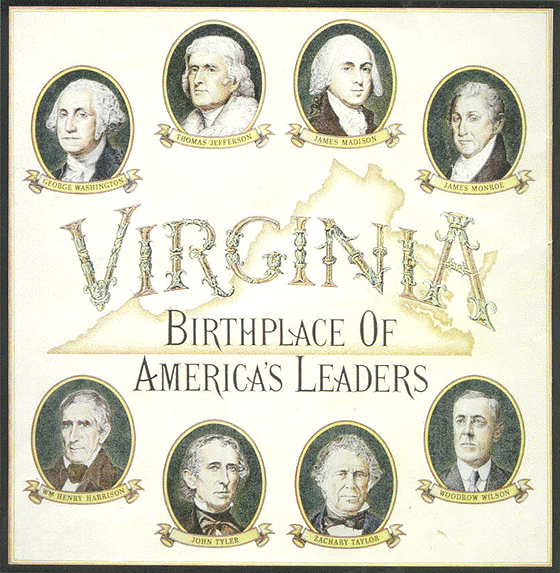
Virginia is, after all, where the English first staked their claim to a piece of the New World. Spain was busy down in South America, Mexico and Florida, Portugal had claimed Brazil, France was working its way down the St Lawrence and up the Mississippi. That left the eastern seaboard of what is now the USA to the English. It was here that Sir Walter Raleigh first ate potato and smoked tobacco (thank heavens he didn't get them the wrong way round!). The James Town settlement was founded here, plantation culture took off here, and many of the leaders of the early United States hailed from Virginia - George Washington, Thomas Jefferson, James Madison and James Monroe. In all, from 1789 to 1825 there were only four years when the presidency was not held by a Virginian plantation owner. No wonder the new capital of Washington D.C. was founded so close by.
 
 
Those plantations required workers, however: slaves. The uncomfortable truth is that Monroe, Madison, Washington and Jefferson (he who wrote that "We hold these truths to be self-evident, that all men are created equal...") were all slave-owners. Other Virginia-born presidents such as William Henry Harrison (1840-41), John Tyler (1841-45) and Zachary Taylor (1849-50) were all from slave-owning families - Taylor was the last president to personally own slaves during his term in office. The persistence of slavery meant that during the Civil War Virginia found itself allying to the Confederacy. The Confederate capital was Richmond in Virginia. It also meant that Virginia was right on the front line. Savage battles were fought across its territory and the western hill country - what is now West Virginia - seceded.
 
Is it fair to say that since the Civil War Virginia has lost some of its elan? It is still a big and well-populated state. It is still home to the Pentagon in Arlington and the CIA in Langley. The Navy is concentrated around Norfolk and the Marine Corps is based in Quantico (as is the FBI Academy). It also provides homes for many of the people who serve or work in DC. Yet these days the nation's eyes turn to New York, California, Texas, Illinois, even Ohio before they turn to Virginia.
 
Which is a shame. I saw a bit of Virginia when I visited DC in 2010. On one day we toured out to see George Washington's estate at Mount Vernon. On another we hired a car and headed south-west to Charlottesville. Here, at Monticello, the estate of Thomas Jefferson, I was able to look out east from its ridge-top position. Rather than a dull land of suburbs and fields I could see a sea of trees rolling away to the horizon. Such a view, I thought, must have been enjoyed by Jefferson two hundred years before me... or the first English settlers two hundred years before that. Despite all the turmoil of the last four centuries I was happy to feel that in places Virginia still felt rather timeless.
 
So that's a whole lot of history to cram into just three films but I'll try my best. The films I have chosen are:
  • Pocahontas (1995)
  • The Howards of Virginia (1940)
  • Remember the Titans (2000)