Showing posts with label Utah. Show all posts

Wednesday, 7 November 2012

Broken Arrow (1996)


Dir. John Woo
Starring: John Travolta, Christian Slater, Samantha Mathis, Delroy Lindo 

I remember, back in 1996, some people telling me that they had attended a premiere for the film Broken Arrow. They stated that the highlight of the evening was that Chris Barrie from Red Dwarf and The Brittas Empire was present. The film they really did not rate. I therefore had understandably low expectations when I placed Broken Arrow on my list of films set in Utah.

And, y’know, it was passable if not particularly great. It belongs to that mid-90s school of action movies which so inspired Michael Bay – spend the budget on special effects and explosions and hope the rest of the film looks after itself. Examples from our cinematic odyssey so far would include Twister and Hard Rain (in fact Broken Arrow and Hard Rain share the same writer – Graham Yost – and one of the stars – Christian Slater). And there are plenty of things that explode in this film, including (but not limited to) a stealth bomber, four helicopters, and a train. Oh yeah – and half of Utah when a nuclear warhead detonates. That’s how extreme the movie is. In any other film the hero would be racing to stop a nuclear warhead going off; in Broken Arrow one goes off and the hero has to race to stop a second going the same way.

Slater stars as USAF pilot Captain Riley Hale. Alongside Major Vic Deakins (John Travolta) he flies the B3 Stealth Bomber. Sent off on a training exercise over Utah he is suddenly attacked by his commanding officer: Deakins intends to steal the warheads and hold the U.S. for ransom. There then follows a game of cat and mouse as Deak’s mercenaries try to make off with the missiles and Hale – helped by park ranger Terry (Samantha Mathis) – attempt to stop them.

As I say, there are plenty of things blowing up all over the shop (particularly helicopters; if you’ve ever had a deep-seated hatred of helicopters this is the film for you). There are firefights in canyons, in trucks, in mine passages and on trains. There are expendable heavies to get walloped (even if some of them do get snarled henchman lines: “You probably thought I was a computer nerd, didn’t you? Wrong! I was a Navy SEAL lady!” or “This is where you get off…”). Shit explodes. And slap bang in the middle we have Travolta hamming his way up a sliding scale of madness. We know he’s a bad guy – he smokes! – for heavens sake, but he really ratchets through the gears here. When we get to the part – which you can see coming well in advance – when someone exclaims “You’re out of your mind!” Deak’s only response is “Yeah – ain’t it cool?” Slater, as in Hard Rain, does a competent job. Mathis runs around handily. 
 
He had warned her to take more care while shaving
 
It’s just not particularly well written. People seem to produce guns from nowhere. The characters are never fleshed out. Two major characters – Delroy Lindo’s Colonel Wilkins and Frank Whaley’s adviser Giles – just sort of vanish from the plot. There is a line about “endangered dirt” which I immediately registered as being a Very Important Plot Point – why else would it be in there? But then nothing is ever mentioned of it again. And there is a persistent aura of misogyny. Terry calls Hale “Captain”; he calls her “lady”. Even when she jumps a goon by surprise the goon is able to turn the tables, requiring Hale to rescue her. Sure, she’s brave and she has a good verbal spar with Deakins, but she is still background to the big hard male hero.

Broken Arrow has a couple of good lines (Hale on their training mission: “When the day comes that we have to go to war against Utah we’re really gonna kick ass.” Later, after improvising an explosive petrol can Terry asks “Where die you learn that? The air force?” He replies “New Jersey.”). There were two moments when I actually felt the adrenaline pump that comes from a good action movie. But two moments in an entire film isn’t really good enough. If you are going to sacrifice writing for action at least make it good action. Make it real edge-of-your seat dizzying furious action which leaves you thinking that the characters (whom you should, ideally, care about) could lose. That just doesn’t happen here – despite all the beeping, flashing count-downs that pepper the film. It is a waste of director John Woo’s talents. Broken Arrow is watchable; but you wouldn’t particularly want to watch it twice. It doesn’t even have Chris Barrie in it…

What have I learnt about Utah?
In Broken Arrow we see the same parched landscape and the same red rock canyons as in 127 Hours. The land featured is national park – hence the presence of a feisty park ranger. Who knew park rangers were armed? Rangers have to know the land. Even outside the park – one assumes that if there was copper mining going on until fairly recently that would not be on National Park land. 

Can we go there?
Broken Arrow was set in, over and under Utah (with side trips to Missouri, Colorado and Washington, D.C.). Utah locations include it’s own ‘Little Hollywood’, Kanab, Glen Canyon National Recreation Area and Lake Powell. I think the action was actually meant to be set in Canyonlands as reference is being made to "suspicious trucks" entering via the Needles gate.

Filming took place outside Utah too. The scenes on the train were shot on the Central Montana Railroad near Lewiston, right in the middle of the state. From the photos it looks as though the tunnel is located between Danvers and Denton. The trestle bridge seen in the film (the one, I think, from which Howie Long’s Kelly falls) runs over the Judith River, but was badly damaged by floods last year). 

Overall Rating: 2/5

Tuesday, 6 November 2012

127 Hours (2010)


Dir. Danny Boyle
Starring: James Franco, Amber Tamblyn, Kate Mara, Clémence Poésy 

In 2003 Aron Ralston travelled off canyoneering in the cracked and fissured terrain of Utah’s Canyonlands National Park. He went alone and he told no one where he was going. This meant that when he lost his footing and ended up with his arm pinned by a fallen boulder at the bottom of an isolated slot canyon no one knew where he was. He was lost, trapped and without a hope of a rescue. Danny Boyle’s 127 Hours is the story of his ordeal.  

This is a tale of survival in the most extreme circumstances. Unlike Christopher McCandless in Into the Wild Aron (here played by James Franco, previously seen – uncredited – in Nights in Rodanthe) likes the great outdoors but he does not fetishise it. He fetishises himself. He is an adrenaline junkie outdoors nut. He sees himself as a “big fucking hard hero” able to deal with any problem himself. And as a result he pushes away those close to him. He is a solitary superman through his own choices and inclinations. But when his choices and actions leave him trapped he has to reassess the decisions he has made in his life. In No Country for Old Men Chigurh rationalises his killing of passers-by: every choice, decision, action has led to the intersection at the same time of that person, himself, and the coin he will toss to decide whether they live or die. Likewise Aron is forced to confront the reality that every choice or decision he has made, every action he has taken has led to his present predicament. “I chose this. I chose all this. This rock… this rock has been waiting for me my entire life; it’ entire life, ever since it was a meteorite a million, billion years ago. In space. It’s been waiting to come here. Right, right here. I’ve been moving towards it my entire life. The minute I was born, every breath that I’ve taken, every action has been leading me to this crack on the outer surface.” If he had not pushed his girlfriend (Clémence Poésy) away she would have been with him. If he had answered his mother’s phonecall that morning he could have told her where he was going. If he hadn’t parted company with the two hikers he had met (Amber Tamblyn and Kate Mara) they could have helped. If he hadn’t left his Gatorade in the truck, if he had pickd up his Swiss Army penknife… Reflecting on his life he recognises that he has found himself in his present situation simply because of his “supreme selfishness”. 

He may be selfish but he is ingenious. Considering that Aron is stuck by himself at the bottom of the canyon for 127 hours he has a lot of time to fill. His engineering training comes in useful. Up to a point. He can fashion himself a harness to support his weight. He can use a stick as a hook when he drops his Leatherman. He can work out what he would need to support a pully system to pull the boulder off his arm. He also tries to chisel away at the edges of the boulder with his blunt Leatherman in the hope of being able to dislodge it. Unfortunately gravity means that the boulder only settles more firmly onto his trapped right hand. In the end he is out of water, out of food, out of battery and out if time. He has to do a very grave piece of root cause analysis. What traps him where he is? A boulder on his arm. Can he free his arm from underneath the boulder? No. In that case, can he free himself from his trapped arm? Using the can-opener tool of his Leatherman to hack through his own flesh the answer is: possibly. Recognising that the hand and forearm is going to be lost anyway he chooses to try and save the remainder of his body rather than face certain death. It takes a lot of guts to make such a decision. Seeing the resultant action as he forces his bone to break and then saws through muscle, nerve and tendon to separate himself from his pinioned flesh is genuinely gruesome. 127 Hours is far more sickening than anything that can be seen in ‘video nasties’ like A Nightmare on Elm Street, The Evil Dead or The Texas Chain Saw Massacre. The violence and gore is a result not of evil or madness but of cold, calm rational deliberation. The only other scene in a film I can think of that made me squirm quite so much was in A Clockwork Orange (the scene where Alex’s eyes are clamped open and water is dripped into them). 

It may be horrifying but director Danny Boyle (of Trainspotting, Slumdog Millionaire and 2012 Olympics opening ceremony fame) clearly has fun playing around with the medium. He utilises a variety of styles to capture scenes. Aron relates his impressions into a Sony Palmcorder. Early on some of Aron’s action exploits are captured in a grainier lower resolution mode. He uses splitscreens more extensively than an episode of 24. The first time he sucks on his Camelbak the camera gives a view of the water rushing up the tube. Playfulness I thought. Of course, the drinking of water and the lack of it becomes increasingly important later on… My favourite shot though is Aron shouting for help. The camera is pointing directly down towards him. And then, like zooming out on Google Earth the camera goes up, up, up, the scene expands. He is a man, at the bottom of a fissure, off another canyon, in a rocky plateau, in the middle of miles and miles of empty wilderness. This one shot clearly shows quite how isolated and alone and without a chance of rescue Aron is. 
 
He had written to the council three times,
yet still nothing had been done about the pot holes
 
I liked 127 Hours. It is like a modern-day A Christmas Carol: presentiments of mortality make a selfish individual reflect back upon his life and vow to be a better person. But with better scenery.  

What have I learnt about Utah?
If you were not aware that Utah was an outdoor adventure sports mecca you would be after watching this film. The attraction of the baked brick-red landscape is palpable. The area of Canyonlands is one great rock plateau with gorges and slot canyons carved out of the sandstone by the action of water over millennia. In Canyonlands you can hike, climb, canyoneer and even swim. You can cycle too, though as the end credits point out only certain trails are cyclable, and neither Aron Ralston nor James Franco cycled away from the permitted routes. 

While the general climate is one of dry heat the area does get rain. Storms even. With no topsoil to soak it up rainwater runs straight off the rock into gullys and canyons in flash floods. Being trapped in one of these canyons as it rapidly fills with water is hence not a very good idea. This scene in the movie turns out just to be a hallucination by Aron, however. 

The area really is wilderness. You can trek for hours without meting anyone and mobile phones cannot get reception (or they couldn’t back in 2003 anyway). This underlines the importance of notifying people of your planned routes and timings. It is no surprise that Butch Cassidy and his gang were able to successfully hide away in the maze of canyons, as Aron relates.

We don’t see much of the wildlife of Utah: a raven, a lizard and some ants and that is it. 

Can we go there?
Well, okay. But don’t travel alone, ensure that you have a full survival kit and notify someone where you intend to be and when you intend to be back. 

Those caveats aside I can understand your desire to visit the area. The action takes place in Canyonlands National Park and it looks stunning. Aron leaves his truck at the Horseshoe Canyon trailhead (the Horseshoe Canyon section is a ‘detached unit’ several miles to the west of the rest of the Park). He leads Kristi and Megan through the Robbers Roost area. He gets trapped in Blue John Canyon, about 40 miles away from the nearest paved road. The boulder that trapped his arm can still be seen in situ (though it was shifted to retrieve his arm). Blue John was not used for the filming however; a more accessible – and supposedly better looking – alternative, Leprechaun Canyon was used instead. When he escapes he leaves via Horseshoe Canyon; the canyon’s prehistoric rock art (known as ‘the Great Gallery’) is seen. 

The pool used by Aron, Kristi and Megan early in the film was a fictitious addition. It was shot at the Crater at Homestead Resort, Midway, not far south-east of Salt Lake City. 

Overall Rating: 4/5

Sunday, 4 November 2012

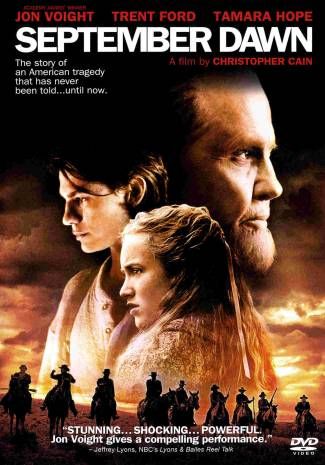
September Dawn (2007)


Dir. Christopher Cain
Starring: Jon Voight, Trent Ford, Tamara Hope, Jon Gries 

It was Joseph Stalin who alledgedly said “One death is a tradgedy; one million deaths is a statistic.” It is hard for people to get their heads around great historical events – the stories have to be humanised. This is the case increasingly in history writing: just this year I have read Anthony Beevor’s D-Day and Stephen Ambrose’s Citizen Soldiers, both of which drew upon the personal testimony of first-hand witnesses. It is even truer in movie-making. How are we expected to understand the drama of the sinking of the Titanic without the relationship between Jack and Rose? How are we expected to understand the horrors of the Great War except through the eyes of a horse? Or, at any rate, those are the questions asked by film company executives. Cinema is sent down the Les Miserables school of history. September Dawn uses an entirely-fictitious love story to bulk out the tale of an all-but-forgotten tragedy: the Mountain Meadows Massacre of 1857. 

A convoy of covered wagons wends its way through Utah en route from Arkansas to California. It is a well equipped and funded party. In the south of the territory they appeal to the locals to let them rest up for a fortnight and reprovision. It is only the intervention of the local Bishop / General Jacob Samuelson (Jon Voight, a hell of a lot older than in Deliverance) that allows them to do so. But Samuelson is the leader of the local Mormons and they don’t like these “immigrants”. The prospect of the party’s horses being used for sinful gambling appals them, as does the sight of a woman wearing trousers and wielding guns as if she was a man. There are rumours that the party includes members from Missouri who killed the Mormon prophet Joseph Smith (Dean Cain) and forced the Mormons off their land. And troops from the U.S. Army are heading towards Utah; the fear is that the United States government intends to crush the Church of Latter Day Saints. And so the decision is made to destroy this potential fifth column in their lands. The party is attacked by Paiute Indians and local Mormons dressed as Indians. When the party resists they are besieged. Eventually the Mormons intercede under a flag of truce. As the survivors are led away to what they believe will be safety their ‘rescuers’ turn upon them and slaughter them. 

Against this background is played out a classic story of forbidden love. Bishop Samuelson’s son Jonathan (Trent Ford) and pastor’s daughter Emily (Tamara Hope) fall in love and pledge to marry each other. Theirs are two radically different worlds colliding – “a world of love and a world of hate” as it is expressed at the start of the film. To be together Jonathan will have to rebel against the rule and the teachings of his father and the Mormon faith. 

For in Mormonism, as it is shown here, rule and teaching go hand in hand. Under the governance of Brigham Young (Terrence Stamp) the Utah Territory is to all extent and purposes a theocracy. Being Governor of the Territory goes hand in glove with being President of the Church of Latter Day Saints. Dissent is not tolerated because Young and his ‘Apostles’ are guided directly by God. To go against their decrees is to rebel against God. This is a sin. And in the Mormon faith the only way to expiate sin is “blood atonement”. Whereas Christians believe sins can be atoned for by repenting before God and receiving His grace Mormons believe that sins can only be atoned for by blood and death. Repenting does not matter. Death is atonement. It is a kindness to kill a sinner.

To be honest, it’s a hatchet job. I have no idea if the events of the Mountain Meadows Massacre are as depicted here, nor if the theological arguments put into the mouths of the Mormon characters are those expressed at the time, but the Mormons do not come out of this film well. Their double-dealing and polygamy (Bishop Samuelson has 18 wives and Brigham Young 27, though it is stated that ideally men should only have three) are the least of their negative traits. They may well have felt persecuted and affronted but the fact of the matter is that a Mormon militia, believing that they were doing good, massacred over a hundred innocent travellers; only seventeen children survived. I always get a bit nervous when I see a film allegedly depicting historical events and I cannot see what bias the film is pushing. Here the contrast is made quite clear. Two scenes are spliced into one another at one point. In one the wagon train’s pastor prays for God to bless the locals who have granted them succour; in the other Bishp Samuelson thanks the Lord for delivering the “Gentiles” into their hands and prays for them to be damned to hell. The date of the final massacre is made quite plain: ‘September 11 1857’. Parallels are being drawn between two massacres of innocent Americans in the name of religious fundamentalism that occurred 144 years apart. The Mormons, in this film, are an enemy of the United States; the implication is that they remain an enemy within. 

Whilst taking note of the above, I have to say that the film is not terrible. Historical revisionism can be entertaining as long as the audience goes in with its eyes open: I, for instance, enjoyed U-571. September Dawn is certainly not a great film, but it is competently written and directed, the storyline is clear, as are the contrasts between the two camps. The young actors are engaging and a touch of gravitas is provided by the performances of Terence Stamp and Jon Voight, two holy men that you certainly wouldn’t want to get on the wrong side of… 
 
"What do you mean this won't count for Movember?"
 
What have I learnt about Utah?
The Utah depicted in the film is the Utah Territory rather than the State of Utah. As shown it is a stop on the Old Spanish Trail between the Midwest and the boomtowns of Goldrush-era California. Its borders already seem to be fairly well set, and its population is comprised of two groups. 

The first group is that of the Mormons. Firm followers of the Church of the Latter Day Saints and its President, Brigham Young, they are paranoid, polygamous, hierarchical, cowed and blood-thirsty zealots. Young combines the role of Church President, Territory Governor and representative to the Indians, combining both spiritual and temporal power.

The second group are the Paiute Indians who live in the woods. They have a relationship with the Mormons who seem to treat them with respect rather than trying to eliminate them. From one comment made in the film it is possible that the Paiutes had converted to Mormonism too.  

Can we go there?
Mountain Meadows is located in present-day Washington County in the south-west of Utah. At the site can be found two memorials, one a replica of the 19th century cairn originally constructed by the U.S. Army over the largest gravesite (and now maintained by the Church of the Latter Day Saints) and the other located down in the meadows and maintained by the Utah State Division of Parks and Recreation. The entire site has been decreed a National Historic Landmark. The nearest town is that of Enterprise.

September Dawn was not filmed in the vicinity however. Shooting took place near Calgary in Alberta, Canada. Principle locations were the Augustina Farms and the CL Western Studio and Backlot. 

Overall Rating: 3/5

Week 45: Utah

"Took all the shopping carts from the mall
 And took them to Utah,
 Which was Zion;
 He built an empire out of the desert,
 Out of the dust and sand just like Las Vegas
 But he never took the route that the Mafia did..."
 - 'History of Utah',
 Camper van Beethoven

From the deserts of west Texas we're heading out to the deserts of Utah. With so much to see and do in the 45th state of the Union (and in the 45th week of my film challenge) I hope you brought a good pair of hiking boots.
 
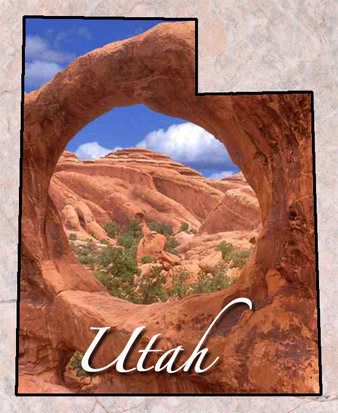
I've always thought of Utah as a hot desert state. It has borders with Arizona (south), Nevada (west), Idaho (north), Colorado (east) and Wyoming (north-east). My mental images of it are empty expanses of baking plains, red rock gorges and gullies and great dessicated salt lakes. But it must have some snow on its mountain tops because its capital, Salt Lake City, hosted the Winter Olympics in 2002 - the Olympics that was so famously rescued by Mitt Romney.
 
Ah yes. Mitt Romney. If Utah is famous for anything internationally it must be for the Mormons. Brigham Young brought the followers of the Book of Mormon out to Utah in the 1840s, just as the USA was seizing it from Mexico. Salt Lake City is still the world headquarters of the Church of Latter Day Saints. 63% of the state population are still adherents of the LDS church. General views of the Mormons, not least in American public discourse, are that Mormons are a little bit weird - rumours of polygamy have persistently dogged the church.
 
The church and the bulk of the population is centred in the north of the state. Given the choice it is the south that I would want to visit with its embarrasment of natural wonders. There are National Parks galore down here: Arches, Bryce Canyon,  Capitol Reef, Canyonlands, Zion. Throw in Grand Staircase-Escalante, Hovenweep and Natural Bridges national monuments and the famous Monument Valley and you would need more than a fortnight just to tick off the sights. That's the kind of roadtrip I dream of!
 
The three films I have slipped into my backpack for the journey are:
  • September Dawn (2007)
  • 127 Hours (2010)
  • Broken Arrow (1996)