Showing posts with label Pennsylvania. Show all posts

Friday, 28 September 2012

Witness (1985)


Dir. Peter Weir
Starring: Harrison Ford, Kelly McGillis, Josef Sommer, Lukas Haas 

Let’s get this out in the open: I love Harrison Ford. The man is far too cool for school. He just looks far too good as the rogue with the heart of gold. He really made his name playing those who skirt around the edges of the system but end up doing the right thing in the end: Han Solo in Star Wars, Indiana Jones in Raiders of the Lost Ark, Rick Deckard in Blade Runner. So it is interesting to see Witness where he plays a good guy who has to learn to act outside the system.

Ford is Philadelphia police detective John Book (I know: where do they come up with these names? It leaves me waiting for a follow up where he is partnered with Mike Bell and Alan Candle…). He is called to investigate the brutal murder of a fellow police officer in a train station rest room. There was a witness: an eight-year-old boy called Samuel (Lukas Haas) who identifies one of the killers as another cop. Book has to protect the boy and his recently widowed mother Rachel (Top Gun’s Kelly McGillis) when the killers come after them. 

There is an additional complication: Rachel and Samuel are Amish. They come from a rural community of devoutly religious folk who have turned their back on modernity. They plough the fields by hand, drive horse-drawn buggies, dress “plain” in severe black and white, and eschew telephones, violence and people outside their own community. Book has to hide out among these close-knit people until he can work out a way to take down the people who betrayed him.

It is a clash of two very different cultures. The Amish are traditional and clannish, keeping themselves separate from the “English” (their name for anyone who is not of their faith) and trying to avoid having to interact with mainstream American society at all. For them the worst possible fate is to be “shunned”: for the other members of the community to ignore them. Book, however, is the brash big-city cop. He carries a gun and goes around “whacking people. His boss, Schaeffer (Josef Sommer) says that the police department is like the Amish: it is a close community whose members all look out for one another. Their strength comes from their unity. Nowhere is the difference between the two sets of individuals more apparent than in their attitudes to violence. Book is aware of the necessity of violence: force has to be used to stop bad people doing bad things. The Amish put their trust in God. Murder is a sin, and no good can come out of committing a sin. Samuel’s stern grandfather Eli (Jan Rube) explains to him that “the gun of the hand is for the taking of human life. We believe it is wrong to take a life. That is only for God. Many times wars have come and people have said to us: you must fight, you must kill, it is the only way to preserve the good. But Samuel, there’s never only one way… What you take into your hand you take into your heart.” And at the film’s climax when Book has to take on the corrupt cops it becomes apparent that pacificism can have its day. Just as Book is bested the massed Amish turn up. They do not fight. They look. They stand as witnesses. Killing Book would mean killing them all too. Realising this, the villain surrenders. Despite what Hollywood would lead you to believe, there are very few bad guys who can stomach the cold-blooded slaughter of two dozen unarmed people.
 
ZZ Top suited up for the wake
While this is going on Book and Rachel struggle against an increasing attraction. Theirs is a forbidden passion. Surrendering to it would mean one of two outcomes: “If we’d made love last night”, Book tells Rachel, “I’d have to stay. Or you’d have to leave.” It is an attraction that can never work – as is shown in the final scene when Book drives away, greeting Rachel’s admirer Daniel (Alexander Godunov) as he goes. The Amish are torn in their views of Book. He is an outsider and does not understand their ways – yet he is a good man. Daniel is jealous of his relationship with Rachel, yet it is clear that he admires his carpentry skills (real ones – Ford worked as a carpenter before his big break) and he leads the other Amish to his rescue in the end. John is willing to help out with the farm chores and participate in community tasks such as raising a barn. And while the Amish abhor violence Book is unwilling to just stand by and see his hosts bullied by street punks. “It is not our way” Eli protests. John’s answer is simple: “It’s my way.” When he leaves at the film’s end Eli tells him “You be careful out among the English”: the same warning he had given Rachel earlier. Book has been accepted into the community. 

Witness is a straightforward police thriller. It is never going to win any prizes for originality of idea. The inclusion of the reclusive Amish is, however, unique and serves to contrast two very different moral codes and ways of life. It is almost as though Book has become a Connecticut Yankee at King Arthur’s Court as he is transported back in time. The opening scene shows the Amish at work in the fields with their broad-brimmed hats, their bonnets and aprons, and their sunflower-burst beards. The initial thought is that this must be a scene from the early 1800s. And then the heading comes up on screen: ‘Pennsylvania, 1984’. The traditional lifestyle of these people is timeless. Several times Kelly McGillis’s Rachel stands framed in a room or a doorway, and she looks like nothing quite so much as a study by Vermeer (not Weir). The use of the Pennsylvania Dutch language and accents doesn’t hurt either (although most of the Amish conversation heard in the film is actually anachronistic High German spoken by non-Amish actors; as shown in the film, the Amish do not like their photographs being taken, and so the slightly more modern Mennonites with their fridges and their telephones rounded out the cast as extras). Within this structure the performances are good. Harrison Ford is Harrison Ford, so I knew I was in safe hands before the film even started. Lukas Haas was wonderfully unaffected as Samuel. I enjoyed the supporting perforrmances from all the villagers, but for me Kelly McGillis was the revelation. I only knew her as the token love interest in Top Gun; here she handles the nuances of a strange lifestyle well, and displays the conflict her character feels torn between two different worlds. The only low point, personally, was the awful Vangelis-lite synth soundtrack by Maurice Jarre (whose score won the BAFTA that year, beating Harold Faltermeyer’s Beverly Hills Cop!). Other than this Witness is a fine film to watch. 

What have I leant about Pennsylvania?
The Philadelphia depicted in this film is a long way from the tourist brochures. It is a dangerous big city with police corruption, drug gangs and sleazy bars on sleazy streets. But a contrast can be found out in the countryside. Not too far away, in Lancaster County, we find idyllic farms with neat white-painted wooden houses situated amongst fields of rippling wheat. Sturdy, traditional folks clip-clop down the country roads in horse-drawn buggies. These are the Amish, who have turned their back on the modern world. They choose to keep themselves to themselves – and, thankfully, it seems that the local authorities are happy to give them the space they desire. Tour guides are not so considerate however, and these private people are looked on as a tourist attraction, like animals in a zoo. Tourists are bused in to marvel at their “quaint” ways and intrusively take photographs. As well as the Amish there are also Mennonites, whose lifestyle is not quite so strict.
 

Can we go there?
There are two main settings for Witness: Philadelphia and rural Lancaster County some fifty miles further west.

In Philly the main setting is the echoing concourse of 30th Street Station. I caught a train from there in the summer of 2010, and I can attest that the great bronze statue that Samuel admires (the Pennsylvania Railroad World War II Memorial) is still in place. The restroom murder was actually shot on a set created for the occasion in the (now-demolished) Harrisburg Pike Posey Iron Works. The grain silo scene was also shot here. Other ‘Philadelphia’ scenes were actually filmed in Lancaster, including the police station and its underground garage (both Lancaster County Courthouse). 

In Lancaster County the film was shot in the areas inhabited by the Amish and the Mennonites. The train station that Rachel and Samuel depart from is that in Parkesburg. The feedstore, where the tourists come to gawp at the Amish, is the W. L. Zimmerman & Sons store in the town of Intercourse (giggle! It always makes me laugh that such devoutly religious folk live near a town which shares a name with the sexual act. But then again, Eli did laugh at Book’s joke about teats, so maybe the Amish aren’t as prudish as we imagine them to be). The Lapp farm was located in the vicinity of Strasburg on Bunker Hill Road. Bizarrely, it is now open to the public for tours. Sadly both the waterwheel and the barn they raise were constructed purely for the movie and were taken down again afterwards. 

Overall Rating: 3/5

Wednesday, 26 September 2012

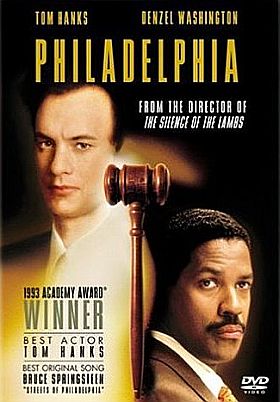
Philadelphia (1993)


Dir. Jonathan Demme
Starring: Tom Hanks, Denzel Washington, Jason Robards, Mary Steenburgen
 

It is reassuring to think that Philadelphia is a victim of its own success. It is less than twenty years old (although it seems more recent than that to someone who can remember it’s release) but the storyline struck me as dated. The attitudes and actions of the characters seemed almost incomprehensible to someone watching in 2012. The world depicted in 1993 seems dead and gone. And maybe it was the success of Philadelphia that helped effect that.

I am quite surprised that Tom Hanks has not cropped up on this cinematic odyssey earlier. Here he plays young hot-shot lawyer Andrew Beckett. Some critical legal paperwork goes missing from where he left it. He is sacked by the practice’s board as a consequence. 

Andrew, however, suspects that the story is not quite as clear-cut as that. Although he has not mentioned it at work, Andrew is gay. Furthermore, Andrew has started to exhibit the symptoms of AIDS. His belief is that the partners picked up on this and that this is the real reason he was fired. He intends to fight back by lodging an appeal for unfair dismissal. If he can find a lawyer to represent him.

Of course, no one will touch him with a bargepole. This is not just a metaphor. After he tries to hire his old adversary ambulance-chaser Joe Miller (Denzel Washington) Joe immediately rushes to see his personal doctor to ensure that his clothing has not somehow become contaminated. It is clear that not only does Joe know little of the syndrome but that he has a personal antipathy towards gays. However some time later Joe sees Andrew’s quiet dignity when a librarian tries to hide him away in a private reading room: “Sir, wouldn’t you be more comfortable in a study room?” “No. Would it make you more comfortable?” Maybe he remembers the discrimination African-Americans routinely experienced just some 25 years earlier. He takes the case. Joe’s task is then to prove that Andrew’s work was completely satisfactory, that the law firm knew or suspected that he had AIDS, and that this then influenced them to fire him.

I would never say that homophobia does not exist today. Of course it does. But it is a lot less socially acceptable than it was twenty years ago. Society has moved on. There has been a change in attitudes over the intervening period. Probably the best way I can express it was that in the UK in the 1990s the Conservative party still routinely decried homosexuality. When they came back into office after the 2010 election they had a prominent front-bench spokesman who was in a civil partnership with his male partner. The Labour governments of 1997-2010 get blamed for a lot but I think they should get the credit for overseeing such a widescale shift in attitudes (Tony Blair had three gay men in his Cabinet). I am not sure I even met an openly gay man until 1995; I certainly didn’t associate with any until I reached university. Now I regularly spend time with people who are in open, supportive, loving long-term homosexual relationships, both in my free time and at work. Hell, I’ve even marched in the Manchester Pride parade (in drag). The tale presented in Philadelphia centres upon a case of institutionalised homophobia of the sort that I would find hard to believe would exist today. A man was fired because he was gay. While there is a limited understanding of AIDS expressed by some of the characters, it is Andrew’s homosexuality that upsets his bosses. They come to suspect that he is gay because one of the partners notices a lesion on his forehead and recognises it because he once worked with a woman who likewise exhibited these symptoms of AIDS. However she contracted AIDS through a blood transfusion; it wasn’t her fault. Andrew contracted it – as the opposing council (Mary Steenburgen) is keen to point out to the jury – by engaging in risky, anonymous, unprotected sex in a gay pornographic cinema. It is Brass Eye’s characterisation of “good AIDS / bad AIDS” 

Whether the characters approve or not of Andrew’s lifestyle (and Joe, at first, certainly does not), the case comes down to a matter of law: was Andrew discriminated against? Disturbingly the argument that is put forward by Andrew and Joe is that he was not discriminated against because of his sexuality but because of his disability. AIDS is a disability. Discrimination due to disability obviously seems to be an easier case to argue than discrimination due to sexuality. And this is where the setting comes in. Philadelphia is exactly the right backdrop for so many reasons. The clever ‘Philadelphia Lawyer’ has become a stereotype, so where better to have a legal case? The city was the place where the Declaration of Independence was drafted and signed, so where better to have a story talking about the essential equality of man? And there is the name of the city itself, ‘Philadelphia’, from the Greek. It is usually translated as ‘The City of Brotherly Love’. This could relate to the support Andrew gets from his family, from his lover Miguel (Antonio Banderas), or from Joe, the former opponent who comes to respect his bravery. 

And the film argues its case passionately: “We’re standing here in Philadelphia, the city of brotherly love, the birthplace of freedom, where the Founding Fathers authored the Declaration of Independence, and I don’t recall that glorious document saying anything about ‘All straight men are created equal’. I believe it says ‘All men are created equal’.” “This is the essence of discrimination: formulating opinions about others not based on their individual merits, but rather on their membership in a group with assumed characteristics.” But legal arguments are all well and good. What needs to happen is for them to become the attitudes of society. When the judge (Charles Napier) comments that, in his courtroom, justice is blind to matters of race, creed, colour, religion and sexual orientation Joe has to make the obvious point: “With all due respct your Honour, we don’t live in this courtroom do we?”

The attitudes of the senior partners of Wyant, Wheeler, Hellerman, Tetlow & Brown nowadays seem positively antediluvian. Maybe not the private jokes in the sauna, sadly, but certainly the discrimination shown against a amember of their team. Likewise the picketers protesting outside the trial are now reduced to a minority of extremists. Yet I cannot pass without commenting that, to a certain extent, I thought the depiction of gay characters verged a little on the clichéd. Andrew and Miguel seem to have a very desexualised relationship (perhaps understandably given the circumstances). Andrew used to frequent a gay pornographic cinema where he had sex with a stranger with a Village People moustache. Andrew is moved to tears by opera (a very elite interest as I commented when writing about The Untouchables). When he throws a party it is a fabulous fancy dress affair, with men in drag, a barbershop quintet, a live band and Quentin Crisp on the guestlist. All gays are, of course, incredibly cultured and talented and extroverted. Personally I think we will really have arrived over the rainbow when we see Hollywood depict a gay character as ignorant, slobby and unpleasant. Considering that Joe is introduced as a bigoted black man here, I hope that we are well on that road.

When the Motorcycle Cop was the only member of the Village People
to attend the Pride march questions had to be answered...
 
This should not take away from the quality of the story, the writing or the performances. Denzel Washington is great as the macho showman who confronts his own prejudices. But the film – and the Oscar – is most deservedly Tom Hanks’. He may have found fame with flicks like Big and Splash but it is in Philadelphia that he finally revealed what he could do.  There is an absolutely heart-wrenching moment when Joe first turns his case away. Andrew walks out of the office and stands on the step. Up until this point he had always come across as very self-assured – cocky even. But now fear, desperation and loneliness wash across his face, all held in close-up. It was brave of Hanks and director Jonathan Demme to go for that shot. If it hadn’t have been pulled off right it would have been excruciating. But it was and in that moment everyone in the audience empathises with how Andrew must feel. It is a perfect moment and encapsulates, for me, the quality of the performances on display here. 

 
What have I leant about Pennsylvania?
Having been to Philadelphia previously it was exciting to see, during the opening montage, a selection of images of places I remember: Independence Hall, the Liberty Bell, the statue of William Penn atop City Hall, the Delaware River waterfront, the Reading Terminal Market. However these were interspersed with other shots: condemned builders, panhandlers, the homeless lying in the streets. The message: Philadelphia is not just the glossy tourist attractions. It has the same problems any big city would have with crime and deprivation. It is a salutary reminder. 

Philadelphia continues its association with lawyers. The fictional Wyant, Wheeler, Hellerman, Tetlow & Brown is the city’s biggest law firm. It recruits the best and the brightest from the law school at Penn State University. It maintains a private box for the directors at the local basketball stadium. It is eminently respected. The implication is that Philadelphia is a good place for law to be practiced. 

Can we go there?
Much like Manhattan, Philadelphia opens with a montage of the city's famous sites. But whereas Woody Allen shot his vision of New York in arty black and white and set it to the music of George Gershwin here Jonathan Demme juxtaposes images of Independence Hall and the Liberty Bell with those of decaying houing projects and homeless beggars, all set to Bruce Springsteen’s ‘The Streets of Philadelphia’. He does not aim to show off the city; he aims to show the disease beneath the skin.

This means that the film was, accurately, shot on location in Philly. The Mellon Bank Building on Market Street was used to depict the Wheeler Building; the offices of a real law firm (Mesirov, Gelman, Jaffe, Cramer & Jamieson) were used for the fictional Wyant, Wheeler, Hellerman, Tetlow & Brown. Across the street is the Pickwick Pharmacy, where Joe is asked out on a date by a gay law student. Joe’s office was much lower profile, and was located on the first floor of 1901 Chestnut Street. The office is now a bar called NoChe. 

Andrew and Miguel’s trendy loft apartment was located on 10th Street at Bainbridge Street. Andrew’s hometown, where the rest of his family still live, was Lower Merion in Montgomery County, just north of the city. (I find it weird that someone can grow up, go to a top university and then find a very well paying job, all without travelling any more than twenty miles. Thank heavens for Miguel bringing a little bit of diversity into Andrew’s life!) 

The library scene was shot in the Univeristy of Pennsylvania’s Fisher Library. It is actually a fine arts library rather than a law library, however. The courtroom used was a genuine courtroom however. It was Courtroom 243 in Philadelphia’s City Hall  (the white and green building with the tall spire topped by the statue of William Penn). It is the largest municipal building in the United States. There are guided tours at 12:30 Monday-Friday. The observation deck is also open on weekdays.

Overall Rating: 4/5

Monday, 24 September 2012

The Deer Hunter (1978)


Dir. Michael Cimino
Starring: Robert De Niro, John Cazale, John Savage, Christopher Walken

The success of Michael Cimino’s first directorial feature, Thunderbolt and Lightfoot, gave him licence to make more ambitious cinematic offerings. His follow up was The Deer Hunter. Whereas Thunderbolt and Lightfoot was an ADHD-fast romp of car chases, guns and explosions with a buddy-buddy turn from Clint Eastwood and Jeff Daniels, The Deer Hunter  was something very different. Spread languorously over three hours it purports to be nothing less than a modern-day American tragedy in four acts. 

Act one. We meet a group of six friends in an industrial steel-milling town. They have several things to celebrate. Steve (John Savage) is getting married in the morning. And then he, Nick (Christopher Walken) and Mike (Robert De Niro) are off to join the Airborne in Vietnam. Keen hunters, they are looking forward to the thrill of serving their country. In between wedding and shipping out they find the time for one last deer hunting trip into the mountains.

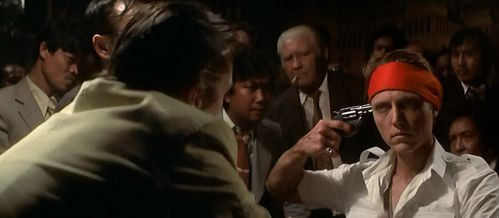
Act two. Contrasting with the glacially-slow pace of the first act, we suddenly find ourselves thrown into bloody conflict in Vietnam. Women and children are massacred, Vietnamese troops burn to death, and Mike, Nick and Steve are captured by the Viet Cong. Held prisoner, they are forced to play a barbarous game of Russian roulette for the entertainment of their guards. Led by Mike they escape, but Nick vanishes dazed off into the shady twilight world of Saigon. 

Act three. Mike returns home. He cannot fit in to his hometown any more. He cannot even bring himself to shoot a deer. He finds out what happened to Steve, and he learns that Nick is still out in Vietnam. 

Act four. With the fall of Saigon imminent, everyone is trying desperate;y to get out of the city. Into this maelstrom comes Mike, looking to make good the promise he made to Nick that he would not leave him over there. He travels deep into Saigon’s sordid underbelly and finally finds his friend, changed beyond recognition.  

For a film of four acts it is very much a story of two halves. The hometown scenes crawl along in washed out wintry greys. The scenes in Vietnam are fast and tumultuous, full of greenery and dark corners. It takes 50 minutes before the wedding is even over and they go hunting. Sure, the opening scenes set up the characters and there is something to be admired about direction that has the balls to take its time over these things, but it smacked to me of directorial preciousness. This part of the film could have been trimmed down, massively. 20-30 minutes could have been cut without any problems at all. In Vietnam the scenes are all action-action-action: explosions, a firefight, Russian roulette, the escape, the helicopter rescue, the backstreets of Saigon. Arresting image follows arresting image. And then we are once more back in America and the pace slows once more. Mike is not a talker. In many ways he seems quite uncommunicative. Apart from his five buddies he certainly seems to have trouble relating to women: Stan (John Cazavale) talks about how he keeps setting Mike up with women only to see him strike out. There is an attraction between Mike and Nick’s girlfriend Linda (Meryl Streep), but the attributes that make Mike Mike (an iron will, a love of guns, manly camaraderie, a direct approach to matters) are the ones that serve him well in Vietnam. It is no wonder that he gets drawn back to the madness of the dying days of the war in his quest to find Nick. 

In many ways I found it quite hard to understand Mike. Nick is much easier to understand. There is probably a reason why Christopher Walken’s Oscar-winning turn has become the performance most often associated with The Deer Hunter. I didn’t even know De Niro was in it until I started watching the film. But the transformation of Nick from the happy young man dancing at his pal’s wedding to the haunted spectre seen drifting obliviously through the gambling circles of the Vietnamese underworld is a startling one. His is a mental disintegration under the stresses and strains of combat. Steve has a physical disintegration. When Mike finds him again his wrecked body is likewise shocking.  

The Deer Hunter shows the effects on the Vietnamese War on America. We see the injured soldiers in the hospitals in Saigon and back home, hidden from sight. We see the bodies lined up to be shipped home. We see the barbarity of conflict. Yet it is harder to see the mental scars. Iron-willed Mike cannot shoot a deer. Nick slips into a world where he gambles nightly with his life for the buzz of being right on the edge. He puts all his trust and faith in luck, on the vaguaries of the spin of a chamber. He has no life or free will of his own anymore. Mike has to remind him who he is. It is almost as though those who come to Vietnam are drugged by it. It is an opiate. It is the symbol for the war itself. The one moment of free will Mike, Nick and Steve had was enlisting; after that their survival is purely down to luck. It is a metaphor of involvement in the war. The final somber rendition of ‘God Bless America’ is pure irony.  
 
Things turned grim once they exhausted the Revels
 
But it also shows the effects of the American war on Vietnam. Saigon is shocking, a crowded, gaudy, neon mess. Pedestrians and traffic choke streets where G.I.s brawl and young women sell themselves for cash. In the backstreets even more unsavoury things go on. Yet this is not a revisionist piece. This is not showing the Americans as alien intruders in a cultured land – 1978 was far too early for that. The North Vietnamese are the bad guys. They are clichéd sadistic orientals. The first North Vietnamese soldier we see massacres women and children. The captors torture their prisoners and cruelly force them to play Russian roulette for their entertainment and gambling pleasure. This has nothing to do with winning a war: it is pure barbarity. Notably, when the film was shown at the Berlin Film Festival in 1979 the Soviet, Cuban, East German, Bulgarian, Polish and Czechoslovakian delegates walked out in ‘solidarity’ with the “heroic people of Vietnam”.  

I do not know what the over-arching theme of The Deer Hunter is. The contrast between the dull small concerns of hometowns and the hyperactive threat and danger of Vietnam perhaps. The enigma that is Mike is at the heart of this. It is certainly packed full of memorable images and packs a punch. But it is far too long. There is no need for it to be a three hour epic. Cimino could and should have trimmed 45 minutes from the running time. The Academy disagreed with me: The Deer Hunter won the Oscars for Best Film, Best Director and Best Editing alongside Walken’s Best Supporting Actor gong. However, the inflation of ambition, budget and run-time between Thunderbolt and Lightfoot and The Deer Hunter is immediately apparent. The shoot went over budget and over schedule. The producers should have noted it before they allowed him loose on his third movie, the ill-starred Heaven’s Gate 

What have I learnt about Pennsylvania?
Pennsylvania is not just historic buildings. It also has tough blue-collar industrial towns. Clairton, the town featured in The Deer Hunter, is based around a steelworks. The work seems dangerous, with tankers barrelling around corners, fire and molten metal everywhere. The rest of the town seems designed to service this one industry. Streets are lined with neon advertisement for bars where men bond over pool and booze. The beers are big and are accompanied by a spirits chaser. Drinking seems to be a major pastime. This might be due to the ancestral heritage of the inhabitants. A large proportion of the town seem to be of Russian descent – inlciding Michael Vronsky, Nikanor Chevetorovich and Steven Pushkov. They attend Russian Orthodox church services, they can sing in Russian and they known Russian folk dances. 

But outside the towns the landscape is stunning. I knew that Pennsylvania had hills, but I did not know that it had sky-scraping mountains like those shown in the film. The peaks pierce the clouds. Glaciers of ice slide down the valleys. The mountains are heavily forested and are home to wild deer. Hunting is permitted, but seems to be licensed (based on the pieces of paper bearing numbers that the hunters all have on their backs). 

Can we go there?
Things are not quite as they seem in The Deer Hunter. When I said that I didn’t know that Pennsylvania had mountains like those depicted in the film I was more right then I knew. Those scenes were not shot in Pennsylvania: they were shot in North Cascades National Park in Washington. The spot on the road where the guys drive off while John (George Dzundza) is peeing is along State Road 20, just east of the Colonial Creek campground. When Mike lets the stag go free in the third act he sits on the bank of Nooksack Falls to listen to his echo. 

In fact none of the scenes in the movie were filmed where they purported to be. The scenes in Vietnam were shot in Thailand, largely along the infamous River Kwai. The backstreets of Bangkok’s Patpong district doubled for those of Saigon. The Mississippi Queen Bar was a real bar; I believe it is now known as Goldfingers. The U.S. Military Hospital was actually Bangkok’s Rajini School. And while Clairton (“City of Prayer”) really does exist, being located south of Pittsburgh, the film was not shot there. It was largely shot in Ohio - ironically enough considering that only one of my three Ohio films was made in that state, with A Nightmare on Elm Street being filmed in California and Super 8 being shot in Weirton, a similar industrial town in West Virginia (in fact the trailer occupied by Mike, Nick and Linda was shot in Weirton). Welsh’s Lounge was constructed specifically for the film in an empty storefront in Mingo Junction, Ohio, less than ten miles south of Super 8’s Weirton. After filming was completed it was then taken over and run as a genuine steelworkers’ bar (Mingo Bar). It has now closed down. The scenes inside the steel plant were shot inside the U.S. Steel Central Furnaces complex in Cleveland. Starkweather Avenue in Cleveland’s Tremont neighbourhood was also the real location of the St. Theodosius Russian Orthodox Cathedral, where Steve and Angela are married. The Eagle Supermarket, where Linda worked, was further down the same street. The reception party was filmed nearby in the http://clevelandhistorical.org/items/show/325 Lemko Hall. The Louis Stokes’ Veteran’s Administration Medical Center was also in Cleveland. The Bowladrome Lanes in Struthers, Ohio, was used for the visit to the bowling alley. 

One of the few Pennsylvania locations used was the cemetery at the end. This was filmed in Duquesne, Pa.  

Overall Rating: 3/5

Sunday, 23 September 2012

Week 39: Pennsylvania

"It started in Scranton, it's now Number 1;
 It's bound to entertain ya,
 Everybody has a mania
 To do the polka from Pennsylvania..."
 - 'The Pennsylvania Polka',
 The Andrews Sisters

Ah, Pennsylvania, sweet mother of liberty, the Keystone State. As a British colony it was founded by the Quaker William Penn as a haven of religious freedom. It then, along with Massachusetts, played one of the largest roles in the fight for American liberty. But whereas the Boston mobs were firebrands and demagogues, Pennsylvania produced individuals like all-round clever-dick Benjamin Franklin. The Continental Conventions held in Philadelphia were high-minded affairs that produced first the Declaration of Independence, and later the Constitution of the United States.
 
I have been to Philadelphia. Very nice it is too! It makes great play of its central role in the march towards independence. Despite being a big city I felt that it was a cultured, nice, approachable, friendly city. I regretted having only booked two nights in the city en route between New York and Washington D.C. I would happily go back. It has the historic Independence Hall (a UNESCO World Heritage Site!). It has the first home of Congress. And it has the legendary Liberty Bell (which is just a bell with a crack in it if you want to know).
 
Philadelphia has this fame for high-minded ideals and intelligence (a fame not entirely borne out by the stereotype of the slippery 'Philadelphia Lawyer'). But there is more to the state than just Philly and its famous cheesesteaks. Second city Pittsburgh has a reputation as a tough, brawling, blue-collar industrial city. It does have its own claims to artistic merit however: Andy Warhol hailed from Pittsburgh. The Allegheny Mountains part the two. Elsewhere the state sprawls from the Delaware River in the south-east to the shores of Lake Erie in the north-west. In between there are the famous 'Pennsylvania Dutch', known more commonly as the Amish. These strict Christians shun modern technology in their quest to live a simple existence. Until the reality TV shows come calling anyway. Democratic political consultant James Carville once described Pennsylvania as "Philadelphia in the east, Pittsburgh in the west and Alabama in the middle."
 
So the challenge for this week's films is to try and find ones that reflect this diversity - Philadelphia, Pittsburgh and Alabama. My three choices are:
  • The Deer Hunter (1978)
  • Philadelphia (1993)
  • Witness (1985)
So load up on pretzels from Reading Terminal Market, stick the shoofly pie in the oven and come join me by the TV!