Showing posts with label Nevada. Show all posts

Friday, 20 July 2012

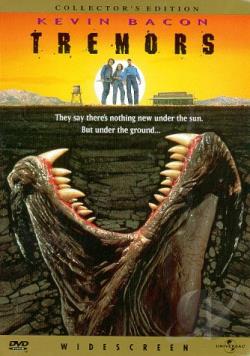
Tremors (1990)


Dir. Ron Underwood
Starring: Kevin Bacon, Fred Ward, Finn Carter, Michael Gross


I think that what I have realised most of all on this cinematic mission impossible through the States is this. While I may appreciate and admire some of the more cerebral or art-house films, the ones I most enjoy are just well-executed action movies. I loved The Untouchables. I thought 3:10 to Yuma was great. And I had huge amounts of fun re-watching Tremors. Okay, two decades later the special effects have not aged particularly well but Tremors was never all about the FX. 

Tremors is, essentially, a B-movie. It is set in the settlement of Perfection, just fourteen solitary souls short of being a ghost town out in the desert. Our heroes are rowdy good ol’ boys Earl (Fred Ward, who played Reese Witherspoon’s father in Sweet Home Alabama) and Val (Kevin Bacon). Tired of scratching around for odd jobs they decide finally to up and leave for the bright lights of Bixby. Only they find the one road out of the valley blocked. Something is moving up the valley, funnelled by the mountains, towards Perfection. And it is something that has a taste for human flesh! 

With the help of visiting seismology student Rhonda (Finn Carter) – there’s always a helpful visiting seismology student when you need one – they figure out that there are creatures under the soil, vast tunnelling three-headed worm creatures they name ‘graboids’. These creatures home in on vibrations, bursting up from the ground to engulf their prey. The only way to stay safe is to keep off the ground. Their only hope of salvation is to round up the townsfolk and somehow make it to the bare rock of the encircling mountains. But the graboids are smart and they learn from experience… 

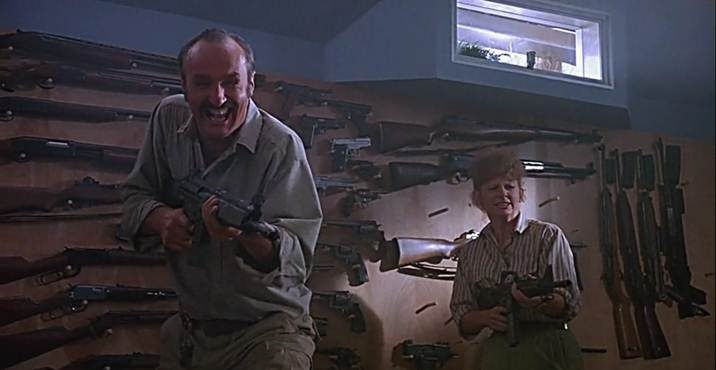
All this takes place with tongue firmly in cheek. It is silly. Earl and Val bicker back and forth (“Running’s not a plan! Running’s what you do once a plan fails!”). Supporting characters include paranoid survivalist gun-nuts Burt and Heather Gummer (Michael Gross and Reba McEntire) whose approach towards the graboids consists of blasting away with a variety of high calibre fully-automatic firearms. One escape tactic involves pole vaulting. (Maybe more unintentional as comedy was the producers’ efforts to Bowdlerise bad language. I’m sorry but I can’t take seriously anyone who refers to deadly killer worms as “motherhumpers”). But one can see the difference with, say, The Mist. The Mist takes itself so monumentally po-faced seriously that it sucks all the fun out of the film; Tremors keeps the mood light. In fact, apart from one scene, all the action in Tremors takes place during the day, the sunlight bleaching the desert white. Yet it also manages to jam in suspense, with characters having to outrun or outwit these clever deathworms as they tunnel through the sand. 

Don’t expect any back story about what these graboids are, where they came from, or why they have just decided to pop up now. The characters have a spot of banter about their mysterious disappearance, but really the focus is on getting the hell out of Dodge / killing the motherhumpers. And to be honest you can pick holes in any back-story, so it’s probably just best that it is ignored. The graboids are just there and they pose a clear existential threat. Speculation about their unique place on the evolutionary ladder can wait until after our heroes are safe. 

As I mentioned, the special effects look a tad dated these days. The whole ‘tunneling under the ground’ looks good, but the jets of steam fail to convince. I’m glad that the graboids actually have a physical presence rather than just being computer-animated: the original animatronic Jabba the Hutt always looked much better than the CGI one seen in the 1997 re-release of Star Wars. But they do, at times, resemble little more than dirty vacuum-cleaner hose being waved around randomly. There is a scene where a graboid invades the Gummer’s rec room / gun store and it is clear that the image of Burt blazing away on full-auto has just been super-imposed over the image of the graboid (it looks very Ray Harryhausen). But I suppose all that adds to the entertainment. It’s like being able to spot the walls wobbling on Blakes 7 or noticing that the Doctor’s Tardis always lands in the same quarry. It’s a B-movie. It’s not trying to make some deep, profound Stephen King-ish statement on humanity. It’s Comedy Cowboys vs Mongolian Death Worms, and it’s all the better for it! 

The Gummers really hated woodworm

What have I learnt about Nevada?
This is Nevada away from the bright lights of Las Vegas. Perfection is a small hamlet in the desert scattered with rusted junk and century-old wooden buildings. It is hemmed in by mountains, scattered with rocks, and is connected to the outside world by only one road through the wilderness. The people who live there are recluses who choose to live out there: either because they have always lived there (like Chang I suspect) and have no impetus to move on out (like Val and Earl), or because they have moved their specifically. These would include artist Nancy and the survivalist Gummers who choose to get as far away from the state as they can. It is a place for the hardy and the self-sufficient. And guns and bulldozers are always appreciated. 

Can we go there?
The film is set in Perfection, some 38 miles to the north of Bixby. Neither Perfection nor Bixby exist in real life (in later Tremors sequels it is stated that they are located away from Las Vegas towards Carson City, but aren’t really close to either). Filming took place not far from Nevada, in Lone Pine, California. Lone Pine is located west of Death Valley and east of Kings Canyon up in the Owens Valley mentioned in Chinatown, sheltering beneath the Sierra Nevada mountains. The desert landscapes certainly conjure up what one would expect of Nevada. Many films have been shot here to take advantage of its parched surroundings since 1920’s The Roundup, including The Lone Ranger, High Sierra, Rawhide, Bad Day at Black Rock, How the West Was Won and Zabriskie Point 

Sadly the town of Perfection was specifically constructed to be torn down after use (local townspeople contributed labour in exchange for the lumber after shooting was finished) and so nothing survives. Even the large rocks scattered about the place were fake and have been removed. The concrete drainage ditch is out east of Lone Pine, and the final scenes when the survivors are ‘fishing’ from the big rock is out west. The narrow defile where the road workers were killed is out in this direction as well. 

However the graboids are still there! Well, one or two. One of the graboids used in the film, along with a ‘Shrieker’ (a separate stage in the Graboid lifecycle that appeared in a later Tremors sequel) can be seen at the Lone Pine Film History Museum. 

Overall Rating: 3/5

Tuesday, 17 July 2012

Casino (1995)


Dir. Martin Scorsese
Starring: Robert DeNiro, Joe Pesci, Sharon Stone, James Woods 


At one point in Casino Sam talks about all the punters funnelling in to Las Vegas and points out that the only one to ever win is the house. His tragedy is that he does not realise that, to Las Vegas, he is just another punter. 

We open in 1973, just two years after Hunter S. Thompson wigged out big style. Thompson wanted to compare the glitz and glamour of The Strip to the seediness of North Las Vegas. In Casino we are shown that the seediness reaches right up to the front desk. The person whose job it is to hide the seediness behind the glitz is Sam ‘Ace’ Rothstein (Robert DeNiro), the Mafia’s top book-maker. With a track record of always getting a result when gambling he is sent out to Vegas to manage the casino at the Tangiers on the behalf of the Midwest Mob bosses. They are known men so they can’t go any further west than Kansas City. It is up to Sam (aka “that Jew motherfucker”) to keep the money flowing in. He doesn’t even need to be corrupt – well, no more than any other casino in town. His job is just to keep people gambling, keep them coming back, keep an eye out for professionals looking to do over the house, and keep the heat away from their door. And there is no one better at it. As for how the Mob get their cut? They take the cash straight from the counting room in a suitcase before it can be accounted for. So much cash coming in, off the books? They are prepared to give Sam the leeway he needs to do the job he wants to do. 

He is not the only man carving out an empire in the desert. Hoodlum Nicky Santoro (Joe Pesci) has also realised that the Mob bosses dare not tread on Nevada soil. Their eyes are fixed only on the suitcases coming in from the gaming floor. They have never employed the usual tactics that have worked so well in other cities: extortion, robbery and muscle. Las Vegas is “virgin territory”. So he brings in some guys and goes to work. Both Sam and Nicky are useful to the Mob, each bringing in valuable earnings. But Las Vegas goes to their heads. They start to think outside their pay-bracket. Sam starts to turn professional: he wants to run an efficient, respectable casino. Meanwhile Nicky thinks of breaking off from the old-timers in Kansas City and go solo. 

Their both thrive on the independence they are given but their aims and tactics are mutually incompatible. Nicky’s robberies are nosy and noticeable; Sam’s skimming relies upon being done quietly. He does not appreciate that whenever Nicky makes the news he drags in Sam too. Sam loves running the casino and is good at it, but his known link to a criminal like Nicky from back in the day jeopardises his respectability. He wants the respectable lifestyle: the trophy wife, the family, the country-club membership, the fame for running a tight ship. So he makes two mistakes. Firstly he sacks one of his undermanagers after one mistake too many. Fair enough, the guy was a doofus. But he was a doofus with influential family. Not ‘Family’ in a Mafia sense, but family that is settled in Nevada and has been for generations. He is one of the honky-tonk cowboys with boots, bootlace ties and big hats that have to be kept appeased because they own the land, the council and the state legislature. “Everybody out here with cowboy boots is a fuckin’ county commissioner or related to a county commissioner. I’m fuckin’ sick of it!” complains Sam. Part of his job is keeping them sweet with “comps” – complimentary stays, chips, girls. And jobs. But this doofus offends his professionalism and he refuses to compromise and take him back. With a stroke he has put the backs of the Nevada cowboys up. He is warned: they own the town. He is only a guest. 

His second mistake is falling in love. For the cerebral bean-counter this is unexpected. But I suppose it is another sign of how Vegas has got to him. It can make any man feel like a king. With his ego flattered he feels he can make it with whoever he wants, and he wants hustler Ginger (Sharon Stone). She is charming, beautiful, blonde, smart – who wouldn’t want her? So he proposes to set her up with a lifestyle she could never attain by herself. But she doesn’t love him. Her heart, inexplicably, remains with weasely gigolo Lester Diamond (James Woods). Her marriage to Sam is transactional. He gives her the dream house, the walk-in wardrobe, the million dollars of jewellery and she gives him that perfect home life. For as long as she can. But she is in thrall to self-destructive influences: booze, coke, Lester, Nicky. The bitter disintegration of the Rothstein’s marriage is a subplot to the disintegration of the Mafia’s Las Vegas empire. It becomes too loud, too public, too violent. Las Vegas chews them all up and spits them out the other side: Sam, Ginger, Nicky, the Mafia. Only Las Vegas itself endures. The rest – they are just punters… 

"Welcome to Jack-a-fuckin'-nory. Are you cock-suckers
sitting comfortably? Then we'll fuckin' begin..."

Casino was Martin Scorsese’s follow-up to Goodfellas – with all the guns and f-bombs that involves. And – like The Departed – it is an intelligent film. In The Departed the audience are left trying to think through the twists and double-crosses; in Casino they can intellectualise how to make money from gambling. Here you have the casino bosses and the gamblers each trying to outwit the other and keep just one step ahead for long enough to make a killing. But where Frank Costello in The Departed shown the seductiveness of evil, here we see the banality. The Mob bosses are old farts bitching in a back room over their momma’s ragĂș. 

For all that, though, the rampant criminality of Mob rule is presented as the better than the alternative. The Mobsters were hands off gentlemen who knew the benefit of hospitality. Who has taken their place?

After the Tangiers, the big corporations took it all over. Today it looks like Disneyland. And while the kids play cardboard pirates, Mommy and Daddy drop the house payments and Junior's college money on the poker slots. In the old days, dealers knew your name, what you drank, what you played. Today, it's like checkin' into an airport. And if you order room service, you're lucky if you get it by Thursday. Today, it's all gone. You get a whale show up with four million in a suitcase, and some twenty-five-year-old hotel school kid is gonna want his Social Security Number. After the Teamsters got knocked out of the box, the corporations tore down practically every one of the old casinos. And where did the money come from to rebuild the pyramids? Junk bonds.”

It is clear that Sam – or Scorsese – finds the latter approach less noble. 

One gripe I would have is the voiceovers. The film was adapted from Nicholas Pileggi’s book. Many of the characters were based – at least loosely – on real life individuals. Sam Rothstein was Frank “Lefty” Rosenthal, Nicky Santoro was Tony “the Ant” Spilotro, Frankie Marino was Frank Cullotta. But Scorsese could not escape from the literary nature of it. Rather than have the characters drop great chunks of exposition in dialogue he uses voice overs from Sam, from Nicky and – in one place – from Frank (Frank Vincent). Considering that from the very first scene it looks as though not all of those characters will reach the final reel alive it is more confusing than otherwise. It might be preferable to Doctor Who­-ish exposition, but it is still a clunky tactic and it is disappointing that Scorsese couldn’t escape from it. It jarred more here than just having a single voice narrating the story (as in Goodfellas). 

What have I learnt about Nevada?
The film chronicles the rise, fall and rise again of Vegas. The Mob moved in, they funded their casinos with Teamster money, they sold the idea of glitz and glamour, they built up the image, and then they imploded. Now Vegas is a corporate hospitality playground where the marketing strategies are, if anything, even more cynical. 

For all that, though, Las Vegas is a city in a desert. That desert has its uses – such as disposing of bodies – but it is a reminder that there is a wider Nevada out there, and that the Mafia do not control. Rube cowboys have their own dynasties and run the state, and their coexistence with the flash casinos run by Easterners is a tenuous one. They may look dumb but these cowboys hold all the aces. People who refuse to accept that come a cropper. As do those that refuse to tread carefully. 

Can we go there?
There is no Tangiers Casino. There never was. The story is in part based upon that of the now-demolished Stardust Casino (something obliquely referenced by use of the tune Stardust on the soundtrack). But Marty did get better access to Vegas than Terry Gilliam did for Fear and Loathing… - surprisingly considering that this film damns the casino authorities rather than the punters. The Riviera was used for principal filming. 

Sam and Ginger’s house can be found on Cochise Lane. Nicky’ restaurant was Piero’s on Convention Center Drive. Nicky’s jewellers, the Gold Rush, was set in a now-demolished Kawasaki dealership in West Sahara. When Sam is called to meet Nicky in the desert, that scene was again filmed at Jean Dry Lake Bed. They also meet at an isolated cafĂ© – this was the Idle Spurs  in Sandy Valley. Nicky later meets Ginger for sex at the La Concha Motel on Las Vegas Boulevard South; the motel can now be found in the Las Vegas Neon Museum. Nicky plays golf at the Las Vegas National Golf Club; later he and his brother have an unpleasant time amongst the corn at the Rocking K Ranch. 

Overall Rating: 4/5

Sunday, 15 July 2012

Fear and Loathing in Las Vegas (1998)


Dir. Terry Gilliam
Starring: Johnny Depp, Benicio del Toro, Craig Bierko, Christina Ricci 

“We were somewhere around Barstow, on the edge of the desert, when the drugs started to take hold…” 

What a great opening line to a film. And it was, of course, the opening line of Hunter S. Thompson’s most famous piece of writing: Fear and Loathing in Las Vegas, a warped psychedelic trip through the sordid underbelly of Sin City. 

Raoul Duke (Johnny Depp) is a journalist. He is sent on assignment to Vegas to cover a motorcycle race. With him he takes his attorney, Dr Gonzo (Benicio del Toro) and a car full of hard drugs (“As your attorney I advise you to rent a very fast car with no top. And you’ll need the cocaine…”). And the assignment is all but forgotten, passing in a mescaline kaleidoscope of images and perceptions, a nightmarish world where bats attack from the skies, casino patrons transmogrify into squamous reptilians and entire chapters of time are lost. It is the ultimate bad trip. It is the ultimate hangover. 

For someone determined to binge on mind and mood altering drugs Las Vegas must be the worst place in the world. The city is already so vivid and otherworldly that what you get is Madness2. The patrons are goyish and gross, the streetscapes are glittering neon in the darkness, while interiors are permalit dungeons where night and day have no meaning. Endless identical corridors lined with doors stretch away to the horizon and any desire no matter how warped can be catered for. It is a city of excess where nothing makes sense. The Bazooko Circus casino Duke and Gonzo visit whilst high on ether would be a terrifying assault on the senses at any time. The bar revolves, apes wear human clothing and an unearthly calliope plays (there are few sounds more laden with dread than that of a calliope).

And above all there is a feverish expectation about Las Vegas. Everyone believes they are just one card or roll of the dice away from the big time. They dream they can make it. It is the American Dream. They are, in Duke's words, “humping the American Dream, that vision of the big winner somehow emerging from the last minute pre-dawn chaos of a stale Vegas casino”. The American Dream is that everyone can make themselves what they want to be: a president, a millionaire or a rockstar. And of course they can’t. But there is a curiously American optimism that contrasts with the weary cynicism of Old Europe. For Raoul (and for his creator Hunter S. Thompson) Las Vegas in 1971 represents the abrupt awakening from that dream. The ‘60s had passed under its spell, a dream of hope and love born of San Franciscan acid. A new generation was rising and they could change the world. Or so they thought. And then the trip went sour. The opening sequence, set to a warped nightmarish version of My Favourite Things sets the scene beautifully. Raoul states that they thought that their “energy would simply prevail. We had all the momentum; we were riding the crest of a high and beautiful wave. So now, less than five years later, you can go up on a steep hill in Las Vegas and look west, and with the right kind of eyes you can almost see the high-water mark – that place where the wave finally broke and rolled back.” TV screens reflect the reality of 1971: Vietnam – bombs – Vietnam – Nixon – Vietnam – war. The boorish middle aged middle classes of Middle America won (typo alert: I just wrote ‘missile classes’; Thompson would be so impressed with my mind making the intuitive leap). The small-town morals of the “silent majority” snapped back and left Duke and Gonzo stranded on the other side. Something was fun and wonderful and affirming and now it had turned vicious and mean and nasty. The American Dream was replaced by one of reaction and hate. Fear and loathing. In drug terms they went up, and then they came down. 

And the drugs replicate exactly the same change upon Duke and Gonzo. From what we see drugs do not seem to be the greatest lifestyle choice. The world that Duke and Gonzo take with them seems to be sordid and unhygienic. It is as vicious and violent as those of the red-faced cops they encounter at the District Attorney’s conference. If they zonk out so much that they cannot remember their actions they cannot therefore be responsible for their actions. This makes them mean drunks. They are self-absorbed egomaniacs. They do not care for anyone. Raoul’s solution for what to do with Lucy (Christina Ricci) is to keep her perpetually sedated with acid and pimp her out for gang rape. Gonzo pulls a knife on a waitress. Frankly they are dangerous to be around.  

In his drug-addled and paranoid brain Jason
was convinced Kylie was stalking him...

Thankfully Depp is at his entertaining best. With his bow-legged waddle and balding crown he barks out his lines and voiceover as urgently as a reporter filing a dispatch from a war zone. The cast is further dotted with stars in supporting roles: Cameron Diaz as a reporter, The Cider House Rules’ Tobey Maguire unrecognisable as a hitchhiker, Christina Ricci, The Red Hot Chili Peppers’ Flea, last seen in Fight Club, as a San Francisco hippy. Even Hunter S. Thompson himself is briefly glimpsed at a party. And they have to be entertaining. I would say that the film has a great concept and a well-executed surreal aesthetic. But it runs out of steam half way through. For the first section of the film I was carried along like andrenichrome coursing through a bloodstream, not knowing what was going to happen yet. Thereafter the film became somewhat predictable. I knew that there wasn’t going to be much of a plot, I knew that it would just be a chronicle of two men behaving badly. I knew there wouldn’t be much of a pay-off. I’d come up, and I knew there would be a come down to follow. Though to be honest I’m impressed with what director Gilliam put out there at all. As seems eternally to be the case with Terry Gilliam movies the production was a nightmare. Gilliam was brought in at a very late stage and had to write a new script in ten days. It bombed at the box office. But there remains something appealing about the fact that the film was even attempted at all. Fear and Loathing in Las Vegas certainly deserves an A- for effort, even if the finished product warrants only a C. 

What have I learnt about Nevada?
Las Vegas is far from the glamorous destination we have all been led to believe it is. Sure, there are the celebrities and the glitter. But behind that is an over-the-top nightmare of decadence. Desperation drips from the walls, its denizens shuffle around like zombies. People can be brought to Vegas for other events, like the Mint 500 motorcycle race or the DAs’ conference, but no one really cares. Vegas is its own little isolated reality. Away from the Strip we have Downtown for those who cannot afford to live the dream. And beyond that is North Las Vegas, where even the rule of law is patchy at best. 

The state has – or, in 1971, certainly had – very strict anti-drug laws. Even possession could earn someone twenty years in gaol; dealing life. Drinking alcohol and smoking tobacco are all fine. It is almost like the good folk of Nevada have to protect themselves from the insidious hippyish Californians over their western border. 

Outside Vegas the terrain is desert all the way over to Barstow in California. We are talking very light soil, barren and empty. 

Can we go there?
In Vegas Duke starts off at the Mint Hotel to cover the Mint 400 desert race. The Mint no longer exists; interiors were shot at the Binions Horseshoe. The ‘Bazooko Circus’ casino is meant to be Circus-Circus (in his writing Thompson explicitly states that “Circus-Circus is what the whole hep world would be doing Saturday night if the Nazis had won the war”). The management refused permission for the crew to film there, so it was recreated on a Warner Bros soundstage back in Hollywood (the Stardust casino, demolished in 2007, stood in for its exterior). Duke is then sent back to Vegas to stay at the Flamingo. Interiors were shot inside the Riviera. 

Out in the desert the Mint 400 was filmed at the Jean Dry Lake Bed south of Vegas. Other exteriors were shot in Red Rock Canyon. The airport at the end was actually that in Kingman, Arizona. 

Los Angeles is represented by the now demolished Ambassador Hotel on Wilshire Boulevard (which is meant to be the Beverley Heights Hotel), and a fleeting appearance by the Bahooka Family Restaurant in Rosemead as a tiki bar Raoul and Gonzo visit. 

Overall Rating: 3/5

Saturday, 14 July 2012

Week 29: Nevada


"These tables are haunted by the ghost of Las Vegas,
 Their chips were once mountains but they came here to play;
 They could take me if they wanted but I have nothing worth counting,
 And like the sands of Nevada they go drifting away..."
 - 'Sands of Nevada',
 Mark Knopfler

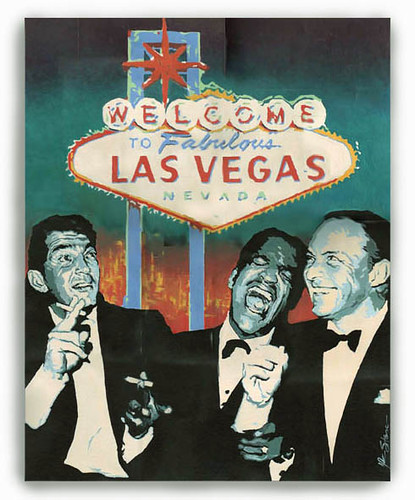
Bright light city's gonna set my soul, gonna set my soul on fire. There, like a diamond burning bright, like an oasis amidst the desert, is one of the most implausible cities on earth. A paradise of excess surrounded by an excess of nothingness: Las Vegas, Nevada.

We know Las Vegas. In our convertible we scream out of the desert and down The Strip, neon flashing overhead. And then we're out the other side, back into the desert. Vegas is just one brief bright glare of civilisation - or, depending upon your view, barbarity - in the expanses of the Nevada basin. Sands and rocks stretch off towards California, Arizona and Utah.

Nevada is a state of boom and bust. It is also a state of mind, a fever dream of getting rich quick. It owed its birth to the riches beneath its barren wastes: it is officially known as the Silver State. The Comstock Lode of silver produced a fortune for a few and desperation for so many more. And now Nevada is synonymous with new dreams of the big time: casinos.

The casinos in Reno and Las Vegas have their history of mob ownership. There is an anything goes morality that has led to Vegas's nickname of 'Sin City'. Visitors can drink and gamble to their hearts' content. Love is cheap too at the countless wedding chapels. Or even cheaper (and possibly not love) at the state's legalised brothels.

Nevada is a state of extremes - great wealth and great poverty, won and lost on the throw of a dice. The great glittering city of Las Vegas and the barren empty wastes that surround it. The style and glamour of the Rat Pack and the 'style' and 'glamour' of Siegfried and Roy. I'm hoping that we can capture those extremes.

We could fill a week just with films set in Las Vegas: Leaving Las Vegas, Bugsy, Honeymoon in Vegas, Diamonds are Forever, any of the various incarnations of Ocean's 11. But I'm going to try, where possible, to get out from the city. My three films are:
  • Fear and Loathing in Las Vegas (1998)
  • Casino (1995)
  • Tremors (1990)