Showing posts with label Montana. Show all posts

Thursday, 5 July 2012

Thunderbolt and Lightfoot (1974)


Dir. Michael Cimino
Starring: Clint Eastwood, Jeff Bridges, George Kennedy, Geoffrey Lewis 

The service in a small wooden Montana church is interrupted when a man enters and starts taking pot shots at the preacher. The preacher flees. Meanwhile a young man in leather trousers screeches out of a car lot in a Pontiac TransAm, the owner left behind in a cloud of dust. By chance the TransAm just happens to pass by at the right time for the preacher man to catch a lift. And thus meet Thunderbolt and Lightfoot! 

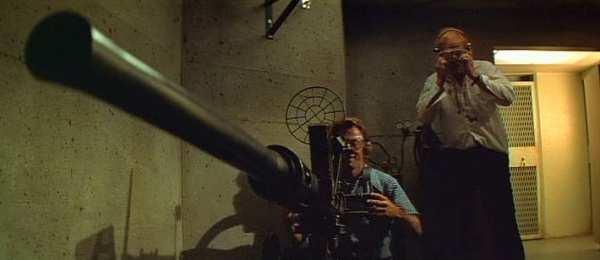
That preacher is no holyman. He is the bank robber known as The Thunderbolt (Clint Eastwood, appearing in this list for the second time on screen after The Bridges of Madison County). He is laying low from the ex-partners who believe that he betrayed them after their last big job. His rescuer is a roguish young drifter by the name of Lightfoot (Jeff Bridges). They become friends and try to keep one step ahead of Thunderbolt’s pursuers, Red (George Kennedy) and Goody (Geoffrey Lewis, seen over twenty years later as the fly-keeping Luther in Eastwood’s Midnight in the Garden of Good and Evil). When the four finally meet up Lightfoot proposes they recreate their last job, taking out the vault of Montana Armored in exactly the same way: using a 20mm anti-tank cannon with armour-piercing shells. 
"Do ya feel lucky punk? Well... do ya...?"

I was half wondering where the film was going. It takes thirty minutes for Clint, sorry, I mean Thunderbolt, to tell Lightfoot his history. Until that point they were driving around, stealing cars, picking up girls, and trying to keep one step ahead of Red. Thunderbolt even says at one point that when you can’t think of anything to do, just keep on moving. And that’s what I thought this was – a buddy road movie, with the heroes moving through a dusty Wild West landscape populated by girls with peachy asses and crazy drivers with cars filled with white rabbits and raccoons. Thereafter it becomes a more conventional heist movie as the reserved Thunderbolt and high-spirited Lightfoot are brought into an alliance of convenience with the bad-tempered Red and the gormless Goody. 

So what does it have in its favour? The heist is well executed – lots of shots of ticking watches as they synchronise their actions. Bridges is infectious fun, despite his character’s habit of talking in clichés and his really annoying laugh; he was nominated for the Academy Award for Best Supporting Actor for his performance. I’m not really sure I can see why if I’m honest. But then again Fred Astaire was also nominated for his role in The Towering Inferno that year, so it probably says something about the calibre of performances in 1974 (it’s okay, don’t worry, the other three Best Supporting Actor nominations all went to The Godfather Part II, with Robert DeNiro taking home the trophy). But what might have been seen as a successful movie is just lacking a bit of excitement through modern-day eyes. When one considers the number of car chases in the film, there are very few memorable moments from them. When one compares the sort of thing one might see in Bond, Bourne or Ronin this movie just gives us cars driving after each other. Overall there is not enough meat on the bones for a real meal. 

What have I learnt about Montana?
Action in Thunderbolt and Lightfoot keeps moving between the cities and the countryside. The cities are seen by night, seedy and neon-lit. We then move out to well-tended suburbs. And then there is the great outdoors. Miles of nothing (except for the occasional wooden church, stranded among the wheat-fields, where the congregation tie up their horses outside). Roads dip and twist across the landscape, cars throwing up clouds of dust in their wake. Montana is a land of hills and lakes once you get away from civilisation. 

The police are armed and dangerous. Certainly they respond to bank robberies by shooting first and asking questions later. 

Can we go there?
There was a moment when I found myself cursing. Thunderbolt and Lightfoot had been cruising around the west for a while before Thunderbolt asks where they are. The answer: Hells Canyon. On the Snake River. On the western border of Idaho. Bollocks. 

Thankfully their sojourn in Idaho is short-lived. They are soon back in Montana to knock off the depot of the Montana Armored. They walk past the Chouteau County Bank in Fort Benton to drink beers by the river. They head up to Warsaw to try and find the old one-room schoolhouse where the original haul was stashed.  

The film was shot on location around Great Falls. Thunderbolt disguises himself as a preacher at St John’s Lutheran Church in Hobson, south-east of Great Falls (sadly it is no longer there). Lightfoot steals his first car in Choteau. They go via Sun Canyon Road to Diversion Lake near Augusta. In the film they catch the ‘Idaho Dream’ down the Snake River; in reality the boat was the Sacajawea 2, moored at Gates of the Mountains Marina in Helena. The bar and telegraph office were in Great Falls. Lightfoot met a hammer-wielding motorcycle girl on Ulm Bridge. Red finds out just how vicious the department store guard dogs are at in Fort Benton. The old one-room schoolhouse (when they finally find it) is south of Great Falls on Interstate 15 near exit 240. 

Overall Rating: 2/5

Tuesday, 3 July 2012

Legends of the Fall (1994)


Dir. Edward Zwick
Starring: Brad Pitt, Anthony Hopkins, Aidan Quinn, Julia Ormond 


The grandeur of Montana demands cinematic epics. Legends of the Fall is another epic. Thankfully it is 30 minutes shorter than The Horse Whisperer. Unfortunately it feels like it is at least 60 minutes longer… 

The Ludlows ranch in wild Montana. The Colonel (Anthony Hopkin) resigned his commission in protest at the American government’s treatment of the natives and settled in this out of the way location to avoid “the madness beyond the mountains”. His wife cannot stand the wildness and she leaves, but not before she has given birth to three sons. Helped by Cree warrior One Stab (Gordon Tootoosis) the Colonel raises the three as a tight-knit family: responsible Alfred (Aidan Quinn), wild Tristan (Brad Pitt) and studious Samuel (Henry Thomas). 

And then Samuel returns from university with a fiancée, Susannah (Julia Ormond). One might almost think she is the first woman the Ludlow boys have ever seen before. They all fall in love with her. And then they all go off to war – against their father’s wishes they head for Canada so that they can sign up and fight in the trenches in France. The battle is not as heroic as they hoped it would be. Alfred gets wounded. Samuel is gassed and killed despite Tristan’s attempts to safeguard him. So Tristan cuts out his heart, daubs himself in his brother’s blood, and goes all Rambo, sneaking about behind the enemy lines and scalping Germans. As you do. This is meant to show how sorrowful and guilty he feels about his brother’s death; I think it shows that he is a borderline sociopath who takes a delight in war-crimes, but each to their own.  

Brad resolved to pay the extra for Gillette in future

Meanwhile back in Montana Alfred develops a yearning for Susannah, which she rebuffs. Susannah develops a yearning for Tristan. He doesn’t rebuff it. Alfred leaves in a huff. And then Tristan leaves too. He takes a gap year (or six) in south-east Asia, sleeping around, taking drugs and generally acting like a hippy (apart from the hunting and killing of rare animals). 

If the film had ended at the point when Tristan deserted Susannah the film would have been salvageable (although it would still have felt like a long film). It doesn’t end there however. There’s Tristan sailing off around the world, there is Alfred becoming a Congressman, there is Tristan coming home, there are bootleggers and gangsters on the mean streets of Helena, there is Tristan going all Rambo again… And I’m sat there watching the clock asking myself when it is going to end The longer it went on the more frustrated I became with the film. And all the while there a Titanic-esque Irish-ish soundtrack, swelling dramatically, desperately trying to get me to emotionally engage with the drama, and I’m sitting there bored senseless. Who am I meant to be cheering for? I think we’re all meant to be following Tristan. Tristan the borderline psychopath, who screwed his dead brother’s fiancé and then deserted her so that he could go off to slaughter wildlife and sleep with tribeswomen. And still everyone loves him. Susannah says that she will wait for him forever, his father suffers a stroke when Tristan is bad mouthed and then is delighted when he returns, his mother comes back to Montana so that his bride can wear her wedding dress – presumably she did not do the same when Alfred got married. At one point Alfred turns to Tristan and says “I followed all of the rules, man’s and God’s. And you, you followed none of them. And they all loved you more. Samuel, father… and even my own wife.” And I just don’t understand why everyone loves him, and why the audience are expected to. Really, we should be sympathising with Alfred. After all, he follows his heart, he is loyal, and he realises his ambitions. But we don’t really sympathise with him either: he is warped by jealousy. When Samuel dies Colonel Ludlow comments that “He was the best of us.” He was. Samuel is a nice guy. Everyone else is a shit. And I won’t forgive them for making me spend an evening watching them.

What have I learnt about Montana?
Once again we see the vast open plains, the meadows and the rivers and the forests, all backed by the majestic mountains. And we understand why there weren’t any Native Americans in The Horse Whisperer: the US government had turfed them all off their land in the late 19th century. Children were slaughtered, settlements burned. Those who remained had to face prejudice – we see a bartender who doesn’t serve Indians, and we see a family with a “half breed” daughter resigned to the fact that she will never get an education. But the Native Americans seem to be a people who are relics of the past and who have been hunted off the land – much as they themselves strive to hunt grizzly bears off the land too. 

We can understand a bit about the mind-set of those who settle in Montana. The Colonel builds a life here to escape “the madness beyond the mountains”. He has a distrust of government and believes that his family should be self-sufficient with minimal interference. His dislike of government causes him to blow up when Alfred reveals that he is going to stand for Congress. He encourages Tristan to become a bootlegger during Prohibition for the simplest of reasons: “Screw ‘em!” The border with Canada seems quite porous. The Ludlows cross over easily, and go off to fight in the army of a foreign nation, without any come-backs from the US authorities.  

Helena, Montana, is the local centre and is surprisingly cosmopolitan. Even here there were Irish mobsters with the police force in their pockets, growing fat off Prohibition. 

Can we go there?
The Ludlow’s ranch is located somewhere near the headwaters of the Missouri River. The nearest town is Helena, the state capital but only the fifth largest city in Montana.

But, just to show how porous that northern border is, it was shot on location in Canada. The great Montana plains are actually located in Indian territory – the land of the Stoney Nation west of Calgary and east of Banff National Park. The ranch (now gone) was built 16km west of Morley. The trenches of WWI France were also filmed locally, near Bearspaw. Helena was created in Vancouver: Maple Leaf Square in Gastown, and Powell Street in Japantown. Only Brad Pitt got to go abroad – his travels may have looked like New Guinea and Java, but they were actually Ocho Rios in Jamaica. 

Overall Rating: 1/5

Sunday, 1 July 2012

The Horse Whisperer (1998)


Dir. Robert Redford
Starring: Robert Redford, Kristin Scott Thomas, Sam Neill, Dianne Wiest 


I remember the satirical online magazine The Onion once publishing a list of the "Top-Selling Books of 1998". Up at number one (above ‘How I Grew Up Covered In Me Da’s Vomit In Ireland’ and ‘The Seven Habits of Highly Reprehensible People’) was ‘The Quiet, Compassionate Country Man With A Windburned But Handsome Face Who Was Kind To The Widow And Her Daughter And Always Spoke Respectfully To The Symbolic Livestock’. I wonder what they could be referring to…? 

The novel The Horse Whisperer was actually published by English author Nicholas Evans in 1995. Three years later it was released as an epic (i.e. 2¾ hour long) movie directed by and starring Robert Redford as Tom Booker, the aforementioned quiet, compassionate country man with a windburned but handsome face. He works alongside his brother (Chris Cooper) on the family cattle ranch in remotest Montana, and he has an uncanny ability to soothe and handle horses.

He comes into the story through an accident. The MacLeans are a very well-to-do East Coast family. Father Robert (the great Sam Neill) is a lawyer, and mother Annie (Kristin Scott Thomas) is a magazine editor. With such high-powered jobs a lot of pressure is placed on the shoulders of their only daughter, Grace (Scarlett Johansson). Her one release is riding her horse, Pilgrim. And then, one icy morning, there is a terrible accident. Grace’s best friend Judith (Kate Bosworth) and her horse are killed outright. Grace and Pilgrim survive, but are horribly scarred, both inside and out. Grace loses the lower half of her leg; Pilgrim is wounded and suffers a personality shift, becoming angry and uncontrollable. Annie fixates on the idea that the future well-being of horse and girl are linked, and researches cures. She comes across references to Booker as a “horse whisperer”. When he refuses to come to New York to see Pilgrim, she loads up the horse and a sullen daughter and drives cross-country to Montana to find him. 

Life in Montana differs radically to the life the MacLean’s have lived in New York. The icy blues of the snow are replaced with the warm yellows and greens of the expansive rolling pastureland. Life is simple and homely: Tom’s sister-in-law Dianne (Dianne Wiest) uses recipes for cooking, not jarred sauces. There is a warmth around the hospitable Bookers that is lacking from the MacLeans – particularly Annie. She is a glacial ice queen. Arriving at the hospital following Grace’s accident she takes charge. When told that Grace will lose a leg, she replies “which one?” As if it matters. But she is analysing, reacting intellectually rather than emotionally. The MacLeans are a small unit of three, and even then they don’t interact with each other particularly well. The Bookers, working in harmony together, where everyone has a specified role from the oldest down to the youngest, are a complete contrast. They engage with the local community, where everyone is ready and willing to lend a hand. They practice social cohesion. Around the dinner table they are visibly discomfited by the outspokenness of the New Yorkers. 

Yes, it’s an East Coast meets Midwest culture clash. And Annie is about as far East Coast as she can be – she’s British. The daughter of a diplomat, she has never had a fixed home. You may scoff, but I think that what Lawrence Durrell referred to as “a sense of place” is important. Going away to university I felt better supported having always lived in one house and knowing where I was from, as opposed to those whose families had constantly moved around. I thought there was a clear difference that could be seen in the two types of people. The former we more grounded – but maybe could be accused of limited ambition as a result. Or maybe I am just extrapolating from my own experiences too much! The MacLeans are the latter sort of people: high achievers with high expectations. The Bookers are the former. They know their Montana land and they love it. Dianne has a dream to visit Morocco, but she accepts that it will probably never happen. Tom was once married to a girl from Chicago, but her heart was in the city and his was in the country, and so the relationship could never work. 

History repeats itself as country-boy Tom and city-girl Annie begin to feel an attraction to each other. Just as Pilgrim starts to respond to Tom’s care and attention, so too do Grace and Annie, melting under the warmth of the Montana welcome they receive. Annie begins to experience a sense of freedom, a view of another way of life she had never before considered. As a woman she wants to stay with Tom; as a mother she knows she must support Grace. The surprise arrival of her husband – the very morning after she and Tom kiss, naturally – brings this home to her. 

The Horse Whisperer wasn’t exactly what I was expecting. I thought it was meant to be this great romance; in actual fact there’s very little of that in there. Tom rests his hand on Annie’s calf while helping her into her saddle, he touches her finger while playing cat’s cradle, they kiss… that’s it. Compared to another film about an unsatisfied wife and mother meeting a quiet, compassionate country man with a windburned but handsome face – The Bridges of Madison County – it is all very chaste. No fucking on the linoleum here. One might say that Tom and Annie’s dance is, if anything, more erotic however. The grasping interplay of hand over clothing, the press of two bodies against each other – this is sex by proxy 

But what there is is an expanse of exquisite landscape rippling away to the mountains, horses galloping through free-slowing streams and up to high vantage points to watch the sunset. As director Redford gets a completely different feel out of this made-for-Cinemascope scenery than he does from the internalised suburban protagonists of his Ordinary People. Though there is, of course, Grace’s cathartic tear-filled break-down at the end. It seems that a good cry can pretty much solve any problem. 

I liked the movie. Less for the plot and the love story and more for the lingering direction if I’m honest. The film could have been cut down by quite a bit, but every minute cut would be one minute less to marvel at the beauty on screen. And I’m not talking about Scarlett Johansson here either (she’s fourteen for God’s sake!) – the glacial Kristin Scott Thomas would win the prize for her fine features. But the beauty is rather the epic landscape, the country hospitality, and the stunning animals. If people were saying that Uggie the dog was worthy of an Oscar for his role in The Artist, then certainly High Tower the horse (‘Pilgrim’) is worthy here too. 

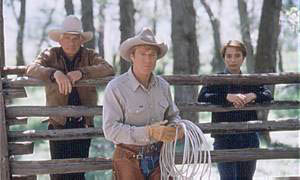
In his spare time Robert recreated Christina Aguilera videos

What have I learnt about Montana?
Montana is referred to as “Marlboro Country” at one point. The comparison is apt. There are miles and miles and miles of open meadows and rolling hills, all backed with awe-inspiring mountain peaks in the background. A lone road, a split-rail fence, some wooden houses sheltering by the stream, this is as much as man has managed to tame nature. There aren’t many signs (well, not printed ones anyway. And, as Grace asks, what would it say? “Ten miles to big rock. Twenty miles to bigger rock”?) Cows and horses outnumber people. And the people that live there are rugged, competent, equally at home in the saddle as in a battered pick-up. Cowboy boots, jeans, shirts and cowboy hats (and occasionally chaps) are the uniform of choice. And it seems there is nothing that cannot be achieved with a length of rope. 

Those people are contrasted with the cold, stuck-up East Coast MacLeans. They have warm, sprawling families, all of whom would drop everything to help one another out. So would their network of friends spread across the neighbouring ranchers. Each helps the other so that the community thrives. They tell tall tales, dance to country music and are reserved in their opinions. They seek to be hospitable to newcomers. They are charitable and Christian. 

The Battle of Little Big Horn was fought in Montana. There is a monument there to commemorate it. Tom talks about a native American from the Blackfeet Indian Reservation, but we never see one. Looks like Custer’s successors were much more successful than he was. 

Can we go there?
That memorable scenery is Montana. Robert Redford shot in the Boulder River valley, south of the town of Big Timber. Those mountains in the background must be the Abaroka Range, and behind them is Yellowstone National Park in north-west Wyoming. Shooting was spread across Park and Sweet Grass Counties. He had filmed an earlier work, A River Runs Through It, in the same area four years previously so I guess he likes it there!

A working cattle ranch about an hour from Livingston was used for the Booker’s estate. The ranch house and Creek House were constructed specially for the film however. Despite the fact that the Little Bighorn Battlefield Memorial is located in Montana it was recreated nearer to Livingstone for the purposes of filming. Since then a memorial for the Indian casualties has also been unveiled at the Battlefield.  

The MacLean’s home was in Saratoga Springs in New York state. 

Overall Rating: 4/5

Week 27: Montana

"Turn me loose, set me free,
 Somewhere in the middle of Montana,
 And gimme all I got comin' to me;
 And you can keep your retirement
 And your so-called social security,
 Big city turn me loose and set me free..."
 - 'Big City',
 Merle Haggard

We're leaving the big city for the Big Sky Country. Endless rolling plains butting up against snow-covered peaks and not a soul for miles. We'll need a sturdy vehicle and an independent heart if we are going to make it in Montana.

There may not be grand cities or sophisticated shopping here. Montana is a state for those who like their outdoors great (with a side order of wild and majestic). On the northern border is Canada is Glacier National Park, a UNESCO World Heritage Site and, from the images I've seen, one of the most stunning places in the world. And down on the southern border with Wyoming you can find another World Heritage Site - Yellowstone National Park. So hide your pick-a-nick basket from Yogi Bear and ask Mr Ranger for directions if you get lost.


It is an epic landscape down here. Just the state's nickname 'Big Sky Country' conjures up images of men on horseback, mere specks in the scenery, beneath an endless expanse of blue, the horizon stretching away until tomorrow. Man is dwarfed by the splendour here. Man shouldn't be here. It demands hardiness to live this rugged life.

So I'm switching my TV to widescreen before I sit down for this week's three films. They are:
  • The Horse Whisperer (1998)
  • Legends of the Fall (1994)
  • Thunderbolt and Lightfoot (1974)
Saddle up partner!