Showing posts with label Missouri. Show all posts

Wednesday, 27 June 2012

Waiting for Guffman (1997)


Dir. Christopher Guest
Starring: Christopher Guest, Eugene Levy, Catherine O’Hara, Parker Posey 

This is Spinal Tap is one of my all-time favourite films. It really created the ‘mockumentary’ genre: documentary-style camerawork following actors purporting to be real members of the public. One of the stars of that film, Christopher Guest, has now developed a career as a director so I was keen to include one of his works. Waiting for Guffman was his first work and it shares lots of characteristics with his later movies Best in Show, A Mighty Wind and For Your Consideration. It is a mockumentary, following a crowd of oblivious and deluded idiots who are working towards what they believe to be a crack at fame. Best in Show was set at a Crufts-style dog show, A Mighty Wind among forgotten folk musicians, For Your Consideration on an Oscar-tipped movie. Waiting for Guffman centres on a small-town drama group preparing a musical tribute to the 150-year history of their hometown of Blaine, Missouri.

Blaine may not have much going for it, but it is proud of its past and is determined to celebrate its upcoming sesquicentennial with all the resources at its disposal. A key part of the festivities will be the dramatic review Red, White and Blaine. Despite the sterling service Lloyd the school music teacher (Bob Balaban) has performed over the years there is really only one choice for director: Corky St Clair (Christopher Guest). Corky is a flamboyantly camp man with a background in “off-off-off-off Broadway” productions in New York. One might even suppose that he was gay, if it weren’t for the fact that he is married. Admittedly, no one can recall meeting his wife, but Corky buy women’s clothing for her so she must be around somewhere. Backed by Lloyd he fills out the cast of his show. First up are Ron and Sheila Albertson (Fred Willard and Catherine O’Hara), local travel agents (who have never travelled further than Jefferson City) and mainstays of the local drama scene. Their audition-piece of a Noel Coward-esque Midnight at the Oasis is a delight. They do have a habit of over-sharing after a glass or two of wine however. Dr Pearl (Eugene Levy, best known as ‘Jim’s Dad’ from the American Pie series) is the Jewish dentist who believes that comedy is in his blood (his grandfather premiered the song Bubbe Made a Kishke on the Yiddish stage back in New York). “People say ‘You must have been the class clown’. And I say ‘No I wasn’t’ – but I sat next to the class clown, and I studied him.” Libby Mae Brown (Parker Posey) is the gum-chewing girl who works at the Dairy Queen. Rounding out the cast is Johnny Savage (Matt Keeslar), a muscular James Dean type who has no interest in acting, but whom Corky is determined to cast in the show. He later drops out on opening night, forcing Corky to squeeze into his shorts and play a succession of rugged young men on stage. 

So far, so haphazard, except that Corky has invited a producer from New York, Mort Guffman, to come see the show. Everyone becomes convinced (without much evidence) that this is it: the show will transfer to Broadway and they will become stars. Hard to see how. Lloyd complains that Corky hasn’t set aside time for music rehearsal, the town council refuse Corky’s request for a $100,000 increase to the budget, prompting him to temporarily quit, Johnny Savage does quit, and the show is full of in-jokes about Blaine’s own local history. Scenes focus on the first settlement of the town when guide Blaine Fabin mistakenly thinks that they have reached California, Blaine’s heyday as “the stool capital of the world” and a 1946 visit by a flying saucer. Not particularly guarantees of cross-over appeal. 

From Uranus to the stool capital of the world

The actual production itself is rather good – surprisingly so when one considers the rehearsal period. Lloyd’s orchestra provide a lovely sound, the singing is in tune and in time, and songs (written by Guest and his Spinal Tap collaborators Michael McKean and Harry Shearer) such as Stool Boom, Penny for your Thoughts and Nothing Ever Happens on Mars are charming. And the performers all succeed in broadening their horizons somewhat. 

The film was largely improvised. Guest and Levy collaborated on the backgrounds of the characters and the aim of each scene, but after that the actors could make it up as they went along. This is how he works. There are some wonderful throway lines. There is a note perfect UFO 'expert' ("Once you go into that circle the weather never changes. It is always 67 degrees with a 40% chance of rain") and a pharmacist called Steve who must be the only other gay in the village. The actor who plays Steve, Michael Hitchcock, along with many other cast members – including Guest, Levy, Willard, O’Hara, Posey, Balaban, and Larry Miller (the Mayor) - reappears in Best in Show, A Mighty Wind and For Your Consideration. It might not be quite as laugh-out-loud funny as Spinal Tap, but then again, few things are. It is whimsical and gigglesome rather than uproarious (Remains of the Day lunchboxes anyone?), but for anyone with a background in amateur dramatics – such as yours truly – it should be compulsory viewing. If only to see how many characters and situations you recognise from your real life experiences. I’m certainly going to follow the sage advice of Ron Albertson from now on: “If there’s an empty space, just fill it with a line, that’s what I like to do. Even if it’s from another show…” 

What have I learnt about Missouri?
Missouri is “the heart of America” – and Blaine is “the heart of Missouri”. So presumably what is said here about Blaine could hold true for a number of mid-western towns. Blaine was founded in the 1840s as the covered wagons rolled west. To this day there is still some cachet attached to those who share the name of those first settlers. There is a strong local pride in the town and its history. It developed a particular expertise in something enabling it to call itself ‘the X capital of America’. It has its own local urban myths, and is small enough for in-jokes among the townspeople. The town is run by a local council. Anyone with a background outside the town – such as Corky hailing from New York – is seen as just a little bit special. 

I think the weather in Missouri is meant to be notoriously changeable. Apparently “there’s a saying in Missouri: ‘If you don’t like the weather just wait five minutes’. In Blaine, with hard work, I think we can get that down to three or four minutes.” 

Can we go there?
Sadly Blaine does not insist. Nor was the film even shot in Missouri. Filming took place in Austin and Lockhart, Texas – the same area that provided the locations for What’s Eating Gilbert Grape?, set in Missouri’s northern neighbour Iowa. Lockhart’s Caldwell County Courthouse can be seen prominently in both movies.  

Overall Rating: 3/5

Tuesday, 26 June 2012

Meet Me in St. Louis (1944)


Dir. Vincente Minelli
Starring: Judy Garland, Margaret O’Brien, Mary Astor, Lucille Bremer 

Clang-clang-clang goes the trolley, ding-ding-ding goes the bell, and we are off and transported to 1903 St. Louis. The city is full of excitement and hubbub, for the very next year the eyes of the universe will be on it as it hosts the 1904 World’s Fair. (It will also host the Olympic Games, but no one makes any reference to that at all. No exhaustive media coverage, no torch relays, no Sebastian Bloody Coe – it’s all quite reassuringly refreshing!). 

One family certainly revelling in the excitement are the Smiths of 5135 Kensington Avenue. A big, bustling family comprising eight people of three different generations (and their maid) they live in upper-middle-class comfort. Eldest daughters Rose (Lucille Bremer) and Esther (Judy Garland) are busy falling in and out of love, younger daughters Agnes (Joan Carroll) and Tootie (Margaret O’Brien) are engaged in the mischief that young girls habitually engage in, and mother Anna (Mary Astor) and the maid Katie (Marjorie Main) try to keep the household running whilst keeping Mr Smith (Leon Ames) oblivious. Basically, he brings home the money, and his family obligingly spend it. 

To bring home more money Mr Smith accepts a promotion. The promotion means that he has to go to New York. His family shrug and state that they expect they will survive without him. But they misunderstand – he has to go to New York for keeps. And he intends to take his family with him. This prompts uproar. It means that they will miss out on the World’s Fair, that Agnes and Tootie will be taken away from their friends, and Rose and Esther will be torn away from their beaus. This is particularly upsetting for Esther who has fallen in love with “The Boy Next Door” John Truett (Tom Drake). Even Katie joins in, muttering that they won’t have space for the large kitchen that forms the focal point of the house in a pokey New York tenement. And all this, just for money. “Money!” Rose scoffs: “I hate, loathe, despise and abominate money!” “You also spend it”, Mr Smith points out. 

And so, over the course of a year, the domestic life of the Smiths play out – the games, the romance, the squabbles, the humour and the threat of being uprooted from a place they love. Esther tries to win the heart of John, Tootie gets into scrapes, Grandpa (Harry Davenport) twinkles appealingly. There is a party and a trolley-car ride and Halloween and a ball and Christmas and the opening of the World’s Fair itself and it is a Technicolor treat full of warmth and humour and music. It is not in any way hard-hitting or fantastical or revelatory. It is a nice big hug of a film that one can imagine the entire Smith family sitting down on the sofa to appreciate. 

Public transport: if it isn't someone with their iPod on full blast
it's only Judy Flaming Garland singing at top volume!

The film was released only two years after another film about a prosperous Midwestern family: Orson Welles’ The Magnificent Ambersons. But the two films could not be more different. The Ambersons were haughty and decadent and slipped into obscurity in a film of heavily shadowed black and white. The Smiths are loving and muddled and look to engage with people outside their front door and their life is rich in colour and texture. Director Vincente Minelli (who married star Judy Garland the following year: Liza Minelli is their progeny) lets warm wood-hues and pastels light up the screen, an orchestral score swelling behind the action, its principals bursting into song. The period tune Meet Me in St.Louis that provides the name and the refrain from the film; it showcases the sense of excitement and expectation that suffused the city. Judy Garland does what she does best: she puts on a show. Whether it is her lovelorn rendition of ‘The Boy Next Door’, the cheeky excitement of ‘The Trolley Song’, or the haunting rendition of ‘Have Yourself a Merry Little Christmas’ she is there to take centre stage. In particular the latter song stands out. Listen to the lyrics again: “One fine day we all will be together / If the fates allow / Until then we’ll have to muddle through somehow…” This is no joyful festive tune. This is a sad song, a song of parting and loss (until Garland insisted they were changes the original words were ‘Have yourself a merry little Christmas / It may be your last…’). She stares agonised out of the window, the words that were meant to provide comfort to little Tootie bringing tears to her eyes. Very powerful. 

Ah yes. Tootie. Tootie is the youngest daughter of the Smith household, based upon the real-life Sally Benson, whose series of short stories about her childhood inspired the film. Margaret O’Brien who played her got second billing in the film, heaps of critical praise and even a special Junior Academy Award. And she is almost unbearable. Gap-toothed, smudge-cheeked, cheeky and precocious, she is everything I hate about child actors. But she was a big draw in the 1940s and hence she is given full reign to indulge her ragamuffin charms with her Halloween escapades, her cakewalks and her family of dolls (none of whom have long to live: “I suspect she won’t live through the night. She has four fatal diseases!”).  

What really comes out is the manipulation young women can employ. The entire family endeavours to make dinner an hour earlier so that Rose can have some private time to receive a long-distance telephone call from her beau in New York. If she is not in private “she may be loath to say the things a girl is compelled to say to her man to get a proposal out of a man.” In the end it takes until Christmas of her ignoring him for him to burst into her house to declare his love (“Rose Smith, we can’t go on like this any longer! I’ve positively decided that we’re going to get married at the earliest opportunity and I don’t want to hear any arguments! That’s final. I love you. Merry Christmas.”) Esther tries again and again to engineer an introduction to John Truett, and then pretends that she needs help turning off the gas lights to get him alone with her (“If we’re going to get married I may as well start it.”). When it emerges that Warren Sheffield is going to the ball with someone else Rose and Esther engineer to fill the girl’s dance card with losers and no-hopers (a plot that backfires when she swaps partners with Rose, who had attended with her brother; Esther then has to martyr herself to the god of unsuitable dance partners. But poor old John and Warren never stood a chance. 

What have I learnt about Missouri?
Firstly, I’ve discovered that the city is pronounced St. Lewis rather than St. Louie. So that’s important. It hosted the 1904 World’s Fair on what used to be a swamp. Inhabitants were proud of their city, so proud that even relocating to New York sounded like a terrible thing. 

Can we go there?
If you want to see where the film was set you really will have to meet me in St. Louis. The Smiths lived at 5135 Kensington Avenue which today is sadly just a vacant lot), and John Truett was the boy next door at 5133. They then caught the trolley out to the Louisiana Purchase Exposition in what today is Forest Park. Several buildings from the Fair still survive in St. Louis. The St. Louis Art Museum was the Fair’s Palace of Fine Arts, the Administration Building is now Brookings Hall at Washington University, and an aviary survives at Saint Louis Zoo. 

The Kensington Avenue seen in the film was specially constructed on MGM’s vast Backlot #3 at Jefferson and Overland Boulevards in Culver City. This set, known as ‘St. Louis Street’, remained in use and existence until 1970, when it was demolished to make way for condos. 

Overall Rating: 4/5

Sunday, 24 June 2012

Winter's Bone (2010)


Dir. Debra Granik
Starring: Jennifer Lawrence, John Hawkes, Lauren Sweetser, Garret Dillahunt


There are unwritten codes that govern life in the Ozarks of southern Missouri. Blood and kinship is important. One should never ask for help; it should be offered. Never step foot inside a man’s house without the man (and it is always the man) granting permission. And keep your mouth shut – don’t gossip, don’t blacken someone’s name, and never, ever, talk to the police. 

It is this web of codes that 17-year-old Ree Dolly (Jennifer Lawrence) must navigate. She is responsible for looking after two younger siblings and a mother suffering from mental illness in the absence of her crank-cooking father Jessup. When he skips bail – having left all the family’s property as security – she has to find him and persuade him to return for trial to stop their home being seized. Once that trial date has passed, however, her mission changes; the only way to protect her family is to present proof that her father is dead. 

It soon becomes apparent that these are missions which are not popular. No one wants Ree to be asking the questions she is asking. It becomes clear that there is a conspiracy of silence. Those that do know the truth about her father’s disappearance are prepared to fight to keep their secrets; even those that do not know the truth recognise that asking questions is a sure-fire way to get into trouble. Her uncle Teardrop (John Hawkes) puts it plainly: if she discovers who killed his brother he does not want to know. Knowing puts him in peril. As the film ends he states that he knows the name of the killer. He says it quite sadly. There are two ways to read his reaction. Firstly, that he knows that he is now in danger because of his knowledge (which would explain why he returned to banjo to Ree). Or secondly, that he is now expected to avenge his brother’s death, perpetuating a bloodfeud. He is not keen for either result. When Ree pokes her nose in too far the fact that she is an innocent 17-year-old girl can only protect her so far. She is beaten – but only by women because the local code of honour prevents men from laying hands upon her. She is asked what she thinks should happen next. She bites back that maybe they should kill her. Melissa comments that ”That idea’s been said already”. Ree only wants to get to the truth to protect her family. She is so devoted to this that she is kinda hard-core. To get to the end of the story she has to be exposed to an awful side of life that most people are thankfully sheltered from. Her determination is inspiring.

It is a hardscrabble existence in the hills. The homes are hand-made, people have guns to hunt for the table, and wood needs chopping for the fire. And Ree and her family are the poorest of the poor, even though they are not yet quite at the bottom. Skinning a shot squirrel her younger brother asks whether they eat the intestines. Ree’s answer is “Not yet” implying that she knows there will come a time when they will have to just to survive. Before his arrest her father was engaged in crime – principally the production and sale of methamphetamines (“crank”). Ree accepts this as fact, even seems proud that he was good at it. She may not take drugs herself, but she appreciates that it was a career that provided for the table. The wooded and difficult terrain makes the Ozarks the perfect place to secrete meth labs. It is a location that encourages clannishness; the inhabitants all seem to be related to each other, even if at several removes. 

Teardrop refused to accept another three points on his licence


It is not a pleasant film to watch. There is no glamour, just a stubborn heroism. The nearest it comes to sudden action is the suspenseful scene where Teardrop faces down the sheriff (Garret Dillahunt). That is one scene that will definitely live long in the memory, along with the passage where Ree is finally taken by boat to bring back her father. There is a creeping dread pervading the entire picture, as the viewer realises that there is very little hope for people from these communities. Shipping out with the army is about the best that they can hope for. It is very affecting and very memorable. And in Jennifer Lawrence’s Ree Dolly it has provided us with an inspiring heroine for these troubled times. 

What have I learnt about Missouri?
The Ozark hills look quite bleak, and the life of its inhabitants seems even bleaker. This seems a land where the only escapes are childbirth or joining the army. Or drugs. Home-made laboratories for ‘crank’ (methamphetamines) dot the landscape. Everyone seems to be either making it or using it, and the local criminal bosses are not people to be messed with. Those who threaten their control get beaten or killed. Bodies are buried or fed to the hogs. Even for those who do get involved with this illegal subculture life is hard. People live in rundown farms or cluttered trailers. Guns are common and so is hunting – squirrel and deer helps to round out the diet. Any vehicle that is not a truck is remarked upon as being out of place. The men wear beards and baseball caps and the women seem beaten down by life. There is no social services safety net except for the kindness and generosity of neighbours.  

Legitimate business seems to revolve around cattle. Fiddle and banjo bluegrass music is the soundtrack to celebrations. Ties of kinship are important – but they cannot get one everything. Talking about things that out not to be mentioned is a bad idea. 

Can we go there?
I’m not sure I’d particularly want to travel down into the Ozarks. The forested hills are meant to be areas of great beauty. The stark winter landscapes shown in this film suggest barrenness rather than beauty to my eyes. And the local craft industry isn’t much to my taste either. 

But for die-hard fans, the film was shot entirely on location in Christian and Taney counties in southern Missouri, stretching down to the Arkansas Line. Forsyth Public School featured, as did the stock yards in Springfield. 

Overall Rating: 4/5

Saturday, 23 June 2012

Week 26: Missouri

"I'm goin' to Kansas City, but that's just me,
 On a Greyhound bus from Tennessee;
 No need to worry,
 I ain't in no hurry -
 Missouri loves company..."
 - 'Missouri Loves Company',
 Ringo Starr

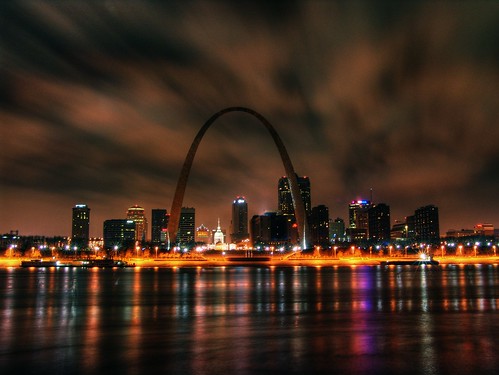
Well folks, we made it! They said we were mad, but we've finally broken the back of this beast and we've crossed the half-way point. So symbolically we're heading back upstream and crossing the Mississippi at St Louis, Missouri, 'the Gateway to the West'.

So let's pause for a moment beneath the Gateway Arch and look around. What is Missouri? Across the wide Mississippi it is symbolically the start of the great Midwest. It has a famous city in St Louis on its eastern border, and another on its western in Kansas City, the 'city of fountains'.

Okay, so Kansas City isn't that famous. I only know of it because I used to work with a guy from Missouri who always wore his Kansas City Chiefs cap and who told me tales of his upbringing in the marvellously-named town of Knob Noster. I cannot honestly say how many of his stories of twisters and storm-shelters, santeria-practicing Mexicans and uncles in the KKK are true. But he has certainly made me think more about Missouri than I ever would have done before. Pre-Tim all I could really have told you was that President Harry S. Truman hailed from the state, and it was in Fulton, Missouri, that Winston Churchill first coined the phrase "Iron Curtain" (just think how different the history of the Cold War would have been if he had called it "the Ferrous Drape"...).

So with Ringo's atrocious pun ringing in our ears, let's settle down and turn our attentions to this week's three films. The three I have chosen are:
  • Winter's Bone (2010)
  • Meet Me in St Louis (1944)
  • Waiting for Guffman (1997)