Showing posts with label Minnesota. Show all posts

Thursday, 14 June 2012

Purple Rain (1984)


Dir. Albert Magnoli
Starring: Prince, Apollonia Kotero, Morris Day, Clarence Williams III


I was dreaming when I wrote this so forgive me if it goes astray…

Actually, forgive me for using that quote. It is, of course, the opening line from Prince’s hit 1999. 1999 is one of the songs that doesn’t appear in his first feature-film, Purple Rain.  

The film focuses on musician The Kid (played by the artist formerly known as The Artist Formerly Known As Prince and who shall, hereafter, be referred to as ‘Prince’). The Kid dresses up like the bastard offspring of Adam Ant and the Cat from Red Dwarf (much like Prince). He plays with a group called The Revolution (whose members are played by the members of Prince’s own band, The Revolution) at the First Avenue club in Minneapolis (where Prince and The Revolution got their first big break). They perform blistering live sets, full of virtuoso rock jams and The Kid’s trademark gymnastic dance routines. But their star is on the wane. They don’t pull in the crowds they once did, The Kid is difficult to work with, his music is self-indulgent, and there are tensions within the band as he dictates what they do and play.

There are others waiting to take advantage of his momentary weakness. Morris (Morris Day) is leader of the rival band The Time, who perform wildly hubristic funk-pop at the same venue. He figures that if he can put together a girl group, one that’s sexy but classy, they can supplant The Kid on the club bill.

Into this clash of egos walks beautiful singer Apollonia (Apollonia Kotero). Everyone wants her – including The Kid. But Morris sees her as the missing piece for his girl group. This group becomes Apollonia 6 (despite there being only three members); the sexy but classy element is the three girls wiggling on stage in nowt but stripperific lingerie singing about a Sex Shooter. Meanwhile The Kid starts to recognise that his gift for music and his controlling nature both come from his tyrannical wife-beating father (Clarence Williams III). “Maybe I’m just too demanding / Maybe I’m just like my father – too bold” as the words of When Doves Cry go. With one last shot to ensure he doesn’t fade away he has search through his own internal conflicts to see if he can use the good from his background without becoming a slave to the bad. This means opening himself to the influences of his father’s music and the input from other band members.

Or something. I think. Frankly the script is a mess. And the acting doesn’t help much either. Prince is by no means the first musician-turned-actor we have come across – think of Elvis Presley in Blue Hawaii or Eminem in 8 Mile. But he is the worst. And the ensemble cast are stilted and flat in their delivery too. Clarence Williams manages to inject some depth into his performance as The Kid’s father in the one real scene he is given, but otherwise the only convincing and entertaining acting performances come from the preening Morris Day and his comedic foil of a valet Jerome (Jerome Benton). Now something has to be wrong when I’m enjoying the villain of the piece more than the hero. Prince / The Kid does come alive on stage, ripping through fantastic ‘live’ numbers such as Let’s Go Crazy, Darling Nikki, I Would Die 4 U and his triumphant resurrection with the title track Purple Rain (When Doves Cry  also appears on the soundtrack). It opens with Let’s Go Crazy and I immediately loved it – I thought I had stumbled upon a spectacular ‘80s cult classic. But off-stage he is a deeply unpleasant – weird even – character. His method of seducing girls is to take them out to the country on his big purple motorbike, get them to strip and jump into a lake, and then to drive away without them. He refuses to listen to a track Wendy and Lisa from his own band have been working on, staring in silence at them when they complain, and then holding a conversation with a monkey toy. Psychological trauma ahoy! 

Prince: one funky monkey

So, script bad, acting bad. The cinematography is actually pretty decent – as long as it sticks to the night. Night-time Minneapolis is a city of rain-slicked streets, dark alleyways and glowing neon, and its denizens look like New Romantic cyberpunk droogs with wildly-styled hair, face paint, skintight leather trousers and flouncy lace blouses (and that’s just the men). It looks like a wonderful companion piece to Ridley Scott’s Blade Runner. The harsh light of day melts away the urban flash style however, making everything look shallow and flat. There is one glaring moment when his father goes on the rampage where the visual quality changes completely. I assumed this was meant to be a flashback or The Kid imagining himself in his father’s place… but actually it was just because the final print of this scene got lost so they substituted a test shot instead. How cheap! The entire thing just needs a bit more care and attention paid to it. There’s no shortage of prep for the live musical numbers, so how come the rest of the film feels so much like an afterthought? 

I’m sure Purple Rain is a cult classic. I can imagine it in its proper place – projected onto the back wall of an indie bar with the sound turned off. And it did make me want to see Prince perform live. But ultimately the movie is pretty lame.

What have I learnt about Minnesota?
Minnesota isn’t all snowfields and lakes. It has a gritty futuristic (well, futuristic for the early ‘80s anyway) city scene too, one that produces innovative and ground-breaking music. The First Avenue venue is so famous for breaking new stars that a young woman like Apollonia is willing to get the Greyhound bus all the way from New Orleans to Minneapolis for her chance to make it big.

But there are lakes too. The Kid tells her that she must purify herself in the waters of Lake Minnetonka if she wants to make it big.

Can we go there?
The big star has to be the First Avenue & 7th Street Entry Club. The nightspot made famous by Prince (and which had itself made him famous) still exists and still hosts live music. The Hard Rock Café across the street did have a Prince exhibition upstairs, but it closed down in September last year. ‘The Taste’, where Apollonia 6 debut was actually the Union Bar. The rest of the film was shot on location in Minneapolis. Except for Apollonia’s hotel. You know, the Huntington Hotel, the one across the road from the club? Yeah, well it’s nowhere near First Avenue Minneapolis in real life: it is located at 752 S Main Street, Los Angeles.

Overall Rating: 2/5

Tuesday, 12 June 2012

Fargo (1996)


Dir. Joel Cohen
Starring: Frances McDormand, William H. Macy, Steve Buscemi, Harve Presnell


Fargo almost got mis-filed. The city of Fargo is located in the state of North Dakota. However, other than an opening scene in Fargo and a closing scene in Bismarck none of the rest of the film is set in North Dakota. Instead, the film is quite firmly set in Minnesota, and makes great play of several of the state’s idiosyncrasies. Good job I twigged rather than leaving it another eleven weeks and getting a nasty surprise. 

The plot of Fargo centres on a crime gone wrong. Minneapolis car salesman Jerry Lundegaard (William H. Macy) is so deep in debt that he can only think of one way to cover his losses: he arranges for his wife to be kidnapped. Her father is very wealthy – and very condescending towards Jerry. This ridiculous scheme sees Jerry making contact with two criminals in Fargo – the weaselly and “kinda funny-lookin’” Carl (Steve Buscemi) and the taciturn Norse giant Gaear (Peter Stormare). For a car and $40,000 (half of what Jerry says will be the ransom) they agree to drive to his house, kidnap his wife, and then release her once Jerry delivers the money.

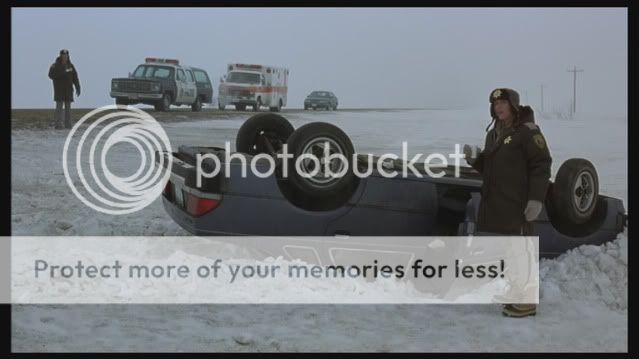
As with all great criminal plans it falters on one small mistake. Carl forgets to take the dealer plates off the car, and they are stopped by a policeman. A ham-fisted attempt to bribe the trooper doesn’t work and Gaear shoots him dead. A passing car sees Carl dragging away the corpse; Gaear pursues, runs them off the road, and then shoots the survivors. This crime brings in the heavily pregnant police detective Marge Gunderson (Frances McDormand) to investigate. She traces the car back to Lundegaard’s showroom; upon returning to Brainerd she is lucky enough to spot the vehicle itself and apprehend the remaining criminal. 

By that point there is only one remaining. Seven people die, two are arrested, and the million dollars of ransom is lost in the snow. The washed-out palette makes great play of the blue-white snow-bound landscape, contrasting it with the black of the road, fences and trees, and the sudden red of violence (be that blood seeping out into the snow or the red parka of a victim). I found myself comparing certain aspects to the intentionally graphic-novel-like Sin City.  It is quite a noir film. In places. Gaear’s inventive use of a wood-chipper for instance. But Marge is in no way a cynical hard-bitten noir hero like Gittes in Chinatown or Frank McCloud in Key Largo. She is an optimistic, upbeat, pleasant woman, full of niceties. When old school-friend Mike makes a move on her she knocks him back forcefully but kindly. She uses manners as a lubricant of social interaction. When she comes to speak to Jerry she does it with a smile on her face and an open manner – but she is also quite purposeful about getting a seat and drawing him into conversation. Even in what could be very dark scenes there is lightness from her performance – witness her investigation of the crashed car. She almost throws up – but that is not a reaction to the deaths, but just morning sickness. And of course she listens to what the other officer has to say and then derails him with a “I’m not sure I agree with you a hundred per cent on your police work there Lou”. Her constant eating and her satisfied home life contrast with the darkness of the crime she is investigating. Her safe, slightly dull existence is what we should be aspiring to, not the brutal, sleazy world of Carl and Gaear.

Marge always went one step too far in the
Design-Your-Own-Sledge competition

Fargo did great guns when it was released. The Coens had developed a reputation as film-makers, but this was them breaking into the mainstream. Frances McDormand won the Academy Award for Best Actress for her role as Marge. The film is certainly watchable, but considering that it post-dates Quentin Tarantino’s arrival into the world of cinema I can’t help thinking that is doesn’t have much of an edge to it – despite sudden and shocking convulsions of violence. In Tarantino’s work the humour comes from hip wit and word-play; one can imagine quick reactions in speech and quick reactions in fights being natural bedfellows. In Fargo the humour comes from the characterisation and the personalities involved. All the best character-driven humour gets the audience to sympathise with the subject, even when the people involved are the likes of Basil Fawlty or David Brent. But we cannot really sympathise with the twitchy indebted Jerry, without knowing how he came to be in that debt in the first place, despite his “you’re darned tootin’”s and “what the heck”s. And we certainly cannot sympathise with the two criminals. So the film is beautiful to watch, entertaining to see, but still somehow lacks something to turn it, in my eyes, from a good-enough film into a classic one.

What have I learnt about Minnesota?
When the snow comes down in Minnesota it comes down very heavily. Parked cars can get covered, incautious drivers can end up off the roads, lakes are frozen over, and everyone has to swaddle up in boots, padded parkas and jackets.

To go with the snowy landscape there is a very strong Scandinavian heritage in Minnesota. One can spot this from the names of characters that appear: Marge and Norm Gunderson, Jerry Lundegaard, Wade Gustafson, Gaear Grimsrud. There is a distinctive local accent with traces of Scandinavian inflections and flat vowels. This goes together with a personality known as ‘Minnesota nice’, which places an emphasis on manners and politeness.

Brainerd, mid-way between Minneapolis and Fargo was the home of Paul Bunyan, the legendary giant lumberjack, and Babe the Blue Ox.  

Can we go there?
Fargo might be named after a town in North Dakota, but all shooting took place in Minnesota. After their psychedelic desert odyssey in Raising Arizona this was a return to home territory for the Coens, who grew up in Minneapolis. As such they knew the terrain well.

The King of Clubs in Fargo, where Jerry first meets Carl and Gaear, was not in Fargo at all – it was actually on Central Avenue in Minneapolis (though it has since been razed). Likewise Jerry’s car dealership was in the suburb of Richfield off Interstate 494; it is now somewhere under the corporate headquarters of Best Buy. The Lundegaard’s house was on Pillsbury Avenue, Minneapolis. Carl steals a licence plate from the parking lot of Minneapolis-St Paul Airport; he later meets up with Wade Gustafson in the lot of the private-members Minneapolis Club. The Jose Feliciano concert he takes an escort girl to was at the Chanhassen Dinner Theatres south-west of Minneapolis. Marge stays at the Radisson in Minneapolis.

Outside of Minneapolis, the kidnapper’s cabin can be found north of Stillwater - and was sold on ebay. The police station in Edina stood in for that in Brainerd. And the giant Paul Bunyan statue is not in Brainerd either. It is the one thing that can actually be found in North Dakota, located on Pembina County Highway 1 outside of Bathgate. However, since 2003 there has been a Paul Bunyan Land amusement park in Brainerd.

Overall Rating: 3/5

Monday, 11 June 2012

Juno (2007)


Dir. Jason Reitman
Starring: Ellen Page, Michael Cera, Jennifer Garner, Jason Bateman

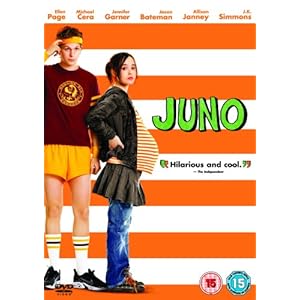
Juno MacGuff (Ellen Page) is a sixteen-year-old girl living in Dancing Elk, Minnesota, and she is, like, too cool for school. She, like, radiates confidence and über-hipness. For shizz. She spends her time kicking it old school. listening to Iggy and the Stooges and watching Dario Argento slasher pics. I know – honest to blog, how cool is she for a sixteen-year-old? Oh, and she has a best friend, Paulie Bleeker (Michael Cera), and she just got pregnant by him. So she needs to nip that in the bud because she’s heard that pregnancy often leads to “you know… an infant”. Wizard. 

And thus does Juno speak. She announces that her waters have broken by crying out “Thundercats are go!” In many ways she is the idealised way we could wish our sixteen-year-old selves were: articulate, funny, confident, opinionated, has taste beyond her years. She plays the guitar and knows – knows! – that the boys want her. I’m not sure if writer Diablo Cody (yes, the former stripper who won the Academy Award for her Juno screenplay) was ever quite so precocious, or whether Juno is just how she wished she could have been. The only cloud on the horizon is just that she seduced Paulie and now she’s up the spout and she doesn’t think that she can go through with an abortion. So she arranges to give her baby up for adoption once born, and even identifies the couple to whom it shall be given: Mark and Vanessa Loring. Vanessa (Jennifer Garner) is just a tad anally retentive who seems to want a baby to complete her picture perfect family; Mark (Jason Bateman) was in a band, listens to Sonic Youth and watches Hershell Gordon Lewis B-movies. Needless to say Juno gets on with him famously.  

What is coolness? I would define it as an imperviousness to outside problems, a refusal to be phased. Juno has that in spades. She is remarkably blasé about being pregnant – look at how she breaks the news to Paulie, sitting on his lawn in a reconstruction of the room in which they had made love, sucking on a pipe. The only thing that can affect her is the idea of love. This gets her. When Paulie – at her suggestion – invites someone else to the prom it does upset her. She realises that she does in fact love him. Again, she is quite happy to give away her baby, but she wants the child to go to a loving family. When it becomes apparent that there are problems in Mark and Vanessa’s relationship this really affects her. Of course, she tries to deny it, claiming that she is “just allergic to fine home furnishing.” But this touches off her own abandonment issues from when her mother walked out. Her plea to her father is that “I need to know that two people can stay happy together forever.” 

True love is a kiss and a finger

Even though Mark is way cooler than Vanessa and Juno can relate to him as a friend he has proved himself to be, not to put too fine a point on it, a dick. Whereas Vanessa, for all her uptightness, clearly wants to become a mother more than anything. The subject of babies brings out an insecure fragility to her. But Juno has seen her at the mall with a child, and knows that she would be a good and loving mother. And let’s face it – Juno would be a terrible mum. The idea of her keeping the baby is not once entered into. Yet, for all that, the subject of parenthood is a recurring theme. And frankly it is refreshing to see such a sympathetic picture of parenthood within the MacGuff household. The adults are pretty cool, and cope with the unplanned pregnancy even though they are shocked by it. Her father (J. K. Simmons) has a light, humorous approach to parenthood. He greets his daughter with a friendly “Hey there, big puffy version of Junebug”, he jokingly threatens his younger daughter that he will “kick your little monkey butt” and he thanks the Lorings for “having me and my irresponsible child over” to their house. Juno also has a step-mother. Usually in fiction there is only one kind of step-mother: the wicked kind. That is not the case here. Bren (played by Allison Janney, last seen as Penny’s wicked mother in Hairspray) is supportive of her step-daughter. Her views on the news that Juno is pregnant is a succinct “I think that kids get bored and have intercourse.” She may be a church-ger but she is not in the least judgemental. She gives an insolent ultrasound technician a verbal dressing down (prompting an awe-struck Juno to breathe “Bren! You’s a dick! I love it!”) and is also there for Juno when she gives birth. 

It is the dialogue that makes the film a delight. I’m not sure that in reality one would ever find a grocery store clerk coming out with lines about a pregnancy test like “That ain’t no Etch-a-Sketch. This is one doodle that can’t be un-did, Homeskillet.”  And Juno is preternaturally too cool for school. But there is an infectious joy in the use of language (“Zeus had tons of lays, but I’m pretty sure Juno was his only wife. And apparently she was supposed to be super-beautiful but really mean – like Diana Ross”). I should also mention Bren’s withering comment that “doctors are sadists who like to play God and watch lesser people scream”, a line that creased up my medical professional girlfriend. Does it glamourise teen intercourse? No, it really doesn’t. Is it pushing a pro-life message? Not really – Juno does not have any ethical issues about seeking an abortion. Sue-Lynn may be the world’s worst picketer but she does amaze Juno by informing her that her foetus would already have finger-nails. If anything the film is pro-choice: it is Juno’s body and she decides what she wants to do and then informs her parents and Paulie afterwards. You make mistakes and shit happens – you deal with it as best you can and try not to hurt those around you as you deal with it. The incident even helps to bring her and Bleeker closer together in the long run. 

What have I learnt about Minnesota?
Minnesota isn’t some rough frontier province. Even when Juno travels up to St Cloud (which Bren describes as being out in “East Jesus Nowhere”) we see a very affluent lifestyle, where there are roads lined with McMansion after McMansion, designer living estates, and affluent young professional couples with an interest in interior design. Pregnancy test kits (and gallon jugs of Sunny D) can be bought in convenience stores. Giving birth in hospital costs money. Sixteen-year-olds can drive in Minnesota, and there are even places where they can procure hasty abortions without parental consent; I am not sure how true either of these things are for other states. For the problems and challenges teenagers face, they might as well be in California as Minnesota.  

Minnesota is not California however. They certainly have more pronounced seasonal changes. When winter comes they get snow on the ground. And even if the town in question is fictional, there is an expectation that a name like ‘Dancing Elk’ would not be drastically out of place in Minnesota.

Can we go there?
If one did not know, there are very few clues to lead the audience to notice that Juno is, in fact, set in Minnesota. It certainly doesn’t broadcast the fact. And the town of Dancing Elk is wholely fictional. To be honest, I’ve had some fun trying to work out precisely where on the map it might be supposed to be located. My best guess is a suburb somewhere to the west or south-west of Minneapolis. My reasoning? St Cloud is described as an hour’s drive away. Juno and Paulie’s lab-partner goes to visit his brother at college in Mankato. Just outside of Mankato is the Minneopa State Park (the name ‘Minneopa’ having several possible derivations, one of which being ‘Water of the Dancing Elk’). And Juno makes reference to the fountain at the Ridgedale Mall in Minnetonka.  The Lorings are quite definitely placed in St Cloud however. I can’t help wondering whether it is deliberate that the potential adoptive parents live there considering that the orphanage in The Cider House Rules was called ‘St. Cloud’s’. 

However, none of the film was in fact shot in Minnesota. Filming took place in and around Vancouver in Canada. The  Macguff residence can be found at 4053 32 Avenue West in Dunbar, and Paulie Bleeker lived at 3961 36 Avenue West, four blocks away. The Eric Hamber Secondary School was used for Dancing Elk High, with South Surrey’s Athletic Park track for the sports ground at the school. Town shots took place in Burnaby, with the Hanna Medical Clinic being used. The Coquitlam Center Mall was used for the scene where Juno and Leah bump into Vanessa. Vanessa and Mark’s house was 13926 23 Avenue in White Rock 

Overall Rating: 3/5

Week 24: Minnesota

"Of travel I've had my share, man,
 I've been everywhere;
 I've been to:
 Reno, Chicago, Fargo, Minnesota..."
 - 'I've Been Everywhere Man',
 Johnny Cash

Sounds like Johnny's getting tired of the travelling. But it's only Week 24 - we've got another 26 still to go! This week we are visiting Minnesota... and possibly paying a side-visit to Fargo, North Dakota at the same time.

What does the mind's eye picture when Minnesota is mentioned? I suppose I think of miles of timberland choked with snow, a great freezing forested taiga. And the great outdoors does have a part to play here. Minnesota is known as the Land of 10,000 Lakes and even just a cursory glance at my atlas has shown me that the state is indeed speckled with lakes, swamps and rivers. The mighty Mississippi is born in Minnesota and the north-eastern border with Canada is comprised of the Voyageurs National Park (think of Ray Mears paddling a canoe). This was a land that was home to the Dakota and was visited by French fur-trappers. Large swathes of the northern half of the state are still given over to Indian reservations. From which we can gather that there are no precious metals buried in the state's soggy soil. Later Scandinavians settled here giving rise to the burly Minnesota Viking stereotype - Marshall Eriksen from How I Met Your Mother comes from St Cloud. The state seems quite folky (Bob Dylan hails from Hibbing and Garrison Keillor's A Prairie Home Companion is set around the fictional Lake Woebegone) and its manners have given the U.S. the phrase 'Minnesota nice'.


But for all the folky countryside there is the big city too. Or cities. Many of the states we have visited have just one stand out city; Minnesota has two. The Twin Cities of Minneapolis and St Paul are separated by the Mississippi. Minneapolis has a name of Dakota descent, is younger and more 'urban' with its skyscrapers and its larger population; St Paul is of French descent, has neighbourhoods and Victorian architecture.

For our two-city state we have, as usual, three movies to get through. These are:
  • Juno (2007)
  • Fargo (1996)
  • Purple Rain (1984)
Am I looking forward to them? Yah, you betcha...