Showing posts with label Maryland. Show all posts

Tuesday, 22 May 2012

The Blair Witch Project (1999)


Dir. Daniel Myrick, Eduardo Sanchez
Starring: Heather Donahue, Michael C. Williams, Joshua Leonard, Patricia DeCou


Lightning only strikes once. And with The Blair Witch Project it struck so ferociously and so brightly that it could never again be recaptured. The film is the perfect storm of suspense, improvisation and guerrilla marketing. 

The film tells the story of three student film-makers, Heather (Donahue), Mike (Williams) and Josh (Leonard). For a college project they have decided to make a documentary about a local legend: the Blair Witch. They head to the nearest town and interview the locals about the legend. They then hike into the woods to find some of the sites associated with the myth. They get lost on the way out. And a series of unexplained phenomena starts to follow them, slowly terrorising them. Maybe the stories about the Blair Watch are true…? 

Firstly, the film really works on the suspense. It does not have monsters looming out of the mist. Everything is subtly done. We are first presented with a variety of legends about the Blair Witch. These are left to percolate in the viewer’s mind. We then see the sites of some of these horrific attacks – ‘Coffin Rock’ and a cemetery with seven small rock cairns. And then things start to escalate. Night-time rustles in the bushes. More stone cairns, outside the tents. Strange stick figures hanging from trees. Children’s voices. Something shaking the tent. Something seen of-camera. Goo over Josh’s gear. A disappearance. A blood-soaked bundle of twigs and clothing containing a tooth. Screams in the night. And finally a climax at a ruined house in the middle of the woods, its walls marked with runes and the imprints of children’s hands, and then a scene down in the basement that tied in to those earlier stories. Frankly, never before have a few small stones and twigs been so frightening. And all the while we have the three film-makers’ growing hysteria and terror. What we see might not seem that scary to us, but it clearly scares the shit out of them, and fear is so contagious. We get sucked in to their increasing desperation. Blair Witch holds true to the inadvertent lesson learnt from Jaws – the longer the monster remains unseen, the scarier it becomes. And in this case, the monster is never seen.  


Sticks and stones may break your bones...


The reason the reactions of the characters seem so genuine, is because they were. They were hired to improvise. They were given general guidelines on what to do and how to behave and directions to take them from scene to scene. But their reactions are their own. When their tent is attacked in the middle of the night it genuinely did come as a surprise to them, and their screams and the flight is honest (as is Heather’s reaction to something she sees but the camera doesn’t). When they walk all day and find themselves back at a log over a stream they had passed first thing that morning their anger and dismay is real. They did not know how the film was going to end, and they did not know that the original stories about the Blair Witch were all made up. Those people they interviewed at the start of the film were all plants. 

What turned it from a clever piece of film-making into a phenomenon was the marketing. It was made on  shoestring budget (apparently the cameras used were either returned for a refund or sold on ebay after shooting was completed). Once picked up by a studio the framing device could be publicised. The meta-story is that the events depicted really happened in October 1994, and that Heather, Mike and Josh were never seen again. Their cameras were discovered a year after their disappearance and that what is seen is a true record of their week in the Black Hills. The DVD even contains a 45 minute documentary, The Curse of the Blair Witch, which supposedly is a documentary about their disappearance and creates some sort of back-story for the witch. It includes snippets of the film, interviews with friends and family, references to historic documents and clips from a 1970s documentary. All were faked. It blurs the line between fiction and reality. It is a mockumentary, and as such clearly influenced a hole host of 21st century media, from Paranormal Activity to The Office. The internet was cleverly harnessed to spread the story and stoke up interest. Basically, it is the first example of a phenomenon ‘going viral’. 

I remember watching it sometime in 1999 or 2000. Fittingly it was watched on a computer monitor in a friend’s room at university. Coming back to it twelve years later the film still felt fresh. Even though I knew the story, and knew how it would end I still got goosebumps as the end drew near (and this on a sunny summer evening). If anything, the second watch was more rewarding – I paid attention more to the legends at the beginning and could then tie them in to events that happened in story. I wouldn’t say that I was scared, but I was certainly thrilled by it. The Blair Witch Project is a masterpiece of what can be done on $25,000 if the idea, the execution and the marketing is right. Michael Bay should take note… 

What have I learnt about Maryland?
The film focuses on Maryland's colonial history. In isolated settlements back in the 18th century witchcraft could be believed in and feared by the residents (the Curse of the Blair Witch documentary argues that this might have arisen because Elly Kedward was a Catholic is a predominantly Protestant town). And local myths and legends can be taken seriously even today if there is enough colour or evidence behind them. Where one might not give credence to these stories in the middle of a city or in the suburbs, travel out to the small towns in the wooded hills and they become much more plausible. 

Can we go there?
Burkittsville really exists. It is in southern Frederick County, near the border with Virginia. It was never called ‘Blair’ however, and the locals are apparently sick and tired of their link to this film. The ‘Welcome to Burkittsville’ sign was stolen so many times they now have a completely different sign welcoming visitors. The cemetery was really in Burkittsville; it doesn’t have a preponderance of children’s graves from the 1940s however.

The land around Burkittsville is hilly, but there are no ‘Black Hills’, ‘Tappy Creek’ or ‘Coffin Rock’. In fact, as the film shows, the filmmakers trek across some pretty flat terrain. This was Seneca State Park, near Gaithersburg, just north of Washington D.C. The abandoned house that Heather and Mike discover at the film’s climax was in Patapsco Valley State Park near Ellicott City, just west of Baltimore. It was called the Griggs House in real life, but it has now been torn down. 

There are a plethora of minor locations seen in the opening sections of the film. Mike’s house is in Wheaton, Maryland. They then stock up on supplies at Staub’s Country Inn in Beallsville (now HarBro Protection Solutions). They interview the waitress at the Silver Rail Diner (now Mommer's Diner) in Brunswick, and are told about the child murders outside Adamstown Village Market (now Stup’s Market) in Adamstown. The motel they spend their first night at is the Hillside Motel in Knoxville. 

Overall Rating: 4/5

Sunday, 20 May 2012

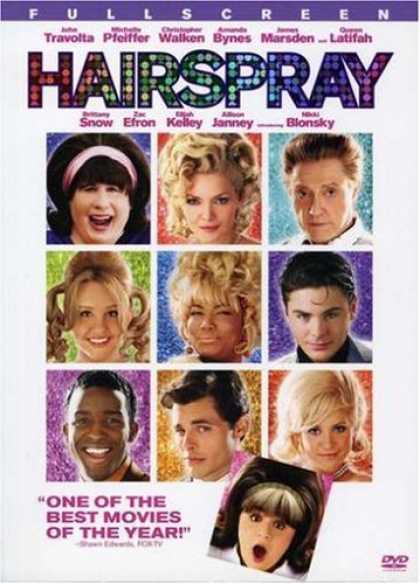
Hairspray (2007)


Dir. Adam Shankman
Starring: Nikki Blonsky, John Travolta, Michelle Pfeiffer, Christopher Walken 


And so from a John Waters film to a film based on a Broadway musical that is itself based on a John Waters film. 

With a cry of “Good Morning Baltimore!” we are introduced to Tracy Turnblad (a brilliant debut from Nikki Blonsky). It is 1962 and she lives for just one thing: the music and dancing on TV’s The Corny Collins Show. When the show announces that it is looking for a new dancer Tracy is determined to apply. The only problem is, she’s not the usual teenage pin up. She’s, well, almost as big as her beehive. And this is an era in which conformity is prized. Anyone different, be they Tracy with her extra baggage or Motormouth Maybelle (Queen Latifah), host of the monthly ‘negro day’, is seen as a threat by station producer Velma Von Tussle (Michelle Pfeiffer, now all grown up from her previous appearance, in Scarface).  

The film, then, is – true to Waters’ vision – about not being afraid to be different. Tracy and her even larger mother Edna (played by John Travolta) find acceptance and self-belief. More inspiring is the move towards integration of the black community, whether it is the ending of segregated TV broadcasts or the budding romance between Seaweed (Elijah Kelley) and Penny (Amanda Bynes). The candlelit march to the TV station to the tune of 'I Know Where I’ve Been’ is the emotional core of the film, and is moving. In this, really only Velma, the police / security guards, the news networks that exaggerate Tracy’s brush with the law and Penny’s straitlaced and fundamentalist mother (The West Wing’s Allison Janney) are the bad guys. Even Velma’s daughter Amber (Brittany Snow) turns away from her mother at the film’s end. The TV show’s sponsor is willing to bend once he sees the way the wind is blowing and heart-throb Link (Zac Efron) looks out for his career and then regrets abandoning Tracy when she does the right thing. In comparison her joke-shop owning father (Christopher Walken) loves Edna whatever she looks like, as he expresses in the song ‘You’re Timeless to Me’. Corny Collins is an enthusiastic integrationist and Maybelle is colour-blind. And, as the end shows, the viewing teenaged audience have no racial prejudice.  

Okay, so the film shoots into an open goal. So what? It has a period setting for a reason – in the ‘60s there was a divide between black and white, and a lot of people supported that. Today the storyline is not shocking. In fact, Tracy is not even particularly fat; she is big-boned rather than obese. And the conceit of having Tracy’s mother being played by a man isn’t shocking either. In Water’s 1986 original drag-queen Divine played the role; 21 years later and it is Hollywood star John Travolta. The portrayal is not particularly controversial: Travolta plays Edna like a pantomime dame. If you’re British you will have seen something similar by your sixth Christmas. Still, he seems to be enjoying himself in women's dress (perhaps not surprisingly if one believes current news stories...). But the basic storyline and the central themes is still mostly that of Waters. Baltimore is seen as a haven of individuality, from the beehive hairdos to Wilbur’s Hardy Har Hut to the eccentric characters Tracy sees on her way to school (one of whom, “the flasher who lives down the street”, was played by Waters; the woman he exposes himself to is his long-time collaborator Mink Stole, who played Sylvia Mallory in Cecil B. Demented and Tammy in the original Hairspray). Other cameos from the original film include Jerry Stiller (Ben’s dad) who was the original Wilbur and now appears as Mr Pinky and Ricki Lake, the original Tracy (and who also appeared as Libby in Cecil B.) appears as a talent agent. 

Not so Divine: Travolta makes it big on the main drag

But it is not directly comparable to the original in one key respect: the nature of the film. It is not a quirky independent film with a limited budget; it is a big budget studio (uh-oh!) production of a glossy Broadway musical! It is big, bold, brash and bursting with energy. The colours are vivid, the characters stylized, the comedy obvious. And it is full of music and songs. And many of the songs are very good. As well as the aforementioned Good Morning Baltimore and I Know Where I’ve Been I also have to single out I Can Hear the Bells. And You Can’t Stop The Beat has become a modern classic. The music is often clever: witness the two different (white and black) versions of The New Girl in Town. And it is added to with good, well-choreographed dance routines. There’s comedy pitched at different levels – I appreciated Maybelle’s wry comments that “if we get anymore white people in here, this is going to be a suburb” or that whites have less to fear on black streets than blacks do on white streets, but I also appreciated Wilbur’s Whoopee Cushion air-mattress too. All in all it is a really entertaining crowd-pleaser. 

What have I learnt about Maryland?
Again with the seafood! Velma is a former ‘Miss Baltimore Crabs’. The initial shot shows Baltimore as a harbour city so maybe that’s no surprise. Baltimore also seems to be a city of terraced housing with corner-shops populated by eccentrics and individualists. The locals call each other “hon”. A lot. 

But most of all it depicts Maryland as a Southern state with open racial segregation and discrimination (interracial marriage was actually illegal in Maryland until 1967, so I hope Seaweed and Penny were not planning on settling down too quickly). 

Can we go there?
Like the original John Waters films, the setting is Baltimore. However only the first establishing shot of the city by the bay actually was Baltimore. The rest was Toronto and Hamilton in Canada. The intersection of Dundas Street West and Roncesvalles Avenue in Toronto was used for many of the street scenes. Lord Lansdowne Public School was used for all school exteriors and some interiors, with the remainder being shot at Hamilton’s Queen Victoria School. Other scenes took place on sets at Showline Studios. 

Overall Rating: 4/5

Saturday, 19 May 2012

Cecil B. Demented (2000)

Dir. John Waters
Starring: Melanie Griffith, Stephen Dorff, Alicia Witt, Adrian Grenier

To commence any cinematic exploration of Maryland, one would have to start with something by John Waters. Baltimore’s own maverick film-maker has been producing work close to his heart (and close to his house) since the ‘70s. His work includes 1972’s Pink Flamingos (famous for the scene in which transvestite Divine eats dog faeces), 1988’s Hairspray (starring Ricki Lake which later spawned a musical remake), and 1990’s Cry-Baby (with Johnny Depp). I could have watched any of those movies, but I was recommended to seek out the more recent Cecil B. Demented.
 
Cecil B. Demented can be seen as Waters’ testament. It is his chance to take a pop at all those things about Hollywood / the studios / mainstream American cinema that irk him. In it Hollywood star Honey Whitlock (an exceptionally game Melanie Griffith) is kidnapped by the eponymous Cecil B. Demented (Stephen Dorff) and his gang of guerrilla film-makers (the SprocketHoles). They aim to cast her in a piece of agitprop cinema outside control of the big studios. They are devoted to the great auteurs of world cinema and believe that movies should be art – which means that it might well be offensive, tasteless, violent, pornographic and, well, un-popular. At first Honey is held against her will. However, as shooting (in all senses of the word) progresses she realises that the old her had a reputation as an unlikeable, diva-ish hack actress. The knives are already out for her. And so she resolves to go for it, and give the performance of her life. She even contributes her own ”vision” of what they should be doing – in her case, invading the set of a Forrest Gump sequel, ‘Gump Forever’.
 
This shows the sort of enemy Cecil and his demented followers have identified. When Fidget (Eric Barry) wavers and wants to return to his parents, the other SprocketHoles remind him of his folks’ bad taste: “Just remember, your parents liked Godzilla…They wouldn’t even let you see R-rated films as a child… They’ve never even been to a midnight movie… They enjoy classic TV sitcoms turned into feature-length films… They’ve never rented a porno movie… And to top it all off, they talk out loud in the theatre once the feature has begun.” Even Honey agrees that that last trait “really is unforgivable”. There are plenty of other pot-shots along the way: Pauly Shore marathons, multiplexes showing nothing but Star Wars or Star Trek, the director’s cut of Patch Adams, the Flintstones sequel, directors who take classic European films and then remake them for an American audience (prompting said director to splutter that American audiences will not read subtitles). The Moving Picture Association of America (“Hey, hey, MPAA – how many films have you censored today?”) and the Baltimore Film Commission get extra special ribbings. Basically, if it’s safe or unadventurous or mainstream or – heaven forbid! – popular it is precisely the sort of thing that Cecil and his SprocketHoles hate.
 
So what do they love? Well, they have their agitprop-y slogans: “I’m a prophet against profit!”, “Technique is nothing more than failed style!”, “Family is just a dirty word for censorship!” The SprocketHoles worship those directors who, like Cecil, imprint their works with their own personal vision and style: Otto Preminger, Andy Warhol, David Lynch, Spike Lee, Kenneth Anger, Pedro Almodovar, Sam Peckinpah, Rainer Werner Fassbinder. The gang comprises the outcasts and unmentionables – drug addicts (Adrian Grenier), ex-porn actresses (Alicia Witt), satanists (Maggie Gyllenhall), homosexual rednecks (Mike Shannon), and heterosexuals ashamed of their heterosexuality (Jack Noseworthy). And in key segments they are helped by kung fu movie fans, the occupants of a porn theatre and an ironic student crowd at a drive-in cinema. If something could ever possibly be described as a ‘cult movie’ then it is certainly in the good books of this cult of movie-makers – appropriately enough as John Waters revels in his reputation as a cult movie-maker. There are elements of his own cult style in there. Regular collaborator Ricki Lake (yes, the chat-show hostess) appears as Honey’s publicist, and Fidget’s mother is played by Patty Hearst (the heiress who was, in real life, kidnapped by the Symbionese Liberation Front and later joined them in their activities – a clear influence upon the story here).

Shooting in Baltimore: Melanie Griffith becomes a cinema terrorist

Overall though, this is Waters let loose with a big budget. No more small-town stories, this has a huge cast, a Hollywood star, guns, explosions, car-chases and stunts. One might almost say that this is John Waters going mainstream. Hollywood movies are all about action rather than personal dynamics, and I would say that this film is, yes, an action movie. Laced with plenty of humour along the way. This is Waters’ own Blues Brothers (though with fewer musical numbers and, if I’m honest, better jokes). So it is not quite as revolutionary as Waters, I think, intends it to be.
 
What have I leant about Maryland?
It seems to be all about the seafood here. Honey is sick of the crab cakes and steamed crabs. Later, the movie execs literally get sick on oysters.
I get the feeling that Baltimore’s style is not for everyone. Honey is furious when a white limousine is sent to pick her up. Obviously though, Waters celebrates the quirkiness of the city’s inhabitants, from the extremes of the SprocketHoles’ various personalities, to the dinginess of its porn cinemas, and to the zeitgeist-y irreverence of the drive-in’s patrons.
Oh, and obviously the Baltimore Film Commission has quite a lot of sway. They are portrayed as wanting to attract movies to shoot in the city.
 
Can we go there?
As one might expect from a John Waters film, the entire movie was shot on location in Baltimore. Honey Whitlock is at first ensconced (in the Presidential Suite) of the Harbor Court Hotel, before she is kidnapped from the Senator Theatre (currently closed for renovations). The Hippodrome (now the France-Merrick Performing Arts Center) was used for the gang’s lair. And Bengies Drive-In was used for the film’s climax.
 
Overall Rating: 3/5

Week 21: Maryland

"William Zanziger who, at 24 years,
 Owns a tobacco farm of 600 acres,
 With rich wealthy parents who provide and protect him
 And high-office relations in the politics of Maryland,
 Reacted to his deed with a shrug of his shoulders..."
 - 'The Lonesome Death of Hattie Carroll',
 Bob Dylan

From the far north of Maine I am heading down the Atlantic seaboard to Maryland, one of the northernmost Southern states. In fact the famous Mason-Dixon line runs along Maryland's northern and eastern borders separating the state from Pennsylvania and Delaware.

Delaware? Oh great. Delaware was a small state ranged along the shores of Delaware Bay, and I had awful trouble finding films set there. Maryland is a small(-ish) state ranged along the shores of Chesapeake Bay. Is it likely that I will have trouble finding films set here?

Thankfully, the answer is 'no'. Maryland seems to have quite a lot going for it. I know that it was founded specifically as a Catholic colony, that its port city of Baltimore was historically one of the largest and most important cities in the U.S. and that, bizarrely, it is one of only seven American states where it is illegal for atheists to hold office. Baltimore still holds a powerful attraction, whether it is as the seedy drug-gang-ravaged setting of the TV series The Wire, or just as the home of the campily kitsch (or possibly kitschly camp) film director John Waters. And in case that's not urban enough for you, the northern suburbs of Washington D.C. spill over into Maryland too.

So all things considered, I shouldn't have too much trouble finding three films set here - even if I have to use three John Waters films. I'm not going to do that however. I hink that just one Waters is plentiful... and another film based on his works. My three films are:
  • Cecil B. Demented (2000)
  • Hairspray (2007)
  • The Blair Witch Project (1999)