Showing posts with label Idaho. Show all posts

Thursday, 29 March 2012

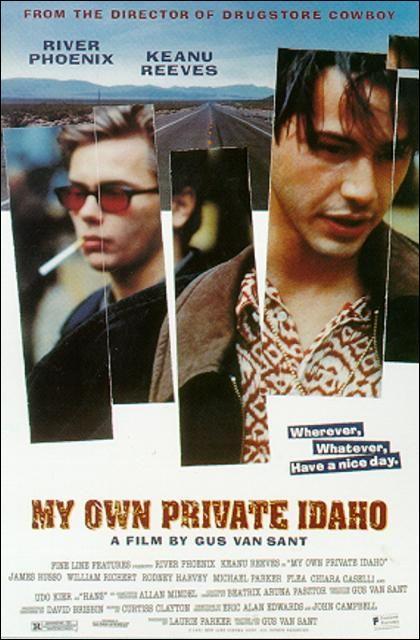
My Own Private Idaho (1991)


Dir. Gus Van Sant
Starring: River Phoenix, Keanu Reeves, James Russo, William Richert


Twice during Gus van Sant’s My Own Private Idaho the same image appears: salmon swimming upstream. Consider that image. These salmon are born in the headwaters of rivers, before swimming down to the sea. They voyage many thousands of miles before, finally, miraculously, finding their way back to the very spot where they were born. There, their life’s journey completed, they die.

I’m sure there’s meant to be some meaning to that image, so here goes. The two protagonists of the film are, in many ways, like those fish. Their stories interweave. First we have Mikey (River Phoenix), a wandering narcoleptic (he is prone to falling asleep suddenly and without warning). He says that he has “been tasting roads my whole life”. He wakes in Idaho, sure that he has seen this same stretch of road before. His thoughts turn towards his mother. He falls unconscious yet again. When he wakes he is in Seattle, being sucked off by a john. Because he is a rent boy. He travels from Seattle to Portland in the company of fellow hustler Scott (Keanu Reeves) before his thoughts turn once more to his mother and he sets out on a bit of a bildungsroman to find her. His quest takes him back to the place of his birth, to Idaho, to his brother / father / whatever Richard (James Russo), then to a hotel (the "Family Tree" appropriately enough) where his mother was known to have worked, and then, incredibly, to Rome. It turns out that Mike’s mother, like Mike himself, is trying to trace her own family. At every step of the way he has just missed her. With no more clues to follow and deserted by Scott he heads back to Portland and sinks back into the gay subculture. Increasingly manic he lives on the streets. But Idaho pulls him like a lure. He is last seen on that same stretch of deserted highway, asleep, being loaded into a passing truck, for who knows what end.

Scott too cannot escape his birth. Except that he knows who his father is – his father is the Mayor of Portland. Scott sinks into the excesses of hustling, robbing and having no fixed abode, encouraged by and in turn encouraging the Fagin-like Bob Pigeon (William Richert). But he tells Bob that when he turns 21 he will leave that life behind and return to his inheritance and his family. “My mother and father will be surprised at the incredible change. It will impress them more when a fuck-up like me turns good than if I had been a good son all along”. His thinking is that he will gain more respect by being bad and then repenting than he ever would be being a good boy all along. And so it transpires. While he joins Mikey on his quest his climactic moment comes in Italy when he meets the young woman Mike’s mother had been teaching Italian to. Scott falls in love with Carmella (Chiara Caselli). He leaves with her. When we next see him he is groomed and suit-clad, Carmella on his arm, taking his place in Portland high society. Confronted by Bob, Mike and the rest of the gang he turns away from them, breaking Bob’s heart – literally. But in the cemetery his eyes stray from the sombre funeral of his own father to the riotous assembly commemorating Bob, and the viewer gets the impression that he knows where he would rather be…

These two characters and two stories interweave about the other. The problem is that they come in two very different styles. Mike’s tale is impressionistic. When he thinks of his mother or otherwise gets stressed he collapses. In his mind’s eye we see snapshots of family life and the seemingly limitless plains of Idaho, empty and void, the clouds scudding overhead. But it is his plot we follow, his need to find his mother that drives the tale along. By comparison Scott’s tale is forced into literary conventions. The plot here is, bizarrely, lifted straight from Shakespeare: Henry IV pts I & II to be precise. Scott is Prince Hal, heir to the King of England / Mayor of Portland. The debauched “Santa Claus” of Bob Pigeon is the dissolute Falstaff, squiring the young prince around the murky underworld of his home city. Even the language and staging is Shakespearean. I have never seen or read Henry IV so I do not know how true to the source material the film is. However, the lines sound like Shakespearean lines with the occasional modern word like “punks” or “zips” thrown in. Bob declaims in an English accent. “Let us not call ourselves robbers” he says “but Diana’s foresters. Gentlemen of the shade. Minions of the Moon. Men of good government.” And the set pieces – Bob’s arrival, the robbery, Bob’s tall tales about that robbery, the sheriff’s raid and Scott’s final turning of his back upon Bob – ring true as Shakespearean plot points. Even the acting is Shakespearean – the forced jollity and back slapping from the gang reminded me of school productions, where the unsure cast try too hard to bring in action to make up for the fact that they’re not exactly sure what the words coming out of their mouths mean. And then, suddenly, when Scott and Mike are alone once again, Keanu starts speaking normally. It is a disjoint. It jars.

What is most interesting really is the characters’ different attitudes to homosexuality. There are as many different colours of homosexuality as there are gay porn magazines on the shelves in one of the movie’s most playful scenes. For Scott, it is just a phase, and anyway, he’s not gay. He argues that “two guys can’t love each other”. He only sleeps with men for cash. It is only when you do it for free that you start to “grow wings, and become a fairy”. Mind you, as Bob points out, he doesn’t actually need the cash – he comes from a rich family and will inherit a fortune when he turns 21 in a week’s time. And in the end he commits to a heterosexual relationship. Mike, however, is gay. Furthermore, he is in love – he is in love with Scott, as he haltingly tells him around a campfire one night in Idaho. Scott rebuffs the attention, but is human enough to give his friend a consoling embrace. And then there is some real verisimilitude to colour the palette. Many of the other hustlers seen in the film were real life male prostitutes. Furthermore, their droll tales of rape and assault were mostly unscripted – these were true stories coming out from society’s underbelly and getting expression on film. I should point out that not all of the gang were local gay hustlers however – one of them is played by Flea from the Red Hot Chili Peppers!
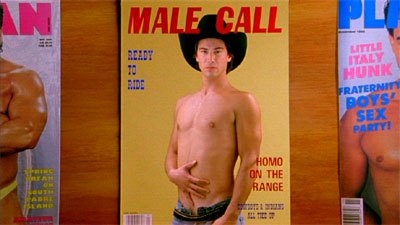
I'm not gay, I'm just drawn that way...
Scott (Keanu Reeves) models the Brokeback look

What have I learnt about Idaho?
Despite the fact that so little of the film actually takes place in Idaho, it is those scenes that do that live longest in the memory. We see Idaho as an empty land for travelling through and out of. Another parable for life, if you will. The image of the long, undulating road stretching on straight, seemingly for eternity, through the barren scrub is a metaphor and a half. The occasional deadbeat shack or wind-whipped tree may break the monotony momentarily; more expressive are the low clouds boiling overhead. Sound effects only seem to come from out of sight – the screech of a hawk or Native American drumming. And as we are warned by sign, tourists should not laugh at the natives…

Can we go there?
As I say above, there is not that much of the film that is set in Idaho. Action is split between Idaho, Seattle (Washington), Portland (Oregon) and Rome (Italy) – a true cinematic road trip around the Pacific North-West. Few places in Idaho specify where they are. The road is, obviously, nameless, though presumably lies in or near a Native American reservation not far from the Oregon / Washington border – the Nez Perce Indian Reservation on the road east from Lewiston, or the Coeur D’Alene Reservation, south of Coeur D’Alene could be contenders. We are given no indication as to where Richard’s caravan is located other than that it is near a railway track. The Family Tree Hotel where Mike’s mother works is on the Snake River, but this river forms two-thirds of the western border with Oregon and then stretches the entire breadth of the state and into Wyoming. In fact, the only Idaho location I can confidently pinpoint is Boise Airport, from where the two leads fly out to Rome.

And there’s probably a reason why I can’t work out where in Idaho My Own Private Idaho was filmed. It wasn’t. The campfire scene was shot on a sound stage. And the grand haunting image of endless Idaho road does not come from Idaho. It comes from Oregon. It is a stretch of Route 216 near Maupin, heading towards Grass Valley.

The Oregon scenes were filmed in Oregon however. Portland is Portland. We first see the city when Mike and Scott arrive there; they sit beneath the ‘Thompson Elk’ fountain near City Hall. They then vanish into the demi-monde of what was at one time known as ‘Vaseline Alley’. The abandoned hotel where Bob’s gang stay is the historic Governor Hotel, then being renovated, and the robbery takes place beneath the St John’s Bridge in Cathedral Park. The restaurant where the hustlers congregate is now  Bailey’s Taproom, located on the corner of SW Broadway and Ankeny.

The Seattle scenes are likewise shot around Seattle (check out the views down to the harbour when Mike first meets Hans). In Rome Mike wakes up in the Piazza del Popolo.

So if you want to visit the locations where My Own Private Idaho was filmed, you had better book a ticket to Oregon rather than Idaho.

Overall Rating: 2/5

Tuesday, 27 March 2012

Napoleon Dynamite (2004)


Dir. Jared Hess
Starring: Jon Heder, Jon Gries, Efren Ramirez, Tina Majorino


Can an indie film be too indie? When the film in question is Napoleon Dynamite then I guess that, unfortunately, the answer is ‘yes’.

The basic plot of the film is a very light one. Napoleon (Jon Heder) is a high-school outsider par excellence. He is both socially and physically graceless, and he has a tendency to live in his own fantasy world. He is also cursed with an extremely dysfunctional family. Elder brother Kip (Aaron Ruell) is a jobless dweeb who spends his time “chatting online to babes all day” and dreams of becoming a cage-fighter and Uncle Rico (Jon Gries) tries get-rich-quick scheme after get-rich-quick scheme and dreams of going back to 1982 and getting picked for the school American football team, certain that this is where all his misfortunes spring from. He strikes up a friendship of a sort with a newcomer to the school, Mexican Pedro Sanchez (Efren Ramirez). Pedro decides to run for class president against the popular queen-bee Summer (Haylie Duff) and Napoleon decides to help him. That is it.

The film is not plot-driven. It is character-driven, and it is full of memorable characters. Head of the list would have to be Heder’s phenomenal portrayal of Napoleon, a boy with no real social skills or redeeming features, yet who still manages to attract our sympathy because, actually, we can empathise with his gangly uncoordinated pubescent agonies. His exasperated nasal exclamations are quite imitable: “Gosh!” He believes that he is a great artist, that ligers (the offspring of lions and tigers) are “bred for their skills in magic”, and that people believe his outlandish stories (such as that he keeps nunchuks in his locker or that he spent the summer “with my uncle in Alaska hunting wolverines”). Deb (Tina Majorino) is soft-hearted and trying to pay her way through college by selling home-made “boondoggle key chains” and offering terrible fashion shoots. Uncle Rico wants to be charming but just comes across as grotesque; twinkly-eyed but blaming all his bad decisions on one turning point some twenty years previously.

Uncle Rico is literally living in the past, going over and over in his head how by now he would definitely be a millionaire and be living with his soul mate if he had only been picked for the American football team back in high school. He even buys a hokum time machine off the internet in the hope of trying to get back to 1982. This is funny, because in many ways the entire film is living in the ‘80s. The fashion is definitely period, from Napoleon’s moonboots to Kip’s moustache to Deb’s puff-sleeved prom dress and back to Napoleon’s chocolate brown three-piece suit. The height of fashion is a soft-focus smoky-eye-shadowed glamour photo. If it weren’t for the opening credits showing Napoleon’s 2004-5 school card and the presence of two more modern numbers for the presidential candidates’ skits (Backstreet Boys and Jamiroquai) I might have assumed that the film was indeed set in the ‘80s.


Heck, this is probably the best flipping time machine ever invented!

I like the characterisation, but the fact that everyone is so god-damn quirky irks me. Napoleon’s grandmother (Sandy Martin) keeps a ham-eating llama and goes quad biking. Napoleon drags an action figure behind the school bus on a string; he never explains why. Rico lives in a bright-orange campervan and dresses like he is from the ‘70s. Pedro shaves his head because he figures it is his hair that is making his head hot. Kip becomes gangsta (after flirting with Rex-Kwan-Do). There is a competition where Napoleon has to guess what is wrong with glasses of milk (“This tastes like the cow got in to an onion patch”). There is so much incidental colour that it threatens to overshadow the movie itself.

What have I learnt about Idaho?
Well, I’ve seen a different sort of scenery. The landscape around Preston comprises flat green valleys fringed by low brown hills – very different to the snow-capped mountains of Sun Valley. It is an agricultural area, with battery chicken farms, farmers’ fairs, and livestock being kept (both cows and llamas). Despite being out in the boondocks the situations faced in high school are familiar to any high school movie set in California (though, of course, with less emphasis on surfing). There don’t seem to be many Mexicans around either (in reality Hispanics and Latinos account for 5.04% of the population of Preston according to the 2000 census). Finally, they love their Tater Tots – hash brown like balls of fried potato that hail from the Oregon / Idaho region.

Can we go there?
The credits state that Napoleon Dynamite was filmed entirely on location in the beautiful state of Idaho. In particular it is set in the south east corner, not far from the Utah border, in the town of Preston. The real life Preston High School on E 2nd Street was used as a filming location. Napoleon’s house is located at 1447 E 800 N, while Pedro’s is 59 S 2nd E (they have some weird street names in this city!) Other locations include Deseret Industries on South State Street, where Napoleon buys his prom suit, Pop N’ Pins Lanes outside of town, where Kip and Rico go bowling, and the Ritewood Egg Farm, where you get paid $1 an hour and all the raw egg you can drink. And do you know something? Preston is pretty chuffed about the connection. In fact, between 2004 and 2008 they even held a ‘Napoleon Dynamite Festival’, featuring a Tetherball Tournament, a Tater Tot Eating Contest, a Football Throwing Contest, a Moon Boot Dance, and Impersonation and Lookalike competitions. Even more bizarrely in 2005 the Idaho State Legislature passed a motion commending the filmmakers  for producing the movie.

Overall Rating: 3/5

Sunday, 25 March 2012

Sun Valley Serenade (1941)


Dir. H. Bruce Humberstone
Starring: Sonja Henie, John Payne, Milton Berle, Glenn Miller


“It happened in Sun Valley
 Not so very long ago…”

Sun Valley Serenade is a weird little number. A box office smash upon its original release, I think now it is only notable as a curiosity piece. I had certainly never heard of it. I would say that to watch it you really have to be in the mood

The plot, such as it is, revolves around a struggling big band, the Dartmouth Troubadours. When news reaches them that the famous Sun Valley Inn is looking for a headline act for their winter season they get the gig – thanks mainly to some swift talking from their chirpy manager Nifty (Milton Berle) and an instant attraction between their pianist Ted (John Payne) and marquee-name soloist Vivian dawn (Lynne Bari). However, before they can head off to the frozen north, one of Nifty’s other little schemes comes to fruition. To gain publicity for the band he had volunteered Ted to take responsibility of a refugee from war-torn Europe. Unfortunately the refugee turns out to be not the cute 10-year-old they had expected, but rather fully-grown Norwegian cupcake Karen Benson (Sonja Henie). She, too, instantly falls for Ted, and follows the band to Sun Valley. There she attempts to scupper Ted and Vivian’s relationship through, obviously, her knowledge of winter sports. I swear I am not making this up!

There are three things that make this film noteworthy really. The first is the aforementioned winter sports. Sun Valley Resort is a high-class ski lodge. While Vivian may not ski, Ted and Karen certainly do (the former’s skill being attributed to his “Eskimo blood”). I can’t think of any film earlier than this to feature skiing so prominently. There are two impressive ski chases down Bald Mountain. To be honest they compare favourably to later skiing scenes in James Bond movies like On Her Majesty’s Secret Service and The Spy Who Loved Me. Except that they have a bit more humour to them – witness Karen zipping between Ted’s legs! There are also two ice-skating scenes for Karen, where she shows off her speciality of whirling around and around faster and faster like a drill bit. And unlike the obvious stand-ins for the skiing, these scenes were acted by Sonja Henie. Not surprising considering that Henie was a massively successful figure skater. And when I say ‘massively successful’ I mean ‘astonishingly massively successful’. We are talking Olympic champion in 1928, 1932 and 1936 and world champion ten times on the trot between 1927 and 1936. She managed to parlay this into one of the best paid contracts in Hollywood. It is therefore understandable that she gets two big ice skating scenes (she did want a third, but the producer Darryl Zanuck would only consider it if she funded the production costs herself). So there you go: a female romantic lead who was actually a champion ice skater.

The second noteworthy point is the comedy. It is, perhaps, a bit hit and miss, but Milton Berle stands out for his performance as Nifty Allen, the band’s publicity agent. Berle later went on to become ‘Mr Television’, American TV’s first bona fide superstar, and his comedic skills are put to good use here. He can be a fast-talking schmoozer one moment and then suddenly outsmarted the next. He is a cheerful, optimistic and bubbly presence throughout the pic, cigar in hand, draped in a ridiculous fur coat. He provides most of the one-liners and certainly all of the best facial expressions in the film.

The third noteworthy point is the soundtrack. It is a zinger. The ‘struggling’ Dartmouth Troubadours were portrayed on screen by the actual Glenn Miller Orchestra – with Miller himself appearing as the Troubadours’ band leader Phil Corey. I knew the music of Glenn Miller, and I knew what he looked like, but for some reason it felt rather eerie to see and hear the man in action – three years later his plane was to vanish in fog over the English Channel. The soundtrack, then, is pure Miller swing: ‘I Know Why (And So Do You)’, ‘Moonlight Serenade’, and – obviously – ‘It Happened in Sun Valley. But the two big show-stopping numbers have to be ‘In The Mood’ and Chattanooga Choo Choo’. ‘In The Mood’ is a full concert performance set in a New York hotel ballroom prior to their departure for Sun Valley and provides all the visuals you could ever wish for for a documentary on big bands. The orchestra are dressed up, looking sharp, hitting their notes, and the camera work focuses in on key sections of the band, often with striking angles, often catching the silhouettes and shadows of the musicians on the walls behind. The choreography of the audience could have been better (they just sort of palpitate on the spot when I was expecting and hoping to see some proper swing dancing) but the music was great. The choreography cannot be faulted for Chattanooga Choo Choo’ however. The scene starts off in a practice room, the musicians casually dressed in warming knitwear. It then segues, somehow, into a staged version of the number with Dorothy Dandridge and the Nicholas Brothers performing a soft-shoe tap version of the same number. There is no link between the main story or even the practice room scene with this little set-up. Apparently this was so that the scene featuring talented black performers could easily be excised in certain states to make the movie more palatable for a bigoted white Southern audience. Frankly, the bigots missed out. These two numbers would be worth the entrance fee alone.

In Sun Valley it's always Miller Time!

The rest of the movie I could take or leave. Henie’s Karen might be all guileless girly giggles but she does set out single-mindedly to win Ted as a husband, even knowing that he is already attached. She has some good interplay with John Payne (who resembles a clean-cut Jimmy Stewart type), but I’m not sure the storyline is strong enough to recommend the film by itself. If you were to describe it, it would be described as ‘the Glenn Miller film with the skiing and skating and Milton Berle’.

What have I learnt about Idaho?
That it is a skiing destination. That I didn’t know. Colorado, yes; Idaho, no. Moreover it is (or, certainly in 1941 was) a very high class one that could attract top talent from across the United States for its winter season. And they would arrive there by train, before debouching into pony traps and husky sleds to take them up to their hotel. The Sun Valley Resort was obviously rolling in money and cleverly marketed – that it could star in its own movie just five years after opening is proof of that. I’m sure skiers would pick up more information that I have – I have no idea whether skiing from 9,000 feet up a mountain is in any way out of the usual. The snow-covered terrain and the fir-tree-fringed mountains provide some stunning Idahoan scenery.

Can we go there?
Sun Valley is still a premier winter sports resort. One can no longer reach it by train, as shown in the film, as Union Pacific discontinued the service in the 1970s. The railroute has, however, been turned into a  trail  that can be walked or cycled. The resort had not been around for long at the time of filming, only opening to the public in 1936. The film can thus be seen to be one long advertisement for Sun Valley. Sun Valley had the world’s first chair lift up Proctor Mountain – those up Baldy Mountain, featured in the film, were installed later, in 1939. They do still disgorge intrepid skiers some 9,000 feet up the mountainside. The top destinations in town have to be the Sun Valley Lodge and the Sun Valley Inn, where much of the action was set. The ice rink outside Ted’s room still exists too. In both locations there is a dedicated hotel TV channel that shows the film on continuous repeat. If you are not lucky enough to be staying there, the Sun Valley Opera House shows the movie at 16:30 every Tuesday, Thursday and Sunday throughout the year, and at 17:00 every day during the peak summer and winter seasons. Whenever it is shown there is no admission charge.

Sun Valley’s neighbouring town is Ketchum (as shown in the train station name sign). The Ketchum Sun Valley Ski and Heritage Museums might be a recommended stop for those interested in the history of winter sports in the area. Novelist Ernest Hemingway is buried locally (he wrote most of For Whom The Bell Tolls whilst staying in Room 206 of the Lodge). There is a memorial to the writer about a mile northeast of the Lodge just off Trail Creek Road. Other local citizens, past and present, include Gary Cooper and Tom Hanks.

Overall Rating: 2/5 

Saturday, 24 March 2012

Week 13: Idaho

"Danny says we gotta go,
 Gotta go to Idaho,
 But we can't go surfin' 'cos it's 20 below!"
 - 'Danny Says',
 The Ramones


You get that? Leave the surfboard back in Hawaii buddy. Idaho is a landlocked state.

And frankly, I don't know anything about Idaho other than that. I could point out where it is, east of the Pacific states of Washington and Oregon, north of the weirdness that is Utah and the gaudiness that is Nevada, west of Wyoming, and south of the Canadian border. I suppose the most notable thing about it is that it then has a very weird shape to the north-east, where Montana takes a big ol' chunk of what was looking to be a nice regularly-shaped state. And the more I stare at it, do you know what I notice? That that section of border looks freakishly like Richard Nixon in profile. No, honestly. It really does. Check it out. You damn hippie.


Other than that my knowledge of Idaho is exceptionally limited. I think an episode of The X-Files was set there once. And I think they produce potatoes. Other than that I know nothing. Any other statements I would make about the state would be pure guesswork. I would suppose that it is rather mountainous and that Idahoans share their cultural traits rather more strongly with the Montanans and Wyomingians (?) than with the inhabitants of their other neighbouring states, but I am basing that on a grand amount of not very much at all. Probably more so than any other state so far, my journey to Idaho is a journey into the unknown. 

The three films chosen to educate me about this mysterious land known as 'Idaho' are:
  • Sun Valley Serenade (1941)
  • Napoleon Dynamite (2004)
  • My Own Private Idaho (1991)